Up next in 10



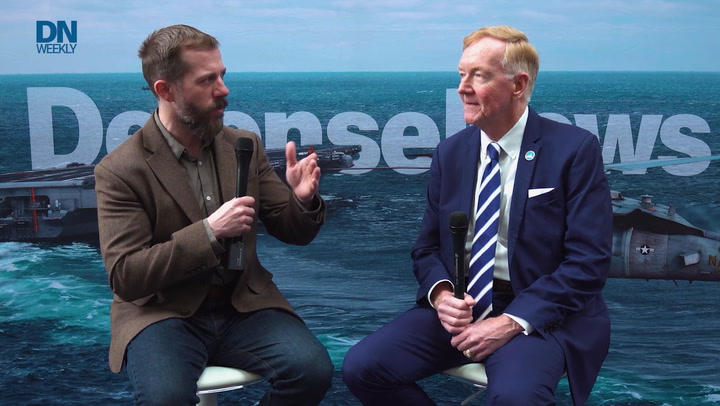
The Center for Maritime Strategy’s Jamie Foggo sits down with Defense News’ J.D. Simkins to talk about the increasing role of unmanned platforms in the Navy.
Show More Show Less View Video Transcript
0:00
I'm here with Admiral Fogo at the 2026 Sea Airspace Conference
0:05
I did want to just start out right out of the gate and see, you know, we've been to a number of these shows in recent years
0:11
What is standing out to you about this year's iteration and that differs a little bit from years past
0:18
Thanks, J.D. Great to be here with Defense News. I think the thing that strikes me about Sea Earthspace 2026 is the volume of sponsors, active, retired, and currently serving officials that came through here in the course of really four days
0:37
It's probably our largest crowd yet. We don't have the census, but we will
0:41
But you can tell by the numbers and by the level of enthusiasm that this was a perfect thing to do at this time of year
0:48
The second thing that came to mind is I walked through the show floor on day one, which is really Sunday
0:56
And it's amazing they can set all of that stuff up in 24 hours
1:00
The thing I noticed that was different from previous years is there were a lot of missiles on display and a ton of unmanned systems, including down at the waterfront
1:11
There are several down there for demonstration purposes. So that tells you the direction that the Department of War is going
1:17
emphasis on weapons in the magazine, because we've certainly used a lot of weapons from the
1:23
magazine in the last month and a half in the Epic Fury campaign. And we're driving in the direction
1:31
of unmanned platforms to augment floating platforms that have people on board. So I'm
1:36
really pleased to see that You mentioned Epic Fury and obviously everything going on with Iran There current ceasefire and talks ongoing That obviously the outcome of that is to be determined But when mentioning these unmanned systems that you seeing just the surge of those at this show and then you looking at how that playing out in that region
2:00
And what does that tell you about where the acquisition is moving and what these systems are going to be looking like in the future and really the immediate future
2:11
Yeah, well, first and foremost, one of the things that I always say is the Navy is an extended arm of diplomacy
2:17
And if you need a big stick, we're there for you. So this is a combined arms campaign
2:23
Epic Fury has involved all the services, including the domains of cyber and space
2:31
But there is a preponderance of naval presence and naval force out there floating on the high seas that are conducting strike missions or blockades of the Strait of Hormuz
2:42
And that is three carrier strike groups that are underway dedicated to this campaign, but also two expeditionary strike groups, Boxer and Tripoli
2:53
To your point, the unmanned displays that are inside is coming to the forefront in mine countermeasures in the Gulf
3:02
So we have a new platform for mine countermeasures, the literal combat ship
3:08
Now, the ship has been around for a long time, but we had placed mine countermeasures capability on that ship
3:15
and we replaced the older Avenger class last year. The Avengers were wooden ships that you had to put in the center of the minefield with U Navy sailors on board The literal combat ship stands off from the minefield and uses unmanned platforms to go in and either map or sweep the mines It also has a helicopter
3:35
with a laser on board that can detect mines below the surface and if necessary drop something in the
3:41
water to go and destroy those mines, whether that's a remote vehicle or whether it's EOD team
3:47
and divers. So you can see that we're moving in the direction of hybrid warfare, meaning
3:53
real ships, real people, combined with unmanned ships, which is part of the theme of this year's
3:59
sea airspace. And the CNO, who spoke two days ago, talks about a hedge strategy
4:05
augmentation for the fleet of carriers, destroyers, future frigates, and small combatants like the
4:13
literal combat ship, so that we don't have to put the people forward. We can use the unmanned
4:18
systems and keep our sailors out of harm's way. And I'm pretty proud of that. You also mentioned counter UAS. That's obviously a prevalent topic, and it's something that ground forces, ships are all likewise dealing with right now in the region
4:34
We've had an essentially like a laboratory to study in Ukraine and then with the Navy's previous engagements in the Red Sea
4:42
We just saw Lockheed Martin announced that they're going to be equipping the Aegis combat system with with Pac-3 interceptors and integrating that
4:50
Aside from that, what are some measures, speaking of the unmanned systems, counter UAS, that
4:58
you're hoping to see come to fruition potentially in the near future that might be cost effective
5:04
or just the ability to knock out those shot head type drones that might only cost apiece so we not expending those million missiles or those types of things in those missions What would you hope to see that move toward in the near future
5:22
Yeah, you're absolutely right. You know, the United States Navy for the past three years has
5:26
been operating in the Red Sea against the Houthis. And the Houthis have thrown everything
5:31
at U.S. Navy destroyers, the Arleigh Burke-class destroyers, an amazing combat system that sees
5:37
everything over the horizon. It sees the incoming missiles. Some of them are slow burners
5:41
you know, cruise missiles. Some of them are fast burners, you know, potential hypersonics
5:46
And then they've got drones, the same kinds of drones that the Iranians are using themselves
5:51
The Shahed you mentioned, and the Shahed has been used extensively in the campaign by Russia
5:57
against Ukraine. So we're slinging SM-2 missiles at a couple million dollars a piece at a $50,000
6:04
dollar drone. You've heard that narrative. You talked about that narrative. That's completely
6:08
unacceptable. So I want to see us move in a direction where we can do faster, cheaper
6:13
counter UAS at scale. And I think the Lucas drone is an example of something like that
6:21
Also, the Ukrainians have counter UAS, which they have been willing to share with Gulf
6:26
cooperation council nations that are being hit by the Iranians. So that's the direction we need to
6:31
go. We need to be able to develop systems that can knock down something like the Shahed or the
6:36
next generation, because these things are going to get smarter as people evolve in their thinking
6:42
and learn from the battlefield. The Ukrainians have done that. There's no reason why the Iranians
6:47
won't do that. And so we've got to be ready and we've got to overmatch them with systems that are
6:52
reasonably priced, very effective, and can neutralize the threat of a Shahed drone or any
6:58
other drone that's coming at us
#news