Up next in 10

‘We need a bigger Navy’ — Fleet Forces commander talks ‘Golden Fleet,’ shipbuilding
Apr 27, 2026


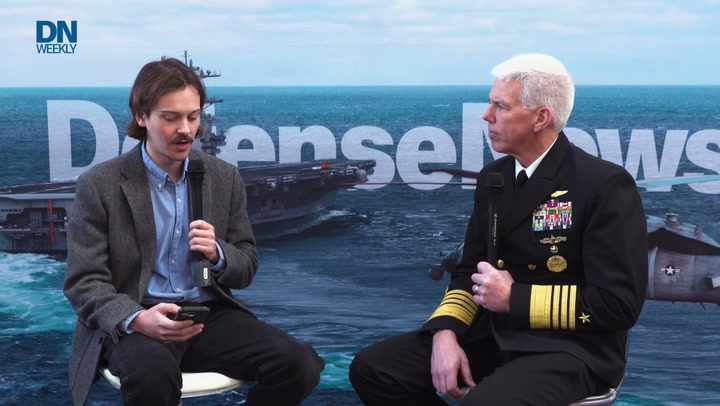
Adm. Karl Thomas, commander of the Navy’s Fleet Forces Command, says [NO COMMA] expanding the U.S.’s ability to expand the fleet is key to long-term goals.
Show More Show Less View Video Transcript
0:00
Thank you so much for doing this. We're sitting here with Admiral Carl Thomas of U.S. Fleet Forces Command
0:04
We'll just dive right in. How is Fleet Forces translating CETO Admiral Darrell Cottle's Golden Fleet vision into day-to-day force generation and certification
0:15
So certainly Fleet Forces is responsible for manning and training and equipping the fleet, getting them certified, sending them forward to our combatant commands
0:23
And the fleet is pretty employed today. And so all those ships that are operating out there at Operation Epic Fury or whether they're down in Fourth Fleet protecting our borders, that's Navy-generated forces that Fleet Forces has created and sent forward
0:39
And so that's our main mission is to generate forces. And then as far as the Golden Fleet initiatives that are being unveiled by Secretary of the Navy and CNO, that's about increasing our industrial capacity
0:52
That's about being able to build a bigger fleet. There's a lot of demands on the Navy today, and we need a bigger Navy
0:58
And that's an effort to try to generate the forces that will allow us to do the mission that we need to do up into the future
1:05
You've spoken publicly about the growing importance of cyber and space readiness as tactical priorities
1:11
How is that thinking shaping how the Navy trains and deploys forces today
1:15
So certainly, as the world changes and we proliferate in space, the amount of sensors that are out there
1:23
the ability to hide. There's a premium on maneuver and fortunately the Navy is a maneuvering
1:30
force but we also have to be a force that can maneuver in silence and so our training
1:35
and the things that we do to prepare ships is oriented that direction We doing a lot of training in a live virtual constructive environment to be able to train the things that maybe we don want to replicate visibly We training our sailors to operate without having to emit and to be lethal in that regard
1:54
The battle space is expanding, and so the long-range fires and the way that we target and understand the damage and be able to retarget
2:03
that's all the future fight that we do at Fleet Force is to prepare our ships
2:08
What are the biggest opportunities to keep the fleet ready and lethal in an increasingly complex security environment
2:17
So keeping the fleet ready. I mean, that all comes down to being able to generate the forces, keep them combat surge ready if necessary
2:26
And so what we're really trying to accomplish is pull our training further left and have more ships available to go if needed and if called
2:34
Not sacrificing the training. The important part of that combined aspect of getting them combat surge ready and being able to go and conduct major combat operations, it's really understanding the quality of the training, understanding how well the sailors can perform, being able to measure and see ourself and be honest with ourself, and then get them trained and certified so when needed they can go
2:59
So that's one aspect of it. But then when they come back, being able to turn the ships around and do maintenance in a more effective and efficient manner
3:07
And so a lot of effort is going into increasing not only capacity, but the way and the process that we do our maintenance
3:14
And when it all comes down to it it about the sailor and the shipyard worker and giving them the tools and the experience that they need to be able to if you a sailor fix your own equipment and if you a shipyard worker keep you on the ship turning wrenches and give them the planning and the detail needed to be really effective when you in that shipyard
3:34
Flip side of that same question, what would be some of the bigger challenges or the challenges that you're facing to keep the fleet ready
3:40
What might some of those challenges be? So certainly we had gotten very lean in our just-in-time part aspect
3:47
aspect. A lot of our suppliers had maybe gone down to single source suppliers. So one of the
3:53
challenges we have is having enough spare parts to be able to get all those parts ready when you
3:59
come in to do a shipyard availability, have them ready before you start. So there's a supply chain
4:05
piece to this. I think there's tremendous opportunity in the world of planning and using
4:11
some of the more advanced planning tools to rethink how we figure out critical path when
4:17
we're doing maintenance. You know, in the end, it's really about industrial fixing pumps, valves, you know, steel bending it
4:26
But more and more, our ships are, you know, IT rich and technically, you know, that's
4:35
what makes our Navy the best is, you know, we have the best radars, we have the best weapon systems and the best interfaces. So that IT aspect and that electromagnetic spectrum and
4:46
the way we need to win in that environment, the technology is just coming up. So having the
4:51
smartest sailors, the sharpest sailors that know how to operate that kind of gear, get the ring
4:55
the most out of it and then repair it. That's really where we've got to improve. The Navy's
5:01
always trying to outpace adversaries in developing future technologies unmanned surface vehicles autonomous technologies in general are the wave of the future How do you see that future playing out when it comes to fleet forces Yeah so I think we all recognize that
5:18
making an unmanned or an autonomous vessel is a great direction to go. I caution us to make sure
5:26
that we think about what applications are the most important for those, and those would be the
5:31
most dangerous places that you wouldn't want to put a human. Those would be taking advantage of
5:36
the extended duration that maybe an unmanned system can provide you, it's a big ocean
5:42
It's a big globe. And so sometimes we think about unmanned, and if they're large, you can still make them
5:50
unmanned, but unmanned usually isn't unmanned. There usually is a manning component behind it
5:55
And so in my mind, it's really about the cost factor. It's how do you make them affordable and scale them enough such that you can have a lot of systems to cover this very large battle space, whether they're sensors, whether they're shooters, and be able to have payloads that can be, you know, C&O talks a lot about containerized payloads
6:20
I think that's absolutely right. having containerized payloads you can put on an
6:25
Allied partnership that you can move around more quickly to get to the theater and get on the ship
6:31
That's the different type of, you know, Tino talks about it as a hedge strategy. That's the different
6:37
way we're thinking today than maybe we have in the past. Keep our carriers, our destroyers, our submarines for that
6:43
high-end warfighting and be able to use more flexible capability in other
6:50
to be able to get on the battlefield where you need those
#news