Up next in 10



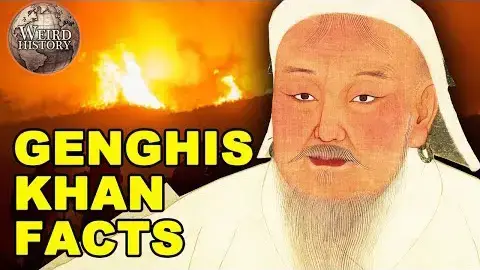
Genghis Khan remains one of the most feared and respected conquerors of all time. His biography is shrouded in mystery and contradiction, but the facts about Genghis Khan are that he rose up from almost certain death on the Mongolian Steppe, united his people, and began a series of gruesome conquests that killed millions, and changed the entire course of human destiny.
Show More Show Less View Video Transcript
0:00
He killed an estimated 40 million people
0:03
He founded the Mongol Empire. He might have a little of his DNA in you
0:08
He is Genghis Khan. Today, we're going to talk about things you didn't know about Genghis Khan
0:16
First things first, you've heard his name hundreds, if not thousands of times before
0:21
But there's a very good chance you've never heard it pronounced correctly. While most Westerners say Genghis with a hard G, that's incorrect
0:28
In Mongolia, the G is soft. So it's actually pronounced like this, Chingas
0:34
But we're going to go with Genghis today because that's what you're used to. What does it mean
0:39
Well, there's no historical consensus, but Khan means ruler or king. And Genghis, or to be 100% accurate, Chingas, is believed to mean stern or fierce
0:48
So Genghis Khan means stern or fierce king. The confusion goes all the way back to spelling and pronunciation getting lost in European translation
0:58
Since we're on the topic of names, Genghis Khan wasn't his name either, despite what you were taught in junior high and most, if not all, of high school
1:06
The man who would unite the Mongol tribes was actually born Temujin, meaning of or from iron, while jinn denotes agency
1:15
Thus, if you break it down, Temujin means blacksmith. His name was said to have come from a Tatar tribesman who had been captured and brought home by the boy's father
1:24
The name Genghis Khan wasn't given to Temujin until 1206, when he was 44 years old, as part of his coronation as the king of all Mongols
1:35
Most of what we know about young Temujin comes from the secret history of the Mongols, an anonymous record of the early days of the United Khanate
1:44
According to that book, written for the Khan's successors, Temujin was born sometime in 1162 on the banks of the Anin River
1:51
His father, Yasuge, was the chieftain of the Borshizhin clan, the ruling class of the Mongol tribes
1:58
If you believe the legend, Temujin was born clutching a blood clot in his fist
2:02
an omen that he was destined to be a great leader. Whether that's true is actually anyone's guess
2:12
For someone who radically altered the world's population with his very own DNA
2:16
we'll get back to that in a bit, Temujin's first son may not even have been his
2:21
It all started when his father arranged a marriage for him and delivered him at age nine to the family of his future wife in order to cement alliances between the Anjarits and the Mongols
2:31
Here's where things get messy. On his way home after delivering his son to the ports, Temujin's father ran into the neighboring Tatars, who had long been Mongol enemies, and they assassinated him
2:42
When young Temujin heard about his father's death by poisoning, he returned home to claim his position as tribe's chief
2:48
But they denied the kid and abandoned his family, leaving them without protection
2:52
After several years of hardship and enslavery, Temujin finally married Bort. But the bad news kept coming
2:58
Not long after the marriage, Bort was kidnapped by the Merkit, a rival tribe
3:03
And she was reportedly given away as a wife. Temujin rescued her several months later, and she gave birth to a son, Joki, nine months after her rescue
3:11
The timeline of Joki's birth was iffy at best. Was Joki Temujin's legitimate firstborn son
3:16
or was Bort impregnated when she was kidnapped? It's something we'll probably never know
3:20
but Joki grew up to become a great military leader nonetheless even though he was excluded from Genghis line of succession We know of Joki the son who may or may not
3:32
have been the first son of Genghis Khan. We also know of eight other sons and daughters
3:37
Temujin had with Bort. But that's not the extent of Genghis's offspring
3:41
not by a long shot. While married to Bort, Temujin took a number of other wives
3:46
far too many to name here. While many of these women were taken as war trophies
3:50
At least one woman, Princess Chigu, was married to Genghis Khan as a gift of sorts
3:54
in exchange for relieving the Mongol siege upon Janku. In short, it's uncertain which, if any, of these marriages were consensual
4:02
although it's certain his spouses bore him numerous children, including a number of daughters whose names weren't even recorded
4:10
As famous and infamous as Genghis Khan is, very little is known about his personal or physical appearance
4:17
No contemporary portraits or sculptures of him survived, and what is written about him at the time is practically revisionist history
4:23
The little we do know about Genghis Khan describes him as tall and strong with a flowing mane of blonde hair, blue eyes, and a bushy beard
4:31
But 14th century Persian chronicler Rashid al-Din claims Genghis had red hair and green eyes
4:37
Al-Din never met the Khan in person, but these striking features were not unheard of among the Mongols
4:44
You hear the name Genghis Khan and the first things your imagination conjures up
4:48
are probably brutish acts of mass destruction, barbarism, and bloodlust. All of those things are a big part of Genghis Khan's story
4:56
But he was quite the innovator, too. He created the Yam Route, which was an efficient postal system
5:00
meant to send written orders to the far-flung outposts of his empire. He also adapted an official script in 1206 upon his election as Khan
5:08
And while he was very likely illiterate, Genghis Khan kept written books of his laws
5:12
a complex and far-reaching system of edicts called the Yasa. Of course, for any good he did, he soured by destroying countless works of art, priceless artifacts, cultural sites, and other various precious objects
5:24
Chinese, Russian, Persian, and Muslim traditions of sculpture and painting were subjugated, and their masters almost always were killed
5:31
While other Mongol leaders appreciated the cultures of the sedentary people they wiped out, the Mongols themselves left little in terms of cultural heritage and almost no written works
5:41
Genghis Khan probably enjoyed the sight of blood, but he was also a man of his word
5:49
Take, for example, the time he honorably murdered the Mongol military and political leader and childhood pal, Jamukha
5:55
According to the secret history of the Mongols, Jamukha was eventually betrayed to Temujin by his followers in 1206
6:02
The first thing Temujin did was execute Jamukha's betrayers on basic principle
6:06
Betrayal merits the worst punishment imaginable. Then Temujin offered Jamuka a renewal of the brotherhood, but Jamuka refused
6:14
He insisted that just as there was only room for one sun in the sky, there was room only for one Mongol lord
6:20
Instead, Jamuka asked to be executed by dying a noble death without the spilling of blood
6:26
Temujin honored his request by having a soldier snap Jamuka's spine. It's said that Temujin then buried Jamuka with the golden belt that he had given to him when they had formed their bond of brotherhood
6:36
Pretty dramatic on the Khan's part. Sounds like something a young George Lucas would have written in the mid-70s
6:49
One of the great things about Genghis Khan was that he had an eye for talent when it came to choosing people for leadership roles Take for example Jebe During the 1201 Battle of the Thirteen Sides against the Taeyju tribe Genghis got hit in the neck with an arrow
7:04
He obviously survived, and his army won the battle, but when he recovered from his wound, he asked the soldiers of the defeated Taeyju tribe to reveal who shot his horse in the neck
7:13
Side note, either Genghis was using his horse's neck as a euphemism for his own injury in an attempt to conceal his injury
7:19
or possibly to smoke out a false confession. Moving along, a soldier named Zergadi voluntarily confessed and told Genghis, and we paraphrase
7:27
you got me, I did it, but if you let me live, I will serve you loyally
7:32
Genghis was impressed. He valued skill and loyalty, so he pardoned and praised Zergadi
7:37
making him an officer and nicknamed him J-Bay, Mongolian for both arrow and weapon
7:43
How's that for luck? It's like hitting your boss over the head with a Louisville slugger because he swiped your idea
7:49
Then he promotes you for your candor and calls you Bat Boy at the next office happy hour
7:53
J-Bay would go on to become one of the Mongols' greatest field commanders during their conquests in Asia and Europe
8:03
Mongol warriors began learning how to fight and live off the land as children
8:07
When they came of age, usually around 15, they had mastered how to ride, shoot, fight, and go for days at a time without provisions
8:15
At this point in their lives, they were Genghis Khan's warriors. These young warriors were tactical and calculating, employing many war-worn strategies when it came to war
8:25
Fighting was never a simple exhibition of force. It was an evenly paced, evaluated, and considered option
8:31
The Mongols would fight using formations, proven battle game plans, and were comfortable with a bow
8:36
If no bow was on hand, then a Mongol warrior was more than comfortable and capable of using a saber or a spear to kill their enemy
8:43
No contemporary army could match a Mongol warrior's skill, bravery, and tenacity
8:52
Like most men in power who wielded their force with little regard for their foe, Genghis Khan was a religious man
8:58
He passed laws declaring religious freedom in conquered lands, even granted tax exemptions to places of worship
9:04
The Mongols generally had an exceptionally liberal attitude towards religion. While they subscribed to a shamanistic belief system that revered the eternal blue sky
9:13
the steppe peoples also included Christians, Buddhist, Muslims, and others. No one was persecuted for their faith
9:20
Genghis Khan also had a personal interest in spirituality. He was known to pray in his tent for multiple days before important campaigns
9:27
and he often met with different religious leaders to discuss their fates. Conquering the Western Shao and Jin empires was a matter of survival for Genghis
9:39
He had no intention of war with the powerful Khwarizmit Empire in modern-day Iran
9:44
but it became inevitable after the Khwarizmian Shah executed Genghis's ambassadors to him
9:49
and massacred a peaceful caravan. In a war lasting just three years, from 1218 to 1221
9:55
the Khwarizmit Empire was annihilated with its population culled and its beautiful walled cities destroyed
10:01
Final defeat was inflicted at the Battle of the Indus River, where 50,000 Med, led by the Shah's son, were beaten and killed
10:08
The Mongols exacted such a toll on the Khwarezmed Empire that of its nearly 3 million people at least 1 million were killed usually executed methodically using swords or axes Of course this is all a drop in the bucket in terms of Khan body count
10:24
Figures vary, but about 40 million people, or 10% of the world population at the time
10:30
were killed or died because of his attacks. Famine and disease killed a large portion of the people
10:35
but Genghis wiped out any city or country that opposed him. After destroying the Khwarizmet Empire, Genghis split his army into two units
10:48
One unit, which he led personally, headed back to Mongolia, but not before laying waste to northern India
10:54
The other unit, made up of two packs of soldiers, were led by Sabatai and Jebe
10:59
They headed west toward what's now Russia, pursuing the Khwarizmian Shah. They didn't catch him, but they made history anyway
11:07
In a raid of so much power and destructiveness that it's never been equaled
11:11
two of Genghis's dogs of war sacked Georgia, Armenia, and defeated a gigantic Kayafan Rus force at the legendary Battle of the Kalka River
11:20
In keeping with Mongol tradition, the Russian princes who resisted were crushed to death under a platform
11:26
their blood never spilling because, you know, royal blood. Hundreds of thousands of Russian peasants were slaughtered
11:32
and Russia itself would take centuries to recover from this Mongol invasion, and his geography was permanently changed
11:41
It's only fitting that Genghis Khan's death is as shrouded in as much mystery
11:46
as the basic details of his personal life. The common tale says he died in August 1227
11:51
during the sack of the Western Jai capital around the age of 64 or 65
11:55
after injuring himself from falling off a horse while hunting. Other sources list everything from malaria to an arrow wound in the knee during the battle
12:03
One chronicle even says he was murdered by a western Zhai princess he was attempting to add to his harem
12:09
After his death, the traditional kurultai was held, meaning all Mongol conquests were put on hold
12:14
sort of like a truce between the Hatfield and McCoys, and all leaders met at the Anand River
12:20
Bypassing Jogi, whose parentage was never confirmed, they elected Genghis's third son, Ogedei, as the new Khan
12:26
After his untimely death in China, Genghis's body was returned to Mongolia
12:34
and presumably to his birthplace in the Kenti Ameg. Per his orders, Genghis was to be buried without any markings or signage
12:42
but many assume his tomb is buried somewhere close to the Anand River. Of course, this was Genghis Khan's funeral, so there had to be some level of barbarism to it
12:50
and the Mongols came through in shocking style. According to historical evidence, 30,000 people participated in his funeral
12:58
Of course, these 30,000 were killed by Khan's army to preserve the secret location of his tomb
13:03
But that wasn't enough. Because Khan's army knew where the tomb was, they were killed by his traveling escorts
13:09
And as Khan was taken to his final resting place by said escorts, all onlookers were murdered in order to keep everything a secret
13:16
When Khan's traveling escorts reached their destination and after they buried his tomb
13:20
They rode horses over his burial grounds to help conceal it, and they might even have changed the course of a river to go over it
13:27
Then his escorts killed themselves, taking the location of their leader's final resting place with them
13:33
And before you ask, yes, numerous excavations have already been undertaken to find Genghis
13:38
and the treasure said to be buried with him. But even with satellite imaging used recently, its precise location is unknown