Up next in 10



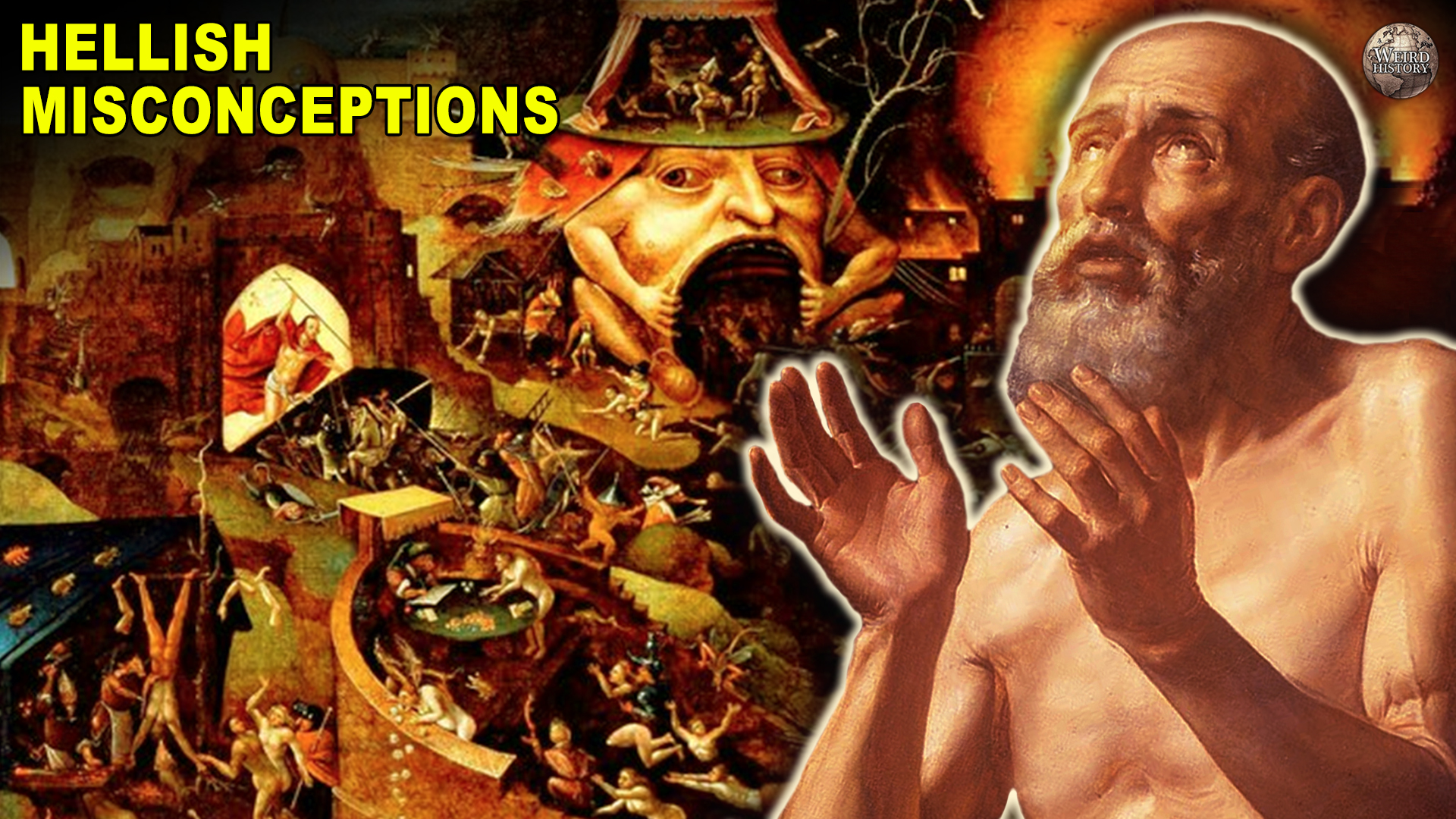
From the intricate paintings of Hieronymous Bosch to the excessive pulp of movies like Constantine, hell has been depicted in dozens of different ways. However, its most common elements - hellfire, souls screaming in torment, and gruesome demons - cannot be found in the Bible.
Similar to how our beliefs about angels formed, today, the imagery of "hell" is the result of hundreds of years of art, theology, and imagination. The Greeks believed in a punishing afterworld called Tartarus, and Christian artists and writers borrowed heavily from its complex mythological structure.
Show More Show Less View Video Transcript
0:00
Every major religion has an answer to the question of what happens after we die
0:05
For example, Christianity teaches that good people go to heaven, while all the bad ones go straight to H-E-double hockey sticks
0:12
However, some of the most popular representations of Christian hell include details that have been added over the years
0:19
but don't actually appear anywhere in scripture. So, today, we're telling you about some popular beliefs about hell that aren't in the Bible
0:29
Part of Christianity's teachings lead many to believe that when we die, we are judged by God
0:35
who then makes the decision on whether we go to heaven or hell
0:39
This has caused many sleepless nights for Christian children worrying about themselves or their loved ones winding up in an eternal lake of fire
0:47
Well, insomniacs all over the world will be happy to know that God probably doesn't really work that way
0:52
What the Bible actually says is presented in the form of a parable
0:56
which says to let wheat and weeds grow together, then burn the weeds at harvest so the wheat will
1:02
be ripe for the pickin'. In other words, every single human who ever lived, from the good to the
1:08
bad, the heroic to the despicable, is still waiting for the harvest. On that day, Jesus will return it
1:15
and make his judgments. Until then, hell is like school during a teacher's work day. The faculty's
1:20
all there, there's just nobody filling out any of the seats. Yet. And the rules for filling those
1:26
seats out may be a bit different than you thought, too. The basic understanding goes, if you do good
1:32
you go to heaven to hang out with your loved ones, Jimi Hendrix, and all your childhood dogs
1:36
But if you're bad, you're getting a one-way ticket to a lake of fire for, as mentioned
1:42
all eternity. Well, what may seem like common knowledge is actually one of the hottest debates
1:47
in the history of Christianity. Some Christians follow what's called a gospel of works, which says
1:53
that committing good deeds is the only way to score points with the big man upstairs. But the
1:58
gospel of grace says that the same big man has the final say of who goes where, based on criteria
2:03
our mortal brains can neither understand nor control. So, how does one know which version is
2:10
correct? Well, Ephesians 2 verses 8 to 9 seems to support the gospel of grace, saying
2:16
In other words, grace comes from God, not you
2:29
So even if you do a lot of good, don't get cocky
2:33
because God can flick you into hell like a paper football anytime he wants Well that might be a revised version of the Bible When you picture Hades everlasting torment just seems to be an unspoken truth that has
2:50
always been part of the deal. Like how every Beatles album has that one Ringo song. Unfortunate
2:55
but there's no way around it. However, there's a large delegation of theologians who have
3:00
determined that the Bible actually supports something called annihilationism, which is somehow not a death metal subgenre, no matter how much it should be. Believers in the doctrine
3:10
of annihilationism say a benevolent God wouldn't just let people suffer down in the big H forever
3:16
Instead, Bible passages like Isaiah 5, 24 continue the wheat from the chaff parable, reading
3:23
Therefore as the fire devoureth the stubble, and the flame consumeth the chaff, so their root
3:29
shall be as rottenness, and their blossom shall go up as dust, because they have cast away the
3:35
law of the Lord of hosts and despised the word of the Holy One of Israel. In other words, God doesn't
3:41
make the rotten suffer forever. He'll just wipe out the consciousness of those souls instead
3:46
Eternal Sunshine style. If we're being honest, that doesn't sound that much better. But speaking
3:51
of the big cheese, God goes through some significant character shifts throughout the Bible
3:56
In the Old Testament, he's full of wrath, ready to damn the next guy that looks at him cockeyed
4:01
New Testament God, on the other hand, is a kind and loving father who just wants the best for his kids
4:07
In sitcom terms, it's basically Archie Bunker versus Danny Tanner. So which version of God do Christians believe in? Will the real God please stand up
4:17
Ultimately, there's significant evidence that God isn't really all that wrathful. According to Ezekiel 18.23, it's quite the contrary. Quote
4:31
ways and live. And when the wicked return to the Lord's arms, he even promises not to say
4:36
I told you so. Throughout history, a popular habit of some of Christianity's most extreme
4:46
followers has been to threaten believers and non-believers alike with eternal damnation
4:51
You may have heard of the Inquisition. It was a whole thing. We did an episode about it
4:56
As often as the threat of hell has figured into the history of the church, you might expect it to dominate a considerable portion of scripture
5:04
Well, the truth of the matter is, the Old Testament, which is the largest section of the Bible
5:09
contains exactly zero mentions of hell. There are mentions of proto-underworlds like Sheol and Gehenna
5:16
but they have little in common with what we know as Christian hell The New Testament on the other hand does mention hell but only for a grand total of 23 times like that Jim Carrey movie about a number I forget which one Compare that to a
5:30
whopping 250 mentions of heaven in the same book, and it seems like hell really isn't all that
5:36
important. The disparity between the two afterlife destinations seems to stem from missionaries who
5:41
would use hell as a motivational tool for converting unbelievers. The actual authors of the Bible
5:47
on the other hand, we're expecting Jesus to return in fairly short order. Making hell about
5:52
as concerning as noticing your driver's license is going to expire in two years. Pretty sure it'll
5:57
get dealt with before then. This next one can be blamed on Dante and his epic fan fiction
6:06
Inferno. Dante's story plunges deeper into hell, observing that higher degree sinners receive
6:11
harsher punishments doled out across seven different circles or levels. This work has
6:17
influenced modern thinking of hell ever since. But at no point in the Bible is it understood
6:23
that different levels of sin affect the severity of punishment. Hell doesn't discriminate
6:28
so all sinners and unbelievers are given the same mandatory punishment. Your experience will
6:33
not vary. It's kind of like going to Walmart. How did Dante get this so wrong-tay? Assuming he was
6:40
trying to create an accurate portrayal of hell in the first place and not just riffing for the
6:44
sake of a good story, that is. He was likely inspired by Greek and Roman mythologies, especially
6:49
the story of Tartarus, who started as a deity punished to ensure eternal hunger and thirst
6:55
trying to drink from a pool that will forever receive. From this punitive fate, Tartarus then
7:00
became an actual location within the underworld, something like a separate circle, an idea that
7:05
clearly appealed to Dante. He was big into circles. Dante also explores the concept of purgatory
7:11
You probably heard the word purgatory for six years straight while Lost was airing
7:16
alongside words like hatch, smoke, monster, and huh? The doctrine of purgatory says that there is
7:23
an intermediary zone in the afterlife that is neither heaven nor hell, kind of like a spiritual
7:29
waiting room where your sins are yzed and purged. Now, a lot of the Bible is open to
7:34
interpretation, of course. But in the case of purgatory, there is no wiggle room. There is no
7:39
evidence that purgatory was ever conceptualized when the Bible was written. The concept was
7:44
originally proposed by Clement of Alexandria, a theologian around in the 200s. But it wasn't until
7:50
Pope Gregory the Great made it part of official church doctrine in 594 AD that the idea really
7:56
took off So that makes purgatory strictly a theological debate not a scriptural one As for the Lost finale well no work of religious text can help you there We know hell is an undesirable vacation spot for the recently deceased but for
8:15
most Christians, personally, it should be fine, right? Only the worst of the worst go there
8:20
and how many of those can there be? Or maybe you've heard of universalism, a modern doctrine
8:25
with some roots in the early Christian church, which basically says that all those who are
8:29
punished will eventually be saved by God. Hey, I knew we liked that guy. Unfortunately
8:35
universalism is completely unsupported by theology. Matthew 7.13 says of hell, Enter ye in at the straight gate, for wide is the gate, and broad is the way
8:45
that leadeth to destruction. And many there be which go in thereat. In other words
8:51
It's a big wide door and the way in is pretty crowded
8:55
Like Disneyland, only slightly less hot. That does sound less nice. Hell certainly isn't depicted as a bed of roses
9:03
but our pop culture conceptions of the place being filled with gigantic rocks
9:07
oceans of fire, and chained up ghouls are a little over the top, biblically speaking
9:12
Some theologians speculate that the true punishment of hell is being forced to live without God for all eternity
9:18
If God is supposed to be the prize, hell is that weird flap that keeps you from reaching inside the claw machine
9:24
These believers assert that a spiritual separation from God is far worse than any physical torment we could associate with hell
9:32
Still, that lake of fire sounds pretty bad. There are some out there who believe hell is not a place of endless torment
9:43
but rather a massive, nihilistic, Matrix-style party attended by the most despicable humans ever to die on Earth
9:50
Like that Billy Joel lyric. Or, uh, well, I guess several Billy Joel lyrics
9:55
This idea of hell as a grim soiree filled with the worst of the worst has been depicted in several TV shows and movies
10:01
but that's pretty much where the idea ends. Basic scripture will show you that hell is no party
10:07
While there aren't many literal details about what hell is actually like, It's clear that fire is a major part of the decor
10:14
Parties usually have chips, pizza, soda, maybe a vegetable tray, but in hell, appetites are never fulfilled
10:21
It's supposed to be a place of eternal despair, so at the very least, any keg you tap down there is going to be flat
10:27
And unlike most ragers, hell is also a place of consciousness and memory
10:32
making the experience of being there even worse as you're forced to savor every millisecond of it
10:37
Heck, even the demons in hell suffer, And any shindig where the party planners also want to go home doesn't sound like anything we'd want to RSVP to