Up next in 10



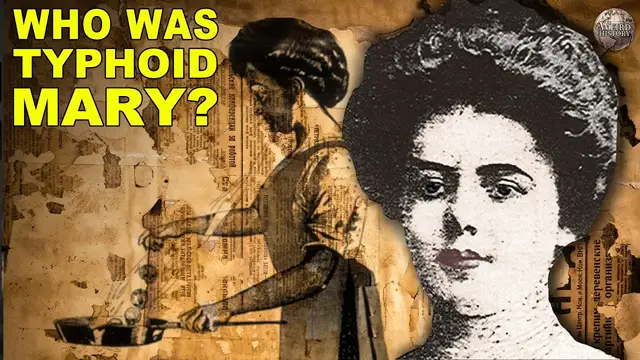
The story of the real Typhoid Mary - In the early 1900s, germ theory was a relatively new concept, and many – including doctors – were unaware of how diseases spread. At the time, bacterial diseases like typhoid and dysentery could still wipe out an entire family.
Show More Show Less View Video Transcript
0:00
In the early 1900s, germ theory was a relatively new area of study
0:05
and doctors were only beginning to understand how bacterial diseases like typhoid were spread
0:10
At the same time, a poor Irish immigrant who worked as a cook for wealthy New York families
0:15
was acting as a one-person super spreader, leaving a trail of sickness and death in her wake
0:21
which would forever earn her the name Typhoid Mary. Today, we're going to take a look at the true story of the woman called Typhoid Mary
0:30
When Mary Mallon was first quarantined in 1907, doctors determined she had already infected 22 people
0:39
and caused the death of a young girl. By the time she was permanently quarantined in 1915
0:45
she had infected 51 people, at least three of whom had died
0:49
No asymptomatic carriers of typhoid had ever been identified at that time
0:53
so Mallon, who was always healthy, never believed she was the source of the outbreak
0:58
Nonetheless, public health officials repeatedly traced the frequent typhoid outbreaks right back to Mary
1:04
and despite a lifetime of resistance, Malin eventually wound up in permanent quarantine
1:13
The first vaccine for typhoid was created in 1896. While it was a great help to soldiers who were at high risk of contracting the illness
1:21
it never became widespread enough to be of much value to the general public
1:25
So in the early 1900s, the disease was still extremely dangerous and had a mortality rate of about 10%
1:32
The symptoms of typhoid are not pleasant. One to three weeks after infection, a person suffering from typhoid typically contracted a dangerously high fever
1:42
This was quickly followed by nausea, vomiting, muscle pain, and headaches. Following that, a distinctive rash would appear on the victim's chest
1:50
If no treatment was administered by this point, the next phase would usually be intestinal bleeding
1:56
leading to blood clots under the skin. In some of the most dangerous cases, the abdomen would then be distended
2:06
In 1906, a homeowner whose family had endured a particularly violent and seemingly inexplicable
2:12
outbreak of typhoid hired a New York State Department of Health sanitary engineer named
2:17
George Soper to figure out what happened. Soper knew the incubation period of the salmonella bacteria that causes typhoid was exactly three
2:25
weeks. Starting his investigation by examining the servants, his suspicions quickly fell on an
2:31
Irish immigrant who had been hired as a cook precisely three weeks before everyone got sick
2:36
That person was Mary Mallon Born in 1868 in what is today Northern Ireland Mary came to the United States in the year of either 1883 or 1884 She started off living with an aunt and uncle and found work as a cook for well families
2:52
Soper ran a background check on Malin and quickly saw that typhoid victims
2:56
seemed to appear wherever she went. He also noticed she had a habit of changing jobs
3:01
and names after each outbreak. Putting two and two together, Soper figured he had his woman
3:06
Soper questioned Mary and raised the possibility that she could be the carrier that was causing the typhoid outbreaks
3:12
Despite the evidence, Malin denied Soper's allegations and resisted testing. No matter how many outbreaks followed her career, Malin steadfastly refused to admit that she was the carrier of typhoid
3:28
Instead, she would quietly slip away after each outbreak, change her name slightly, and find a new job with a new family
3:35
Whether Mary actually understood she was a carrier of the disease and what is to be gleaned from her behavior is unclear
3:41
Her habit of changing her name could imply she was trying to deceive people into hiring her because she knew she was sick
3:47
or it could simply be a person's innocent attempt to avoid press attention. Typhoid at the time was typically associated with poor hygiene and, by extension, poor people
3:57
As such, New York's health officials were surprised to encounter the illness in wealthy and upper-middle-class households
4:04
Servants were put under the microscope, so to speak, and eventually they got around to Mary
4:08
Her poor hygiene did turn out to be an issue. When first questioned by health officials in 1907
4:14
Mallon told them she didn't see any point in washing her hands before she handled food
4:18
This might sound reckless to us today, but in 1907, the theory of germs was relatively new
4:24
and Mary didn't seem to believe sickness could be transferred by physical contact
4:28
That being the case, she wouldn't see why hand washing was important. Scary stuff to think about
4:38
On one occasion in 1907, Dr. Soper came to Malin's workplace to take samples
4:44
Mary took this intrusion about as well as you'd expect, which is to say she completely refused to cooperate
4:50
In fact, one version of the story holds that Malin snatched up a meat cleaver
4:54
and chased Dr. Soper out of the house. Other versions say it was a rolling pin or a meat fork
4:59
But no matter what kitchen utensil it was, the gist is always the same
5:03
It took several more tries before authorities were able to get the goods on Malin
5:07
and she never became more cooperative. Soper eventually planned on having her forcibly restrained
5:12
so samples could be taken. But before he was able to carry out his plan, the authorities intervened
5:17
Even then, Mary wouldn't give in and their attempt to capture her culminated
5:21
in a three-hour foot chase. Mary was apparently pretty fast on her feet
5:29
Despite an all effort to avoid it Mallon was finally apprehended and taken into custody in 1907 Doctors took urine stool and tissue samples which eventually confirmed that Malin was
5:41
carrying the typhoid bacteria. This despite the fact that she displayed no symptoms herself
5:47
By all accounts, she seemed to be a picture of health. With no cure available, health officials had to find another course of action to protect
5:54
the public. Malin was deemed a threat to society, and it was decided that she would be quarantined
6:00
Though she fought every step of the way, she was eventually confined to a single occupancy cottage
6:05
at Riverside Hospital for Communicable Diseases, located on New York's North Brother Island
6:11
When confronted by reporters, Malin said she believed she was being treated unjustly
6:16
and she continued to insist that there was no way she could have typhoid
6:20
Nonetheless, Mary's case attracted so much attention, she was labeled Typhoid Mary in a 1908 issue of The Journal of the American Medical Association, and the name stuck
6:34
Mary Mallon wasn't America's first typhoid carrier, but she was the first asymptomatic carrier ever identified
6:41
This means that she was able to carry and spread the disease without ever showing any of its symptoms herself
6:46
Hmm, that sounds familiar. This was considered a hugely important scientific discovery
6:52
But that being the case, there was no existing protocol that addressed the situation
6:56
While the authorities did have the power to forcibly quarantine anyone who posed a threat to public health
7:02
and they knew Mary was somehow mixed up in all the typhoid outbreaks, they couldn't prove how or why she was involved
7:08
Mary didn't take kindly to the attention. She angrily claimed to be a victim of a government conspiracy
7:14
and at some point the public even seemed to agree with her. Regardless, authorities knew she had to be the carrier and were desperate to stop the trail of sickness and death she left in her wake
7:25
Scientists of Malin's time were never able to figure out how she could carry the bacteria that caused typhoid without showing symptoms
7:32
But in 2013, a group of researchers at Stanford solved the riddle
7:36
To put it as simply as possible, the salmonella bacteria behind the spread of typhoid has the ability to hide in immune cells known as macrophages and hijack their metabolism for their own purposes
7:48
If this hijacking is successful, the person in question can spread the bacteria while themselves appearing healthy
7:58
In 1910, Mary Mallon was released from her first quarantine under the condition that she would never again work as a cook
8:05
She took a job doing laundry, but it didn't last long. She left the position after a short time
8:11
and returned to cooking for families. The authorities got back on Mary's trail
8:15
but she managed to avoid them by frequently changing jobs and names Finally in 1915 Sloan Maternity Hospital in New York had an outbreak of 25 new typhoid cases Mallon was discovered working there as a cook
8:29
and was quickly arrested and returned to quarantine. By 1915, Mallon was infamously known to all as Typhoid Mary
8:37
She had been recaptured and placed back in quarantine at North Brother Island in New York
8:42
Her life there was not pleasant. Whether due to her intransigence with the doctors and staff
8:47
or the facility's complete inexperience at handling cases like Mary's, it's known that she was treated inhumanely
8:54
The initial tests performed discovered that Mallon's gallbladder was riddled with salmonella bacteria
8:59
They wanted to remove the organ during her first quarantine, but she refused to allow it
9:04
They tried again during her second quarantine, and once again, Mary managed to avoid the procedure
9:10
She wasn't able to avoid everything, though. Over her remaining years at the facility
9:14
doctors took over 160 biological samples from her body, all against her wishes
9:20
As if that wasn't indignity enough, Malin was often shown off to journalists and interns as a specimen
9:26
When she wasn't being prodded or exploited, she was being neglected. As her interactions were severely limited by the doctors
9:33
she was only allowed to wash bottles in a laboratory. Dubbed the most dangerous woman in America
9:44
Mary Mallon had finally worn out whatever goodwill she had left with the authorities
9:49
Deciding that she simply could not be trusted to give up cooking or follow any sort of prevention
9:53
guidelines, New York state public health officials decided she had to be quarantined for the
9:58
remainder of her life. That's right, for life. She spent her remaining years in virtual isolation
10:04
at the quarantine cottage on North Brother Island. Mary died in 1938, and though reports
10:10
on the matter conflict, it is believed she likely passed away from pneumonia
10:14
It's not known how many cases of typhoid she spread in her lifetime, but estimates suggest she caused no less than 51 cases, resulting in three fatalities
10:26
While the discovery of an asymptomatic typhoid carrier was big news in 1906
10:32
by the time Mary died in 1938, it was old hat. By that point, over 400 other healthy carriers had been identified
10:39
Yet, according to the surviving records, not a single one of these others received the same forced confinement that Mary Mallon did
10:46
The jarring discrepancy raised important philosophical questions about epidemic and public health protocols
10:52
Some began to wonder whether forcibly confining someone for the greater good of society at large was justifiable
10:59
Others pointed out that it was Mary's lack of honesty and refusal to cooperate that merited such severe treatment
11:05
These issues are still relevant in modern epidemiology. Thank you