Up next in 10



A blind king rode into battle, two armies clashed over a stolen bucket, and a severed head got its revenge by killing an earl. These medieval war stories sound completely fake - but they're all real. Take, for example, the Battle of Hastings, one of the most important battles in medieval history. It's also one of the strangest battles of the Middle Ages, since William the Conqueror almost lost because of a rumor.
Show More Show Less View Video Transcript
0:00
It's widely said that truth is stranger than fiction
0:03
and when it comes to medieval military history, truth leaves fiction in ye olde dust
0:09
So today, we're going to take a look at medieval war stories
0:13
that sound made up but aren't. Seeger Estenschon, Earl of Orkney, in what we now call Northern Scotland
0:22
didn't hold on to his earldom for very long. That's because during a battle, the 9th century aristocrat
0:27
took on an enemy named Maillel Brigid and took his life. That sounds like an ideal outcome for Sigurd
0:34
but Maillel Brigid had the last laugh, figuratively speaking. After he killed Maillel Brigid, Sigurd sliced off his head and tied it to his saddle
0:42
But then, as Sigurd rode home, Maillel Brigid's tooth scratched Sigurd's leg
0:47
The wound became infected, and wouldn't you know it, that was the end of Earl Sigurd
0:51
It is the only known time in history that a severed head defeated an Earl
0:56
But there's still time. In 1325, the Italian cities of Modena and Bologna fought a war over what was possibly
1:06
the silliest reason any war has ever been fought. A bucket. No, really
1:11
The War of the Oaken Bucket, which sounds like the least exciting novel Tolkien ever wrote
1:17
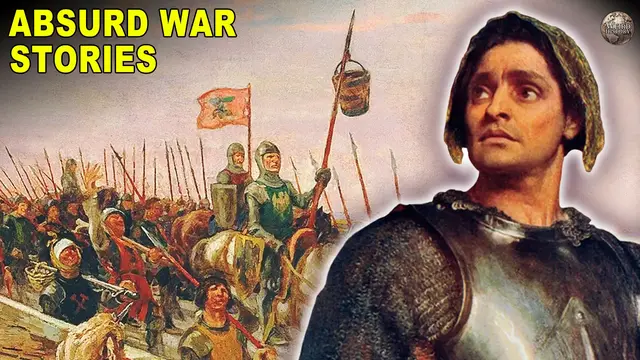
started when the Madenese snuck into Bologna and stole the prized bucket from the town well
1:22
The people of Bologna very much wanted their bucket back and quickly declared war
1:27
They mustered a force of 32,000 men to invade Modena, and the two medieval armies clashed near the town of Zappolina
1:35
At the end of the day, 2,000 men perished over a stolen bucket
1:39
Imagine having to carve that tombstone. During the 1340 showdown between England and France, known as the Battle of Slush
1:50
the French lined up 19 boats and chained them together. They thought the tactic would make it impossible for the English to break their navy
1:58
They were très wrong. An English knight quickly realized the chains opened the French up to an attack
2:04
which when you take a few seconds to think about it, was pretty obvious. With their navy chained together, the French literally couldn't maneuver
2:12
and the battle turned into a rout, with the French losing thousands of men and most of their ships
2:16
But at least the French learned their lesson, and never again got completely routed by an enemy due to going all in on a highly questionable military strategy Uh nobody googled the Maginot line In 1119 King Henry I of England and King Louis VI of France met on the battlefield That setup
2:39
makes it sound like some serious mayhem was about to go down. But according to a 12th century
2:43
chronicle, the battle was one of the least bloody in medieval history. Sorry to disappoint. According
2:49
to the chronicler, I have been told that in the Battle of the Two Kings, in which about 900 knights
2:54
were engaged, only three were killed. Why was the casualty count so low? Well, the fighters on both
3:01
sides decided to go easy on each other, out of fear of God and fellowship in arms. In other words
3:07
the soldiers took prisoners rather than plant each other in the dirt, the chronicler added
3:11
As Christian soldiers, they did not thirst for the blood of their brothers, but rejoiced in a
3:16
just victory given by God. Not a lot of plays for the highlight reel from that battle
3:24
In 1351, two factions fought for control over Brittany, an area in what we now call northwestern France
3:31
But after their numerous battles created a stalemate, the two sides decided to arrange a fight within their fight
3:37
just to keep themselves entertained. Known as the Combat of the 30, the Chivalric Showdown
3:43
wouldn't determine the outcome of the war. Instead, men on both sides simply took a timeout from the war
3:48
for a day of exhibition sparring. The combat of the 30 turned into a spectator sport
3:53
with refreshment stands and viewing areas set aside for visitors. But like a bunch of guys playing tackle football in their 40s
3:59
the sport came at a high price. At the end of the day, at least 11 men perished
4:08
In 1189, a massive crusader army rode for the Holy Land. At its head, Holy Roman Emperor Frederick Barbarossa vowed to retake Jerusalem for the Christians
4:19
The crusader army was attacked several times on the way, but in 1190, it ran into a much bigger problem
4:25
The Calicathnos River. Unfortunately for Frederick, he was powerful and stubborn, and thought he was smarter than everyone around him
4:33
As a chronicler explained, wise though he was in other ways, the emperor foolishly tried his strength against the current and power of the river
4:41
Although everyone tried to stop him, he entered the water and perished miserably
4:46
So to recap, Frederick's men said, hey, don't go in that river. Frederick replied, LOL, I'm going in the river
4:52
And then Frederick drowned. The loss was so dispiriting that according to one account some of Frederick Barbarossa men renounced their faith and became pagans And now their descendants run Instagram selling custom tarot cards
5:08
During the ill-fated Third Crusade, King Richard I of England, better known by pro-wrestling name Richard the Lionheart
5:16
wasn't going to let a little thing like Scurvy get in the way of a good battle. The Crusaders reached the walls of Acre, Israel in 1191
5:22
but that little thing called scurvy kept Richard from mounting his horse
5:26
Unwilling to miss the fight, the king lay down on a stretcher and ordered his men to carry him closer to the walls
5:32
From his stretcher, Richard fired a crossbow at the enemy. It was like clinching the final strikeout in the World Series of Pettiness
5:38
He did a really good job, and everyone was very impressed. And we're not just saying that because he's the king
5:48
Remember in Braveheart when William Wallace led the Scots to victory at the Battle of Stirling Bridge
5:53
Well, in real life, the English defeat, which came during the First War of Scottish Independence
5:57
was caused in part by a sleepy commander. John de Warren, Earl of Surrey, led the English forces
6:04
Thanks to their overwhelming numbers and trained cavalry, the English thought suppressing the Scottish Rebellion
6:09
would be easy. And easy it might have been if Warren hadn't caught a case
6:13
of the sleepy creepies. The English infantry went ahead and began marching
6:17
across Stirling Bridge, only to learn Warren had overslept. That meant they had to retreat and then start again, only for Warren to call them back a second time
6:25
Long story short, William Wallace took advantage of the English bungling, handed them their arses, and was rewarded with an Academy Award-winning film
6:37
The Battle of Hastings would decide whether the English or Normans would rule England
6:41
And in the middle of this high-stakes battle, the Normans nearly retreated when they thought
6:46
William, the Duke of Normandy, had perished. The fearful rumor swept the Norman left flank, nearly causing a panic
6:53
But before the mistake turned into a rout, William rallied his troops by taking off his helmet in the middle of the battle
6:59
Look at me, William yelled. I live, and with God's help, I shall conquer
7:06
Wouldn't it have been funny if he'd been hit on the head with a rock right then
7:11
Yeah, that would have been funny. But Mel Brooks doesn't direct history
7:15
So instead, William's pep talk inspired the Normans to eliminate Anglo-Saxon King Harold Godwinson and come out victorious
7:22
And that how William became known as the Conqueror It good to be the king In 13th century Russia pagans Christians and Mongols fought it out for supremacy
7:36
The Teutonic Order were Christian knights who saw their fight against pagans as their holy duty
7:41
And when they invaded the Novgorod Republic in 1242, it was only a frozen lake that saved the day
7:47
The Teutonic Knights advanced against Novgorod's infantry, but a lake stood between the two forces
7:53
Fortunately, the cold weather froze the lake, so the knights simply rode onto the ice to engage their enemies
7:58
During the Battle of the Ice, as many as 25,000 soldiers fought on the frozen lake
8:03
The battle lasted till the late night. One account related, when the knights wavered and ran, the Russians chased them
8:09
The thin ice began to crack and buckle under the heavily armored crusaders and their horses until it gave way
8:15
So, guess the Russians win by default. In the 6th century, Clovis ruled over a Frankish kingdom
8:26
That's a Germanic people who lived near the Rhine, not like people who were good at being direct
8:30
Although Clovis' wife, Clotilde, converted to Christianity, Clovis refused, until he found himself in a battle that wasn't going so well
8:37
As Gregory of Tours explained, Clovis' army began to be in danger of destruction
8:43
At that moment, Clovis cried out to Jesus and quickly offered him a deal. The terms he offered were, Jesus delivers Clovis a victory, and Clovis will get baptized in Jesus's name
8:53
And maybe Jesus took that deal, because the tides of the war instantly turned
8:58
The Franks won, and Clovis did indeed convert to Christianity. He even started bringing coffee cakes after Sunday services, which is just thoughtful of him
9:10
Vlad the Impaler earned his name by, well, doing the thing his name suggests
9:15
he skewered over 20,000 people in his day. As a ruler of Wallachia, the historical region of Romania
9:21
Vlad wanted to keep the Ottomans out of his territory. So when Sultan Mehmed II invaded
9:27
Vlad welcomed him with the corpses of 23,000 shishkebob Turks. Mehmed, who was evidently the kind of guy who didn't need to be told anything twice
9:35
turned back and left Wallachia to Vlad. In 1462, Vlad himself admitted
9:40
I have killed peasants, men and women, old and young. 23,884 Turks. To the Turks, Vlad was known as Keziklu Bey, or Impaling Prince. That's an
9:52
appropriately fearsome nickname, but it would eventually get supplanted by a more famous one
9:56
Dracula