Up next in 10



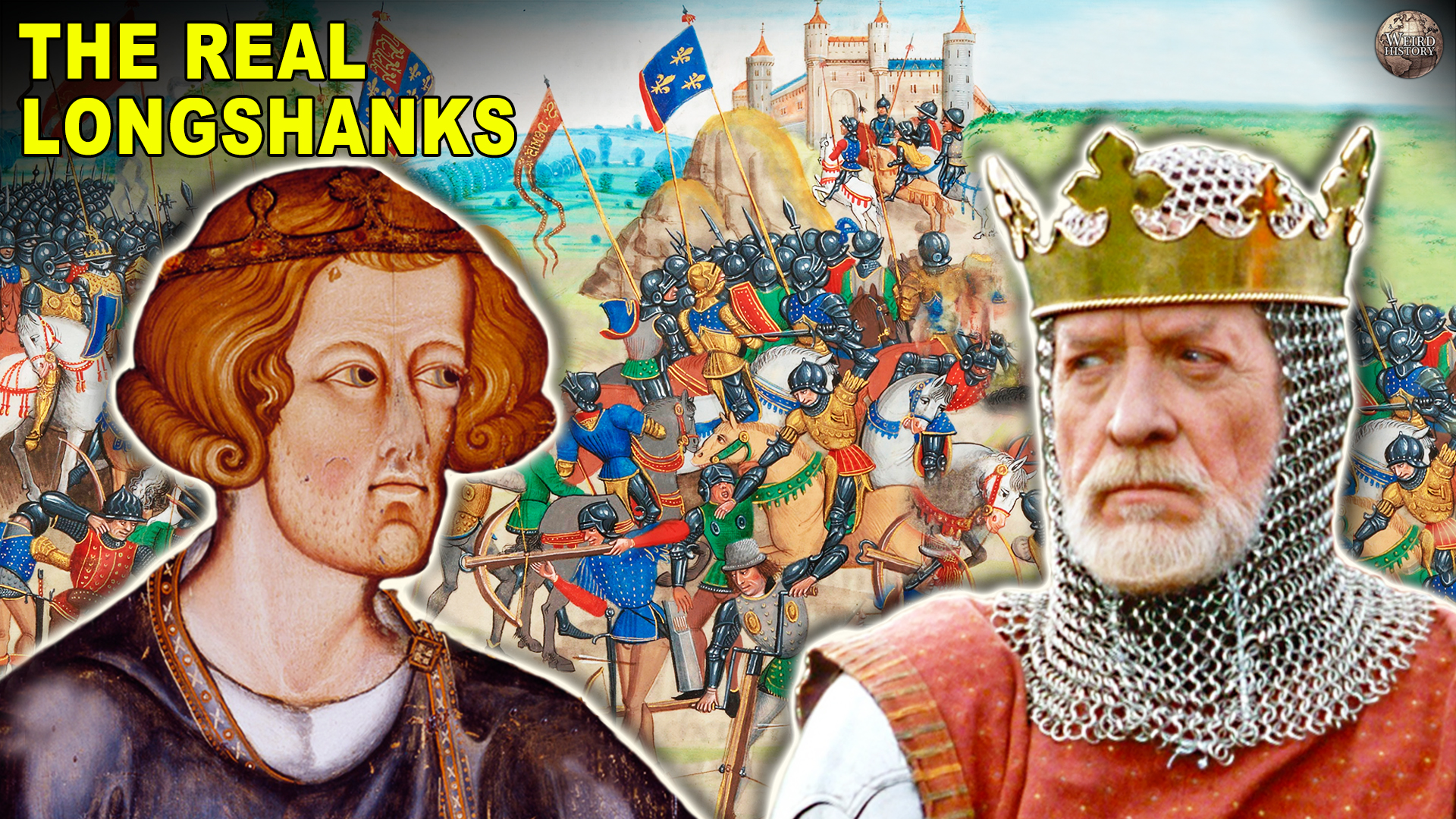
Edward I (actually the fourth, but who's counting?) is familiar to most as the antagonist in the 1995 film Braveheart. Played to malevolent perfection by veteran Irish actor Patrick McGoohan, Edward is typically remembered as a tyrannical but brutally effective ruler. A more restrained portrayal of an aging ruler by Stephen Dillane can be seen in 2018's Outlaw King, but there have been no major portrayals of Edward's rule as a whole or of him in his prime.
Show More Show Less View Video Transcript
0:00
The English king, known as Edward I
0:02
is most familiar to people as the bad guy in the 1995 film Braveheart
0:07
However, the real Edward was one of the most influential monarchs to ever occupy the English throne, and his lengthy reign
0:14
shaped the course of European history for years to come. So today, we're going to take a look at some details
0:19
about King Edward I you didn't see in Braveheart. OK, they may take our lives, but they
0:25
will never take our weird history. The thing you need to understand about Braveheart is that while it may be a classic film
0:34
it's one of the least historically accurate movies ever made. For example, William Wallace's troops didn't wear kilts into battle because they hadn't been invented yet
0:42
And Braveheart wasn't even Wallace's nickname. It was Robert the Bruce's. You know, the guy who betrays Wallace because his rotting old dad tells him to
0:49
Come to think of it, most of those scenes probably aren't true either. Movies, you just can't trust them
0:54
Another area where Braveheart drops the historical ball is the portrayal of Edward I, or Edward Longshanks
1:00
Literally, Edward the Tall, or Edward the Leggy. Hey, when a king has nice gams, you better acknowledge it
1:06
Edward is a great villain in the film, but he wasn't exactly the one-dimensional tyrant the movie depicts
1:11
In fact, by many accounts, he was quite the opposite. When he ascended to the throne in 1274, his first major act was to conduct a great survey of the kingdom
1:19
This led to the most comprehensive review of England in more than 200 years
1:23
Edward issues a series of reforms to reestablish royal authority and to address the grievances that sparked the conflicts that had blighted his father's reign
1:31
His findings would later be recorded as the Hundred Roles. The original documents are still housed in the UK's National Archives today
1:38
You never know it from how things ultimately turned out, but Edward's relations with Scotland were initially cordial
1:44
The Scottish King Alexander III sent a detachment of troops to support the English crown in the Second Baron's War
1:50
A possible marriage between Edward's son and Alexander's only surviving heir, Margaret of Norway, was even seriously discussed in 1284
1:57
But these plans went out the window when Margaret passed in 1290 at the young age of seven
2:02
plunging Scotland into a succession crisis that ultimately culminated in Edward's claim of overlordship, leading to the events we see in the movie
2:10
In Braveheart, we sometimes see Queen Isabella secretly converse with a friend in French, which is a little odd for a couple of reasons
2:17
One, she wouldn't have been in England at the time, as she was an infant during the key events of the film
2:23
Two, the English court would have understood every word, as it wasn until the latter part of the 14th century that English supplanted French as the primary language of the royal court In other words French was Edward native language much like other English monarchs following the Norman conquest
2:39
He was also reasonably proficient in Latin, as that was still the written language of government
2:44
But that's not to say that Edward was good or just. Like a lot of rulers, he had a mean streak of
2:49
running through him. Although several innovations stemmed from his reign, he was still very much a man of his time
2:55
and held many of the same prejudices as his contemporaries. For example, one of his first acts as king was the Statute of the Jewry in 1275
3:03
The act restricted the commercial opportunities of England's small but economically active
3:07
Jewish community. This was eventually followed by a 1290 edict that expelled the Jews from the kingdom entirely
3:13
Expulsion of Jewish communities was unfortunately common in medieval Europe. Edward's uncle and mother had both enacted expulsions of Jews in their own domain some
3:21
years prior. Similar measures had been taken in France and Brittany in the 12th and 13th centuries
3:26
and pogroms and other atrocities directed against Jews were all too common in the Middle Ages
3:31
In fact, it was so common that the Knights of the Shire presented Edward with a colossal grant of 116,000 pounds
3:37
to show their gratitude for his anti-Jewish measure, the largest collection of revenue in the Middle Ages
3:43
Not to be outdone, the Catholic Church awarded the king with even more money in the fall of 1290
3:49
In 1304, during one of his many incursions into Scotland, Edward besieged the strategically vital Stirling Castle, which was sometimes called the key to the
3:58
kingdom due to its position in the center of the country. Although massively outnumbered
4:02
the strength of the castle allowed the garrison to hold out for weeks. Siege weapons were assembled
4:07
to show off the strength of the English crown, and Edward even installed a viewing gallery so
4:12
the ladies of the court could enjoy seeing his machines in action. After weeks of bombardment
4:17
the Scottish garrison came forward to surrender, but Edward wasn't finished yet. His largest machine
4:22
nicknamed War Wolf hadn't been put to use yet, and Edward was keen to test it before he'd accept
4:27
the garrison's surrender. Nobody likes to end the battle until they've shown off their cool new toy
4:32
The mighty trebuchet took more than two months to assemble and was the largest such device ever
4:37
built. You don't spend all that time building a trebuchet and naming it War Wolf just to have it
4:41
collect dust in the garage. Luckily for the Scottish, after satisfying his desire to try
4:46
out the machine, he graciously accepted the garrison's surrender and spared the men's lives
4:50
The strangely festive spirit of the siege ended with a tournament, and then Edward's army returned home
4:58
Since he's known as Edward I, you might assume he was the first Edward to rule England
5:03
But he wasn In fact he wasn even the second or third As confusing as it sounds he was really Edward IV That the trouble with English royalty You gotta mix up those names Throw a Brad or a Kenny in there once in a while
5:15
The first Edward was Edward the Elder, the Anglo-Saxon king of Wessex who ruled from 899 to 924
5:21
The second was Edward the Martyr, who ruled from 975 to 978
5:25
His reign was so short medieval chroniclers sometimes forget he ever reigned at all
5:29
Ouch. The third King Edward was Edward the Confessor, the last major Anglo-Saxon king of England
5:34
After 24 years of rule, he passed without a rightful heir, leading to the tumultuous events of 1066
5:41
As for Edward Longshanks, the designation of the first came because he was succeeded by his son, also named Edward
5:47
and then by his grandson, who was also named Edward. Having three Edwards in quick succession
5:52
meant it was just easier to start numbering them. So our Edward became known as the first
5:57
because he was the first Edward since the conquest of 1066. Tracking royal lineage is like trying to remember
6:03
every character's name on Game of Thrones. I mean, if anybody watches that show anymore
6:07
after that final episode, I mean, come on. You ruined the whole thing. In the 13th century, lords and kings
6:15
were much too valuable to be off like common peasants, so they were rarely killed on the battlefield
6:20
Capture and ransom was the standard practice. Running a kingdom is expensive
6:25
and you need to take every opportunity to make that paper, not to mention the political embarrassment
6:29
of capturing your enemy's leader. Edward was no stranger to the catch and release policy
6:33
of fishing for lordly captives. As a young man, Edward's future kingdom
6:37
was in the midst of a power struggle between the English crown and the nobility. The balance of power swung back and forth
6:43
with the rebel leader Simon de Montfort succeeding in capturing Edward, who
6:47
happened to be his nephew, on more than one occasion. Well, I hope he was his nephew on all occasions
6:51
However, Edward managed to escape on several of those occasions. The most brazen escape came when he
6:57
was permitted to exercise his horse outside the castle walls along with guards
7:01
The young prince rode horses until all but one of the animals were exhausted, so they couldn't be used to chase him
7:06
He hopped on the last fresh horse and repeatedly shouted to his captors, Lordlings, I bid you good day
7:11
Greet my father well and tell him I hope to see him soon to release him from custody
7:16
In terms of medieval burns, that one was particularly savage because Edward made good on his word
7:21
Edward finally defeated his uncle at the Battle of Evesham in 1265. He managed to trap Montfort's army by carefully shadowing
7:28
the smaller force during the night. With no way out, Montfort was forced
7:32
to accept battle in deeply unfavorable conditions. Remember how we said that generally accepted practice
7:37
was to take important people like knights and nobles prisoner Yeah well Edward wasn having any of that this time Edward ordered his troops to show no mercy and they responded eagerly The baronial army was almost completely annihilated
7:50
Even those who sought shelter in a nearby abbey were not spared Edward's wrath
7:54
His uncle Montfort suffered the worst fate of all. Prior to the engagement, Edward tasked a dozen of his best men
8:00
with specifically finding Montfort and finishing him off. To add one final insult to injury
8:05
Montfort's unmentionables were removed and stuffed to the mouth of his decapitated head
8:10
See, that scene should have made it into Braveheart. Edward actually launched his own crusade to the Holy Land
8:17
the Ninth Crusade, which also is known as Lord Edward's Crusade. Crusades were big at the time
8:23
Everyone was doing it. Because of his opposition to a peace deal with the Muslim rulers of the Holy Land
8:27
a bounty was placed on Edward's head. On June 1, 1272, Edward was attacked by an assassin
8:33
While he was able to disarm and eliminate his would-be killer, the wound was believed to have been inflicted by a tainted blade
8:39
One story had Edward's ever-devoted wife, Eleanor, sucked the poison from his wound to save his life
8:44
which is cool and romantic and almost certainly apocryphal, like most of Braveheart
8:49
In actuality, the king's life was saved by an extraordinarily painful procedure
8:53
where the flesh blackened by the toxin was hacked away by a surgeon. Edward drew up a will in the extremely likely event
8:59
of him succumbing to infection, but he ultimately pulled through. After spending Christmas of 1272 recovering in Italy
9:05
he returned to England to learn that his father had passed, making him the new king
9:10
Although he planned to return to the Holy Lands on another crusade, his 1272 departure proved final
9:17
In Braveheart, we see Edward treat his only son, Edward II, with plenty of disdain. But Edward
9:23
actually sired many more children apart from his disappointing heir. With his first wife
9:27
Eleanor of Castile, he fathered at least 14 children. You go, dude. As was often the case
9:33
in the Middle Ages, many of the king's offspring did not survive into adulthood. Edward II was
9:38
actually the youngest of the children born to Eleanor. Edward had three more children with his
9:42
second wife, Margaret of France, two of whom survived into adulthood. In all, only six of his
9:48
many children outlived him. With news of Robert the Bruce's successes in Scotland, Edward evidently
9:55
decided that enough was enough as far as these rowdy Scots were concerned. He prepared to launch
10:00
another incursion to bring the Bruce to heel. You have to admire Edward's stick-to-itiveness
10:05
But a military expedition was a tall order at the ripe age of 68, even for long shanks
10:10
And he never got a chance to pull it off. He contracted dysentery and died shortly afterward
10:14
on July 7, 1307 at Brough by Sands