Up next in 10



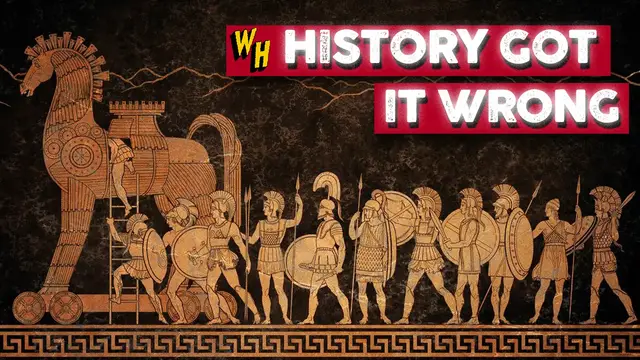
The legendary tale of the Trojan War has captivated people for thousands of years, filled with Greek gods, epic battles, mysterious prophecies, and the famous giant wooden horse said to have brought down the city of Troy. But was the Trojan Horse real, or is it one of history's greatest myths?
Show More Show Less View Video Transcript
0:00
The story of the Trojan War is among the oldest stories in the world
0:04
A sprawling, fantastical tale of gods, omens, and perhaps most famously, a giant wooden horse packed with Greek warriors
0:12
But despite its fame, historians believe this equine weapon of war might be completely misunderstood
0:19
And that's why, today, we're risking the wrath of the gods to discover what the Trojan horse actually was
0:25
It's pretty much impossible to discuss anything related to the Trojan War without first paying
0:34
lip service to the Iliad, an epic poem written by the Greek bard Homer. Or at least, it's credited
0:41
to Homer. Whether he actually wrote the Iliad is a bit of a mystery. In fact, we're not entirely
0:48
sure Homer ever even really existed. Many scholars believe he may be a folkloric character whose name
0:55
was derived from a society of poets known as the Homeridii. But it's also possible the stories were
1:00
purely the result of oral traditions that evolved over the course of centuries, only to be written
1:06
down sometime later. Whatever the case, the Iliad remains our chief source of information about the
1:11
Trojan War, and it says the whole thing began as a rescue mission to retrieve the legendary Helen of
1:17
Troy. Abducted from her Mycenaean homeland, the woman with the face that launched a thousand ships
1:23
sparked an unprecedented 10-year offensive against Troy, also known as Ilion, by a coalition
1:29
of Greek states. Whether this war or anything like it ever really happened is also a mystery
1:36
The works of Homer deal with the real-world politics of the alleged era, but they also
1:40
contain Olympian deities, terrifying monsters, and some seriously badass heroes. For example
1:47
Achilles, the mighty warrior and child of a god. In other words, Homer's account is fantastical
1:53
by design, so it's hard to say whether it's an embellished version of actual historical events
1:58
or a complete fiction. Archaeologists, always looking to be helpful, remain split on the
2:03
question. There is evidence of a real city named Troy having existed in what is now Turkey, but
2:09
there's no proof the climactic battle of legend ever occurred. Thanks, archaeologists! Anyway
2:16
fictional or not, you might think the Iliad was at least responsible for the story of the Trojan
2:21
horse. But much like the legend of Achilles' heel, the Iliad actually contains no reference
2:26
to the famous device. Why? Because the Iliad ends before the story reaches that point in the war
2:33
To find Homer mentioning the Trojan horse, you have to look to the Iliad sequel, The Odyssey
2:43
During the decade-long battle against Troy, the Greeks had to get down and dirty. The city was
2:49
protected by walls, built with the assistance of Poseidon, who was apparently really good at
2:54
building walls, so Troy easily deflected all attacks by their invaders. That is, until an
3:00
absolutely devious act of trickery turned the tide. At the suggestion of Odysseus, a fairly
3:06
crafty dude in any era, the Greeks secretly constructed a large wooden horse on the shores
3:12
of Troy. A band of Greek warriors then hid themselves inside its hollow body. The horse
3:17
was then pushed toward the gates of Troy and abandoned The Trojan soldiers guarding that gate watched with pride as the Greek army left its offering and then retreated to the seas
3:28
Accepted as a gift, or perhaps a white flag, the wooden horse was then brought into the city
3:34
happy with their enormous and kind of random trophy. The Trojans then partied hard into the night
3:40
and eventually hit the hay. Once the coast was clear, the Greek soldiers slipped out from their hiding place
3:46
in the horse's belly and opened the gates of Troy from within. Beneath the blanket of night
3:51
the invading army had returned to the shores of Troy. And after leveling the city, the Trojan
3:56
War ended and Prince's Peach, uh, I mean Helen of Troy, was saved. Since it was the brainchild
4:02
of the legendary hero Odysseus, star of the Odyssey, it seems safe to assume the story of
4:08
the Trojan horse came from that poem. But much like the Iliad's surprising lack of wooden sculptures
4:14
The Odyssey also contains little to no mention of the Trojan horse
4:19
In fact, there are only two lines in the epic poem referencing Odysseus' plan
4:24
Homer's second poem is way more concerned with murderous sirens and cycloptic carnivores
4:30
which begs the question, how exactly did the Trojan horse become so famous
4:35
Well, we can all thank the most famous tour guide to hell for that one
4:39
Yes, before his posthumous appearance in Dante's Inferno, The Roman poet Virgil composed an epic titled The Aeneid, which is where we get all of the Trojan horse tropes found in the cartoons and blockbuster films of today
4:53
It's widely assumed that Virgil's account is based on more ancient sources since Lost, but even if that's the case
5:00
the most famous trick the Greeks ever pulled is mostly only remembered because of a Roman
5:05
Virgil's version of the story offers a fascinating glimpse into ancient espionage
5:10
but it also kind of makes the Trojans look like a bunch of idiots
5:14
Like, seriously, who would fall for that? And that's not the result of thousands of years of hindsight
5:19
because even the commentators of antiquity had trouble believing the whole Trojan horse thing would really work
5:25
Maybe that's why it's not all that surprising, that modern scholars believe the entire concept was a misinterpretation right from the giddy-up
5:33
Barring the discovery of some mind-blowing new evidence for time travel
5:42
there is no way of knowing exactly what the ancient poets meant when referring to a horse at the fall of Troy
5:49
There are, however, a few clues scattered across the history of warfare
5:54
For example, to make a heroic dent in a legendary fortification, old-timey warriors like Odysseus required an engine
6:01
And no, not one of the V8 variety. Before the discovery of gunpowder and chrome
6:06
armies looking to reduce an opposing city to rubble required some good old-fashioned wood
6:11
and rope to make a siege engine, an ancient weapon that utilized primitive physics to crushing effect
6:18
literally. In terms of pure scale, siege towers offered the most baffling visual horror for any
6:25
fresh recruit guarding their cities. Carted to the borders of battle on gargantuan wheels
6:30
Siege towers offered a distinct height advantage for conquests. Side by side, these towers of death could quickly overpower pretty much any army or civilization
6:40
But when it comes to siege engines with deadly ambition the ranged variety took aim at everything in sight from boulder catapults and flaming trebuchets to the unholy terror of a loaded
6:53
ballista. Ranged siege engines were some of the most devastating forms of ancient warfare
6:59
but while it's intriguing to imagine bolts of Greek fire being leveled at terrified Trojans
7:05
Occam's razor suggests the siege engine engine we're looking for might actually be a simple
7:10
battering ram, named both for an ability to ram through the gates of the enemy and for the hooved
7:16
animal often adorned on its focal point. The battering ram was a deceptively simple tool
7:21
whether literally carried and forced against its gates by crazed warriors or hoisted between
7:26
structures and swung back and forth. These siege engines were very effective when it came to ye old
7:33
BNE. Why are we telling you this? Because even though the true nature of the Trojan horse is
7:39
still up for debate, the writer Pausanias dropped this bombshell in the 2nd century
7:44
that the work of Appaeus was a contrivance to make a breach in the Trojan wall as known to
7:49
everybody who does not attribute utter silliness to the Phrygians. Appaeus, for the record
7:55
was the right-hand man of Odysseus, the carpenter extraordinaire who built the Trojan horse
8:00
and the Phrygians were the soldiers of Troy. So what Pausanias was saying was basically
8:05
unless you think the soldiers of Troy were a bunch of morons, the so-called Trojan horse was obviously just a name for a battering ram
8:13
And Pisanius might be right. Some ancient armies did in fact refer to battering rams as horses
8:19
Why? Because of the horse skins wrapped around each wooden element to dull vibrations
8:25
These hide-laden logs were also typically doused with water to prevent an enemy's flaming arrows from setting the whole contraption on fire
8:32
Much like today's Black Hawk helicopters and military drones with names like Raven and Puma
8:39
the urge to give weapons of war animalistic name tags seems very ancient and entirely human
8:45
The Romans, for example, had a siege device called Corvus, which is the Latin word for crow
8:51
When it's all laid out like that, it's easy to imagine some ancient poets heard some military
8:56
types talking about the horse that breached the walls of Troy and simply took it a little too
9:01
literally. That being said, it's hard to imagine a troop of men hiding in a battering ram. So did
9:07
the poets just make that part up, or is there perhaps another explanation
9:16
Siege engines don't have big hollow bellies people can hide in, but ships do, and the ships
9:22
of ancient Greece might just be the answer we're looking for. We say that because the Greeks of
9:27
antiquity often referred to their ships as, wait for it, seahorses. In fact, Homer himself
9:34
or whoever wrote it, uses the term seahorse to refer to ships on multiple occasions over the
9:39
course of the Odyssey. Equally intriguing is that when Homer very briefly describes Odysseus and his
9:44
men loading into the horse that sacks Troy, he uses pretty much the same language he uses when
9:50
he describes soldiers boarding ships. And from a literary perspective, it hasn't escaped the
9:54
attention of historians that the story of the Trojan War begins with the building of boats
10:00
So it would be a perfect bookend to the full tale if it ended with the construction of yet another
10:04
ship or horse Adding credence to this theory is the fact that naval archaeologists have uncovered ancient texts and images of a Phoenician merchant ship with the head of a horse carved into its
10:16
bow. Such carvings were said to imbue each vessel with ferocious speed, and according to ancient
10:22
texts, these ships, which were common in the first millennium, were lavishly decorated with other
10:27
horsey vibes. Similarly, ships with horsehead decorations are depicted on artifacts from the
10:33
Minoan and Mycenaean era, both common reference points for writers of epic legends. So once again
10:39
it's possible that over centuries of oral tradition, a metaphorical name for ships got
10:44
confused with a literal interpretation, resulting in a story about a giant horse
10:49
full of soldiers. So that settles that, right? Well, not quite. Before we finish, there is one last slightly more obscure theory lying among the rubble
11:05
Austrian historian Fritz Schockermeyer sees the horse as a metaphor for an earth-shattering event
11:12
namely an earthquake. This theory holds that the horse in question is actually representative of
11:17
Poseidon. Most popular for being god of the sea, this trident-wielding deity is also symbolic of
11:23
horses and, oh yeah, earthquakes. Fringe theory or not, there are some compelling arguments to
11:29
support Fritz's case. For one, although the fall of Troy has no real documentation outside fanciful
11:35
scribes like Homer and Virgil, there is indeed archaeological evidence the city faced a disaster
11:42
During excavations in the area, archaeologists uncovered signs of damage to the walls
11:47
and most likely, the culprit was an earthquake. However, even if the real Troy was blown to
11:52
smithereens by mother nature rather than the acolytes of Zeus. Most scholars reject the
11:58
earthquake theory as it relates to the horse story. Why? Because while it's entirely possible
12:03
the walls were damaged by the movement of tectonic plates, Poseidon was the least likely Olympian to
12:08
tear down the Trojans. We say that because Poseidon is actually credited with building
12:13
the walls of Troy, so it's hard to imagine him putting tridents through his own drywall
12:18
But nice try anyway, Fritz! Considering the vast strangeness of ancient mythology
12:28
there is, of course, the possibility that the Trojan horse isn't based on anything real
12:34
and is simply a literary device, from the wings used by Icarus to fly just a little too close to the sun
12:40
to Adamant, the impenetrably hard substance shamelessly ripped off by Marvel Comics
12:46
Myths are full of science fiction-style contraptions and materials that could never have plausibly existed
12:52
That said, it would seem that either siege engines or ship decorations are the answer
12:57
Wrapped in the words of a poet, these military devices took on a life of their own
13:02
Oral traditions battered down the battering ram truth behind the Trojan horse
13:06
and entire cultures forgot their pet names for boats. Whatever the case may be, the Trojan horse now survives as a metaphor
13:13
a warning about gullibility that refers to the tactic of tricking targets
13:17
into letting an enemy sneak into a safe zone. In that sense, the horse is a reminder that non-threatening exeriors can become a token of fear
13:26
and fear we must. For as Virgil himself wrote in the Aeneid
13:30
I fear the Greeks even when bearing gifts