Up next in 10



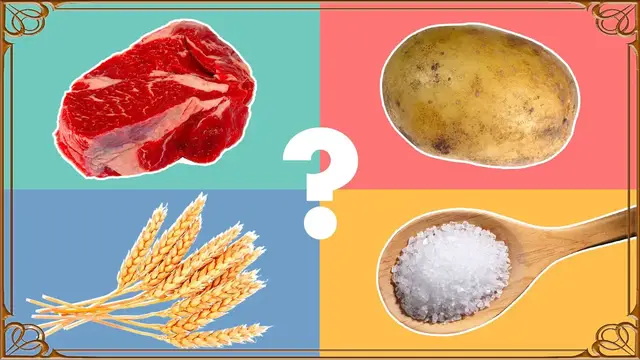
Food history is, in many ways, the history of humanity. But which development was more important, cooking meat or harvesting grains? Producing sugar or digging up potatoes? We break down our picks for the most impactful foods in human history on this episode of Food History.
In this episode of Food History, we're breaking down the four foods that changed the world: meat, sugar, tubers, and grains. Which will take the crown? Join Justin Dodd and special guest Professor Richard Wrangham in an attempt to answer one of the toughest and most interesting questions we've received at Mental Floss!
Food History is a new series from Mental Floss where we dive deep into the culinary stories that lead to the food on our plates. If you have an idea for a dish, cooking technique, or cuisine that you'd like us to explore in a future episode, tell us in the comments.
Read that great New York Times story about sugar here:
https://www.nytimes.com/interactive/2019/08/14/magazine/sugar-slave-trade-slavery.html
These are NOT affiliate links (we make no money off any sales), but they are interesting books that are definitely worth a read:
https://www.amazon.com/Catching-Fire-Cooking-Made-Human/dp/0465013627
https://www.amazon.com/Sweetness-Power-Place-Modern-History/dp/0140092331
https://www.amazon.com/Against-Grain-History-Earliest-States/dp/0300182910
For the origins of mashed potatoes, check out our earlier episode of Food History: https://www.youtube.com/watch?v=js8Cfwj12W0
Don't miss a video! Subscribe NOW: https://www.youtube.com/@MentalFloss?sub_confirmation=1
About Mental Floss:
Mental Floss is where curious people come for trivia-tastic information. Mental Floss produces lists of fun facts, debunks common misconceptions, and tells untold stories from history, science, culture and more.
Website: http://www.mentalfloss.com
Twitter: http://www.twitter.com/mental_floss
Facebook: https://facebook.com/mentalflossmagazine
Copyright Notice: This video and YouTube channel contain dialog, music, and images that are property of Mental Floss. You are authorized to share the video link and channel, and embed this video in your website or others as long as a link back to this YouTube Channel is provided.
2025 Mental Floss
Which Food Influenced Humanity The Most? | Mental Floss
https://www.youtube.com/@MentalFloss
Show More Show Less View Video Transcript
0:00
In June 1822, a man named Alexis St. Martin was accidentally shot in the stomach at Fort
0:05
Mackinac, Michigan. When a surgeon named William Beaumont arrived on the scene, the situation was
0:09
dire. As Beaumont described it, a large portion of the side was blown off. There was a perforation
0:15
made directly into the cavity of the stomach, through which food was escaping. Gross. Beaumont
0:21
eventually nursed his patient back to health, so successfully that St. Martin was able to one day
0:25
paddle his family in a canoe from what is now Wisconsin to Montreal. Though St. Martin was
0:30
able to live a relatively unencumbered life after the accident, the wound never completely closed up
0:35
For the rest of his life, as Richard Wrangham described in his captivating book Catching Fire
0:40
the inner workings of his stomach were visible from the outside. Hi, I'm Justin Dodd. Welcome
0:45
to Food History. Other than morbid curiosity, why should we care about a guy whose guts were
0:51
publicly available information. Well, in addition to being an effective surgeon, Beaumont knew an
0:55
opportunity when it arose. In St. Martin, he had an almost literal window into the workings of the
1:01
human body. The information he gleaned through observation of his unique subject gave us insights
1:06
that might otherwise have been impossible to learn about the digestive system. In an indirect way
1:11
they might even help us understand the incredible contributions made to humanity by cooking
1:16
They give us a jumping off point to discuss some of the foods that have had the biggest impact in
1:20
the history of humanity, all part of an attempt to answer a fascinating question offered up
1:25
by one of our audience members. It's a story that takes a couple million years and involves
1:29
intrepid volunteers chewing raw goat meat, international trade, and the birth of agriculture
1:35
Not exactly in that order. Let's get started. Which food has done the most to shape human development? When an audience member named
1:47
Mike posed that question to us in the comments of our video about nachos, it got us thinking
1:52
Like a lot of interesting questions, it's kind of impossible to answer, but it raises a number
1:57
of interesting questions on its own. How do you define human development? Heck, how do you define
2:02
food? For our purposes, if only to keep this video from being nine hours long, food is something you
2:07
eat. As in, no beverages. Sorry, water, milk, tea, and beer. Although, side note, our next episode is
2:13
going to be all about beer, so don't go crying into your unspecified fermented beverage just yet
2:17
In fact, if you have a cool fact about beer, drop it in the comments below
2:21
Even sticking to solids, we're left with a crowded field of contenders. We batted some ideas around In the Office, back when being in the office was a thing
2:29
and we asked the Ask Food Historian subreddit for their insights, since it's right there
2:33
in their name. And they pointed us to some excellent books, which we will pull from throughout this video
2:38
We're even going to bring in one of the authors of one of those books a little bit later for
2:41
his perspective. We're going to mostly talk about just four types of food today
2:46
tubers, meat, sugar, and cereal grains. But choices were made with a healthy dose of humility
2:52
You could make a convincing argument for rice, or maize, salt, or pepper—no single ingredient
2:57
could ever tell the entire history of human development or a food's role in it, but
3:02
hopefully, each one of our choices tells us something interesting about the way that food
3:05
and humanity have influenced one another. Okay, back to Beaumont, our inquisitive doctor from the top of the video. He studied his holy
3:13
subject on and off for years, often introducing different foodstuffs tied to a string directly
3:18
into St. Martin's fistula. Yeah, the hole in his abdomen. Ugh. He then pulled the string
3:22
back out to note, among other things, the time it took to digest various items. He drew
3:27
a couple conclusions that would prove illuminating even decades later. For one, tender food with
3:31
greater surface area—what he called minuteness of division—was digested faster. And cooked
3:37
food, including potatoes and meat, was processed dramatically faster than raw food. Almost
3:42
two centuries later, Professor Richard Wrangham came to St. Martin's story from the perspective
3:46
of a biological anthropologist. Before he became fascinated with cooking, much of his
3:50
work focused on the differences between human beings and other primates, especially chimpanzees
3:56
Wrangham uses Beaumont's takeaways as one piece of what he would eventually call the
3:59
cooking hypothesis—a fairly persuasive argument that cooking is perhaps the defining difference
4:05
between us and our Homo habilis ancestors. The cooking hypothesis says an ape became human because it learned to cook
4:13
Cooking transformed us, our ancestors I should say, partly because it gave a lot of energy
4:20
and that energy was available for new activities like travelling further, like having babies
4:30
faster, like having a better immune system that gave us better defense against diseases
4:38
It also made our food softer, which meant that the mouth could be smaller, the teeth
4:44
could be smaller, the gut could be smaller because the food was also more digestible
4:50
And at the same time, by the way, cooking meant that fire was being used to heat the
4:56
food, and the acquisition of the control of fire meant that our ancestors could for the
5:03
first time safely sleep on the ground defended by the fire, so they no longer had to be adapted
5:09
to climbing in trees, and that meant that they could really fully adapt for the first
5:13
time to walking and running on the ground." In a 1999 piece published in Current Anthropology, Rengam and his colleagues began to make this
5:23
argument with a particular focus on tubers, rhizomes, and corms. Think potatoes, cassava
5:29
taro root, and yams, which they call underground storage organs. Sexy. Rangham's argument is really about focusing on a technology—fire—over an ingredient—meat
5:40
But unfortunately for the purposes of this video, fire is not a food. Although there
5:44
are fire eaters, so maybe it is. No, that's stupid. Disregard that. Tubers are basically
5:49
way for us to discuss cooking with fire separately from meat-eating. And it's not like the researchers chose underground storage organs arbitrarily
5:57
For one, by the researchers' estimation, tubers would have been a much more plentiful
6:01
food source than meat—one that was unavailable to many other animals, since they likely would
6:05
have required digging sticks to access. They also pointed towards evidence that ancestors a million years before the emergence of Homo
6:12
erectus may have consumed meat without the corresponding physiological changes. Finally, they yzed the hypothetical impact of increased meat consumption versus cooking
6:22
underground storage organs, and determined that cooking would provide a greater potential
6:27
increase in daily energy intake, even over a dramatic rise in meat eating
6:31
Did you get all that? The piece also suggested that cooking tubers could help explain the emergence of male-female bonding
6:39
Cooking changes the site of consumption Rather than foraging and eating what you find in the place you find it cooking involves bringing food back to a central location It trades the security of eating your food immediately for the extra efficiency of letting
6:52
the fire do some of the digestion for you. It's a system fraught with risk for the one doing the cooking
6:58
Cooked food, the researchers argue, would be a more tempting target for would-be thieves
7:02
given its increased tenderness and relatively easy locatability. They outline a hypothetical path to male-female bonding that centers around females protecting
7:10
their tuber-centric resources by forming alliances with males. This also, in their understanding, helps explain the persistent division of labor found between
7:19
the sexes. The most traditional division—men hunt, women gather—is ultimately unworkable for
7:24
Wrangham with a raw food diet. He imagines an unsuccessful hunter returning empty-handed at nightfall
7:30
Even if his female partner had gathered tubers for him to eat, he would have an entire night
7:35
of chewing ahead of him. Against apes, and by Wrangham's association amongst our pre-cooking ape-like ancestors
7:41
a large part of the day is spent chewing. His interest in methods to ease this burden led Wrangham to conduct an informal experiment
7:48
in which friends and I chewed raw goat meat with avocado leaves to help accelerate the
7:52
breakdown of the raw meat. Note to self, ignore all party invitations from Richard Wrangham
7:57
Wrangham sees the use of fire and the reduction in chewing time it entails as a way to free
8:01
up time in the day, and indeed, time at night that's now illuminated by those fires
8:06
Hunting could then grow from a sporadic activity brought about by opportunity—as it generally
8:10
functions amongst modern primates like chimpanzees—into a consistent enterprise diversifying the hominid larder
8:17
Reading Wrangham's counter-narrative is fascinating, but it received far from universal acceptance upon its publication
8:23
In a devastating academic put-down in the comments of that 1999 article, Professor C
8:28
Loring Brace thanks the study's authors for inviting his comments, despite the fact that
8:32
quote, "...they were fully aware of the fact that I look upon their gambit as belonging more to the
8:37
realm of anthropological folklore than to that of science." He goes on to damn them with the faint
8:42
praise that their hypothesis may not be science, but has the makings of an absolutely charming story
8:49
Savage. Critically, Brace argues, the researchers ignored evidence for the use of certain tools that
8:54
the hominids they're discussing did in fact have access to. Those tools would provide an
8:58
an alternate means of externalizing digestion. Basically, instead of requiring fire to help digest meat, you could make a proto-steak
9:05
tartare by cutting meat off a scavenged auroch and bashing it with a club
9:09
Evolutionary biologists Catherine D. Zink and Daniel E. Lieberman published a study
9:13
in 2016 looking into exactly this kind of mechanical processing by having people eat
9:19
among other things, more raw goat. What's with the eating of the raw goat
9:22
Did I miss this viral trend? Anyway, they concluded that cooking wasn't necessary to bring about the physiological
9:28
changes that Wrangham was trying to account for, in that meat eating was largely dependent
9:33
on mechanical processing made possible by the invention of slicing technology. So in their understanding, cooking might still have a place in this pivotal moment of human
9:42
development, but our definition of cooking might have to expand to encompass preparation
9:47
methods outside of applying heat. There's a big reason this explanation is appealing
9:52
The cooking hypothesis requires a degree of fire control by hominids dating back 1.8 million
9:57
years ago. At the time of that 1999 piece, the most compelling evidence for the human control of fire dated
10:03
back only about 250,000 years. Intriguingly, the intervening years have seen new archaeological discoveries that provide
10:10
evidence for controlled use of fire well before that time frame, with compelling evidence
10:15
pointing as far back as a million years ago. Unfortunately for Wrangham, that leaves about 800,000 years of supposed fire use unaccounted
10:23
for in the archaeological record. If we accept even earlier estimates going back maybe as far as 1.6 million years, there's
10:31
still a gap in the record. Wrangham suggests that the absence of evidence isn't necessarily evidence of absence, and
10:37
while he's logically correct, fire does have a habit of leaving visual traces of its existence
10:42
You know, burnt ground, rings of stones, that kind of thing. As Anna K. Behrensmeyer, paleoecologist at the Smithsonian National Museum of Natural
10:50
History said back in 1999, I think there would be evidence if it were behind as important an evolutionary leap as
10:57
Wrangham's team suggests. My point was we need to have this theory in order to encourage people to look for the evidence
11:05
And so it's been very exciting seeing that the evidence for the control of the fire has
11:11
been pushed further back. The evidence is getting in the right direction
11:15
You know, personally I'm disappointed because I thought that within 10 years we would totally
11:19
nail it, but give us another 10 years and we'll see it all the way back.
11:24
That doesn't mean we have to throw out Wrangham's insights, or his fascinating book
11:29
which I definitely recommend. But it does mean that we might be better off thinking about a range of technological advances
11:35
from the development of tools to better hunting practices to the use of fire
11:40
That makes identifying a single food's impact a bit tricky. Tubers and other underground storage organs were probably important, perhaps critically
11:48
so, but they may not deserve any type of singularly exalted status in our discussion of cooking
11:54
Meat is obviously incredibly important to our development as a species. Along with cooking, broadly defined, we might very well say it's what made us human
12:02
But I have to admit, on a qualitative level, the life of a hominid from 1.8 million years
12:07
ago seems to share more with the life of his ape-like predecessor than it does with mine
12:13
They're both living outside, they probably can't conceive of language or art like the
12:17
matrix, maybe we need to come closer to the present to identify a food that shaped life
12:22
as we know it today. When we began considering the question at the heart of this video, one of the first places
12:27
my mind went to was the spice trade. The search for spices like pepper, which is a dried berry incidentally, has undoubtedly
12:35
had a huge impact on human development and exploration. It's arguably responsible for permanently connecting Europe to its neighbors in the
12:42
east and the west. Here, just to give a small taste—pun very much intended—of the ways the spice trade
12:48
shaped the world, the Dutch famously traded Manhattan to the British for an Indonesian
12:53
island with some nutmeg trees on it. That's admittedly an oversimplification, but it speaks to the enormous value placed
12:59
on spices at the time. There are equally fascinating stories we could tell about cumin or pepper—I mean, we're
13:05
just gonna have to devote a whole video to the spice trade at some point—but it's hard to say that one spice jumps out far above the others in importance
13:13
Salt could also make a super convincing case for one of the most important foods ever, but
13:17
its impact on the world is so far-ranging and constant throughout history that it's
13:21
a bit hard to tell a single story of its role in human development
13:25
We can live without it but is there one pivotal change it responsible for It hard to say Like salt sugar is both an ingredient we can buy in the store and a naturally occurring chemical compound If you want to be really annoying we could crown sugar our most important food champion hands down simply for the vital
13:42
role photosynthesis plays in the food chain. Super simplified sixth grade science version
13:47
Okay. Plants take in sunlight, create sugar, provide oxygen. Animals eat plants, life thrives
13:53
Keanu Reeves is born, everybody's happy. As biochemist Albert Saint-Georgi described it
13:58
what drives life is thus a little electric current kept up by the sunshine
14:03
But if anything drove me to discuss sugar, it's actually an oversight we made in a previous episode
14:08
When we discussed chocolate, we stuck mostly to its earliest history and the cool technological
14:13
advances that eventually gave us things like Hershey's bars. But I think a fair criticism
14:17
we read in the comments was that we ignored the role that slavery played in chocolate
14:22
from its early production in Europe's Central and South American colonies all the way up to today
14:27
And if this series is mostly about celebrating the fun and interesting aspects of the intersection
14:31
of food and history, I don't think that means it can't also acknowledge the truly horrific ways
14:37
food can impact humanity. Perhaps no food better represents these awful contradictions than sugar
14:43
Sidney Mintz became the father of food anthropology largely through his seminal work on sugar
14:48
sweetness, and power." Like the title suggests, Mintz looks at sugar not from a primarily culinary
14:54
lens, but in his words, as an old commodity basic to the emergence of a global market
14:59
A major part of that global market was the triangle trade connecting Western Europe
15:03
Africa, and the so-called New World of the Americas. Sugar was an incredibly valuable
15:08
resource for centuries, and the riches it produced are inextricable from the labor of
15:13
enslaved Africans in sugar plantations. Though evidence of sugarcane domestication and dates back as far as 10,000 years ago in New Guinea, it didn't make its way to Europe
15:22
in a big way until around the time of the Crusades, when Christian soldiers returned
15:26
home with sweet salt. By then, large swaths of Asia and the Middle East had mastered the art of growing and refining
15:33
sugar, using it to create desserts and medicinal concoctions and even sugar sculptures that
15:38
functioned as saccharine status symbols. The true age of sugar began when it was introduced to the New World
15:44
according to Mark Aronson in Marina Mbutos' book, Sugar Changed the World
15:48
And while one could perhaps accuse the authors of some geographical bias in that pronouncement
15:53
I mean, it was certainly serving an important cultural role before that in Asia, it's impossible to argue that the role of sugar changed immeasurably when it arrived in the New World via Christopher Columbus
16:03
Yes, that Christopher Columbus. In fact, according to historian Jack A. Goldstone
16:07
The first documented revolt of African slaves in the Americas broke out around Christmas 1521
16:13
in southeastern Hispaniola on a sugar estate owned by the eldest son of Christopher Columbus
16:20
Growing and harvesting sugar is a labor-intensive process, and the rise of sugar plantations caused an intensification of the African slave trade
16:28
Millions of human beings were enslaved and brought to the New World to work on sugar plantations
16:32
some 5 million to the Caribbean alone. Even in the context of slavery, work on the sugar plantations was particularly backbreaking
16:40
By the estimate of a white Barbados planter named Edward Littleton, someone forced to work on the
16:44
sugar plantations had a lifespan of somewhere between 10 and 17 years on average. The impact
16:51
on indigenous populations was also devastating. In the Caribbean, the indigenous population became
16:56
virtually extinct within a generation of European contact. According to Professor Linda A. Newsome
17:02
through a combination of brutal treatment and the introduction of Old World diseases
17:07
In the United States, Louisiana's sugar industry rose in step with its reliance on
17:11
the labor of enslaved people, making the state the country's second richest in per capita
17:16
wealth. There, the inhumane working conditions led to a pattern of deaths exceeding births
17:22
according to historian Michael Tadman. Even after slavery was abolished, plantation labor overshadowed Black people's lives
17:29
in the sugar region until well into the 20th century, according to John C. Rodriguez
17:33
By the way, these last few quotes come from a great piece by Khalil Gibran Muhammad in
17:38
The New York Times. There's a link to it in the description below. The interplay of sugar, wealth, and power wasn't limited to the Caribbean or American South
17:46
Many historians argue that the United States annexation of Hawaii was tied closely to sugar
17:51
production and the cheap labor it relied on. The McKinley Tariff, passed in 1890, made Hawaiian sugar uncompetitive in the American
17:58
market. Whether the white Hawaiian planter's motivation was purely monetary or was tied
18:03
into a fear of losing their dominance over the poorly paid and numerous Asian laborers
18:07
working in Hawaii, by 1893 the Queen of Hawaii had been deposed and by 1898 Hawaii was annexed
18:14
by the United States. We continue to feel the impact of sugar in our world today. Whether we look to the inequality
18:20
faced by the descendants of enslaved people or to the deleterious effects of obesity and
18:25
other health problems associated with excessive sugar consumptions—health problems, it's worth pointing out, that disproportionately affect African Americans
18:33
It's clear that sugar changed the modern world—perhaps irrevocably so—but that leaves
18:37
a question unanswered. How did the modern world arise? In his book Against the Grain, James C. Scott lays out the generally accepted story of civilization
18:46
Sedentism, or the practice of living in one place for a long time, arose from the cultivation
18:51
of cereal grains like wheat and barley, especially the need to irrigate arid climates, which takes
18:56
lots of time and labor. Scott then spends a couple hundred pages dunking on most of the assumptions underpinning that
19:02
story and questions whether it's at all appropriate to view the civilizing process
19:06
as one of generally uninterrupted progress. Archaeological evidence actually indicates that sedentism predates crop field cultivation
19:13
of grains by several millennia. Early settlers probably cultivated wild grains for thousands of years as part of a diverse
19:20
food production strategy, but the shift to a near-monoculture of deliberately domesticated
19:25
cereal grains seems to have risen much later. Cereal grains, by the way, just refer to the
19:30
edible grains of grasses. They account for about 50% of worldwide caloric consumption
19:35
today for both human beings and livestock. Research from landscape archaeologists like Jennifer Purnell suggests the arid southern
19:42
Mesopotamia was, in fact, vastly different during the first instances of sedentism in
19:47
region. Rather than a dry area surrounded by rivers in need of labor-intensive irrigation
19:53
higher sea levels at the time rendered it a forager's wetland paradise, in Scott's understanding
19:59
full of diverse food sources. He notes that other early settlements, from coastal China to Teotihuacan
20:04
near present-day Mexico City, also benefited from natural wetland abundance. In those regions
20:09
incidentally the dominant cereal grains would have been rice and maize respectively Today more people rely on rice for sustenance than any other grain and corn is the most produced grain worldwide by tonnage So while we going to follow Scott book and focus on wheat and barley for the insights
20:25
they can give us about the emergence of the first known states in Mesopotamia, it's
20:29
worth remembering that the story has near-ogues throughout the world with different cereal grains
20:34
You can practically add a parenthetical, and rice and corn, to almost everything I'm
20:38
about to say about wheat. Scott's central premise is that grain domestication didn't lead to sedentism as much as it led
20:44
to statehood, which he defines along a stateness continuum consisting of things like city walls
20:51
social hierarchy, soldiers, and, critically, taxation. Grains like wheat are uniquely disposed to taxation in Scott's telling
20:58
They are visible, divisible, assessable, storable, transportable, and rationable. Tubers may offer similar caloric density, but they could be safely hidden underground
21:07
for years from the taxman's prying eyes. were grown widely but don't have a determinate harvest because they can be picked at various
21:14
times. They're worse candidates for taxation. Against the Grain draws out fascinating connections
21:19
between grains, taxation, and statehood. The earliest writings from Mesopotamia, for example
21:24
were almost single-mindedly concerned with state administration, especially as it pertains to the rations and taxation of barley. More than 500 years separate this type of administrative
21:35
writing and literary or religious writing in the archaeological record, suggesting the
21:39
the critical role state-based accounting played in the emergence of written language
21:44
The other most frequent topics from early Mesopotamian tablets pertain to population
21:48
Here too, Scott shows how grain might have influenced societal priorities. While acknowledging that slavery and war predate the early grain-based states, Scott sees highly
21:57
organized farming and the rise of states as an incentive for both
22:01
In a society based around agriculture, an increase in population can provide a more or
22:05
less direct increase in food production. legal codes are filled with injunctions discouraging and punishing people fleeing the state, and
22:13
warfare of the time seems less interested in conquering territory than in increasing
22:17
the population to produce for the state. Scott sees the emergence of city walls as the two-fold
22:22
result of a society based around agriculture. On the one hand, large quantities of stored
22:27
grains would need to be protected from the so-called barbarians just outside the city
22:31
walls. Just as importantly, though, the walls kept the productive laborers of a city in
22:36
When Scott uses the term barbarian, he does so with tongue-in-cheek, aware that hunter-gatherer
22:40
societies generally existed alongside early agricultural states, interacting and trading with them and enjoying a quality of life that was not necessarily any worse, in his estimation
22:50
Scott views the frequent collapse of early states not necessarily as a tragedy, but at
22:54
times perhaps even as an emancipation from the control of elite rulers within the state
23:00
Beyond the hours of labor required to maintain a state store of grain and the drawbacks of
23:04
being forced to give up a portion of your wheat, these early states likely contributed
23:08
to the spread of so-called crowding diseases, like cholera, smallpox, and measles
23:14
Scott points to a confluence of factors arising from domesticated grain cultivation that would
23:18
carry greater risk of disease, increased population density and the greater concentration of
23:23
feces that it entails, an increase of potentially disease-carrying domesticated animals, and
23:28
a relatively monocultural diet, whose effects we can see in comparing early farmer's skeletal
23:34
remains with their hunter-gatherer contemporaries. According to one study, for example, adult
23:39
height decreased during the transition from hunter-gatherer to agriculture. Of course, today we know that there is no serious risk posed by zoonotic diseases in a highly connected
23:50
society. Given all these drawbacks, why would people allow themselves to be civilized in
23:57
the first place? Scott points to climate change occurring around 3500 to 2500 BCE as one
24:03
explanation. As the Mesopotamian region dried up, relatively low labor flood-retreat agriculture
24:09
making use of annual river flooding, was no longer a viable method of farming
24:13
There were fewer animals to hunt and fewer crops to forage. Water now had to be carried
24:18
or transported through dug cs, incentivizing people to live closer to the source and, by
24:23
extension, to one another. As people relied increasingly on grain and the security it could
24:27
afford, it became a nearly self-fulfilling prophecy for the state to tax their production
24:32
use the proceeds to help develop new methods to increase productivity, and continually grow the
24:37
state until its eventual collapse due to disease, drought, warfare, or natural disaster. Man
24:43
humanity is weird. Scott doesn't go as far as an author like Jared Diamond, who called the move
24:48
away from nomadism the worst mistake in human history, but it's hard not to read his book as
24:53
anything but deeply suspicious of the state. His critics have accused him and his state-skeptical
24:58
colleagues of romanticizing the life of the hunter-gatherer. While modern hunter-gatherer societies can be seen in some ways to evince more egalitarian principles than their state-bound
25:07
counterparts, there's also compelling evidence of high homicide rates and infant mortality
25:12
amongst these populations. And while some interesting research has indicated that hunter-gatherers
25:17
didn't suffer from famine as frequently as previously thought, it's hard to be certain
25:21
how food-secure hunter-gatherers were at the time of early statehood. For our purposes, though, a moral reading of the move to agriculture is beside the point
25:30
Whether you view it as an unmitigated boon to humanity or, in the words of Yuval Noah
25:34
Harari, history's biggest fraud, agriculture may not have caused sedentism, but it certainly
25:39
accelerated it immeasurably through grain farming and the taxation that was born from it
25:45
Any attempt to answer a question as broad as, what food has done the most to impact human
25:50
development, is likely to reveal as much about the person answering it as anything else
25:54
If I was making this video in Mexico, I might say maize. If I were making this video 500 years ago, I might say pepper
26:00
And also I might say, what is video? So while the real answer may be there is no answer, that would probably feel like a total
26:07
cop-out at this point. Instead, I'll reveal my own biases. I'm coming to you via the internet, which was created in part through publicly funded research
26:15
I give away a healthy chunk of every paycheck to taxes, and taxes are partially responsible
26:20
for funding the public transit agency that I use to get to work every day. well, when my life isn't being interrupted by a zoonotic virus spreading rampantly through
26:28
a highly connected world, that is. Industrial farming may be killing our planet, and yet the specialization of labor that agriculture
26:35
helped usher in gives us Keanu Reeves movies. Life is complicated. If nothing else, the last few months have shown me how much we rely on one another
26:45
James Scott's book tells us that inner reliance didn't necessarily have to take the form
26:50
of state-building, but perhaps because of grains like wheat, that is the form it took
26:55
So sitting here in mid-2020, that feels like as good an answer as any
27:00
Plus, you know, bagels
#education