Up next in 10



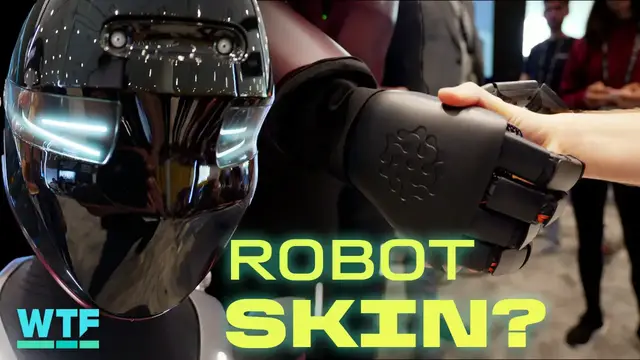
This humanoid robot uses touch-sensitive skin to better understand and respond to the world around it.
Show More Show Less View Video Transcript
0:00
We're here at AMD's Advancing AI Conference with this brand new humanoid with something called
0:04
SmartSkin, which I've never seen before. I'm about to get a demo. Let's learn how it works together
0:09
Meet Gino-1, the new humanoid robot from Italian company Generative Bionics. On its arms are two different kinds of sensors, which can feel, touch, and detect when something
0:19
is nearby. These are time-of-flight sensors, which are constantly sending out invisible light
0:24
and measuring the time it takes for that light to bounce back and return to the sensor
0:28
They can detect nearby people and objects before they're even touching the robot
0:32
So here I'm putting my hand near the proximity sensor on the upper arm
0:36
and I'm going to move it out, out, out, and we're going to see just how far away I can get from the robot with it still sensing me
0:42
There's also a patch of black material on the robot's arm that feels kind of like a neoprene wetsuit
0:48
That's where the smart skin is on this model. And it can tell exactly where the robot is being touched and how much pressure is being applied
0:55
All right, and now we're squeezing on, off, on, off, on off on off And you can also it shows whether I squeezing on the top or the bottom You can see on screen that it detecting the difference
1:11
And there's also, the blue is darker where I'm pressing harder and
1:15
lighter where I'm pressing more gently. So the idea is that this smart skin and
1:20
these proximity sensors will help people work more safely with the robots
1:23
depending on whether they're in a hospital or an industrial setting, doing some kind of manufacturing or logistics work
1:30
We see GENIO1 as a platform. It means modular mechanics and software
1:36
from which we can derive application-specific humanoid robots for the different verticals
1:42
While some robot companies are working toward a more general-purpose humanoid robot
1:46
Generative Bionics plans to customize their robots for different use cases. In this version, the smart skin is on the robot's arm
1:52
but depending on the needs of future clients, the smart skin could show up in different places
1:56
to serve different functions. We are thinking, for instance, in the hospital
2:00
it's going to be really important to have the skin on the chest and also on the forearm
2:05
because if elderly want to grab the robot the robot has to feel the touch Or if they want to hug the robot the robot has to be capable of feeling this hug The company is also utilizing AI not only in the robot movements
2:18
but also in the design of the robot itself. We do not design the systems by human intervention
2:26
but we have basically AI modules that generate also physics, mechanics and control at the same time
2:33
So our modules, like our Generative Physical AI, takes into account the customer KPIs
2:39
and then we generate for them a specific human robots. The company says its target price for its robots are between 50,000 to 70,000 euros, depending on their use case
2:49
So right now we are evolving towards what we call the 1.1 Genie, which is going to be ready by the end of the year
2:57
Because I've seen too many sci-fi movies, I also like to ask where's the emergency stop button on these robots just in case
3:03
We still have the red button but let me tell you that safety is going to be handled in human robotics and physical life is an issue If for instance a robot understands that he has to be has to shut down the way it falls has to be controlled because if you have a child in front of you you have to somehow reserve the
3:24
amount of compute that you need and also you have to act electronically so that that motion is going
3:31
to be controlled. So the red buttons are going to be there but we are also working at the new standards
3:37
in order to understand how these robots had to somehow go to sleep
3:41
Speaking of safety, you may notice the robot reacting to a hand near its proximity sensors
3:46
or to someone touching its smart skin. Because we're at a conference with all these people around
3:50
these interactions are being triggered remotely for safety reasons. I don't think I've ever seen a robot acting autonomously at a conference around people
3:58
Autonomous demos are usually conducted behind a physical barrier, and almost every interactive demo I've seen at events like this has been remotely operated
4:05
Perhaps someday we'll see robots autonomously moving around and interacting with strangers
4:09
but the technology isn't ready for that right now. But hey, maybe smart skin sensors will help robots get there
#Celebrities & Entertainment News