Up next in 10



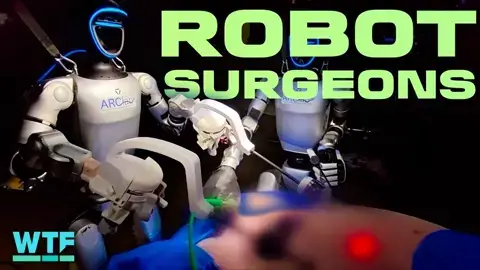
We visit UCSD's Center for the Future of Surgery to see how humanoid robots are taking on live surgical procedures.
Show More Show Less View Video Transcript
0:00
This is how surgeons train for live surgeries with humanoid robots
0:04
Let's see how bad I am at this. I'm here with Surgy, the first ever humanoid robot to perform a live surgery
0:11
But why? We're about to get a demo of how specialized doctors can control one of these robots
0:16
to perhaps someday help people in remote places access medical care they otherwise wouldn't be able to
0:21
I've noticed since starting this project, you get a lot of questions from the public
0:25
from other researchers or patients about does this mean that AI and the robot is going to do
0:33
surgery for us? Does that mean the doctors and surgeons are disappearing? We simply wanted to
0:37
find a way to bring high precision robotics down to the level that everybody had to have access to
0:44
and the humanoid robot was just such an attractive feature where it integrates well into the existing
0:49
workflow that we thought was a good opportunity. We're here at UC San Diego's Center for the
0:54
future of surgery to actually meet the doctors who tele-operated those humanoid robots for this
0:58
very special surgery. In a first-of-its-kind procedure, an experienced surgeon tele-operated surgery to remove the gallbladder in a live pig. A second surgery utilized two humanoid robots
1:08
working together to perform the same procedure. Tens of thousands of surgeons already at a deficit
1:13
and that's only growing. You can't train more so we need to be able to expand our influence. Dr
1:18
Broderick, who tele-operated one of the humanoid robots during both surgeries, told me these
1:23
pressures on the medical system are due to aging populations growing faster than
1:27
the rate at which surgeons can be trained to meet the rising demand. Surgical
1:31
robots have been in use for decades and some surgeons prefer to use them in certain procedures for finer control and precision But these machines can be quite expensive and not every hospital is equipped with them My hope is that the humanoid robots will be able to bridge some of those gaps
1:48
so that we can bring it to more people in the world. Researchers performed the surgery with Unitree G1 robots
1:54
adapted for the operating room, which came with some unique challenges. The robot we use is actually like a child
1:59
It doesn't have enough arm span to have enough work space to operate these instruments
2:08
Sometimes it cannot reach the target area, so we need to carefully examine where is the best docking place for the humanoids before the surgery
2:15
Getting the robot in the right position is just the beginning. Teleoperating these robots requires dedicated training
2:21
So this is one of the teleoperation rigs that doctors use to train how to use these robots in surgery
2:26
As you can see, there's a puzzle game set up right here where the objective is to lift one of these little blocks off of these pegs and put them onto another one
2:34
And they also have some rings to practice with as well. These tools right here are what the doctors would actually be using with their hands normally
2:41
but they've set it up so that what the doctor does on the teleoperation rig, the robot does over here
2:46
After trying my hands at teleoperated surgery, I'm not sure I'm cut out for it
2:50
This is the hardest I've ever focused on anything and still been very ineffective
2:59
Part of the reason researchers felt it necessary to demonstrate these robots with a live surgery at this stage
3:04
is because live surgeries are able to test technology in ways that training games like this and non tissue tests cannot Whenever you have a live specimen you going to have breathing and changes in mechanics with that For this robot in particular that was very important because everything that we see as
3:22
far as tracking port placement relies on visual information. So with whenever the pig was taking
3:28
a breath, that changed a little bit of how the robot was positioned relative to its working space
3:34
The second component is anytime you have tissue that has blood flow or perfusion, as we say
3:39
that tissue is going to behave a little bit differently. The first surgery involved a single humanoid robot working with a human assistant
3:47
and the second test surgery used two humanoid robots, one in the role of surgeon and another in the role of assistant
3:53
By the second surgery, we were doing a lot faster, the amount of collisions and stoppages that we had to do or less
4:00
Even with improvement in speed on the second procedure, these robot surgeries took longer than average human surgeries of similar type
4:06
This is partly because these humanoid robots are being put to use in an entirely new way for the first time
4:11
Shoulder joints often overheats during the surgery and it can only last for like 20 minutes
4:19
So after that we have to like manually pull down like place the ice packs on the shoulder to pull it down
4:26
And while autonomous controls are not in the works yet, that doesn't mean there isn't a possibility for some level of autonomy down the road
4:32
And that particular road could look a lot like the one being forged by self-driving cars
4:37
In autonomous driving, we started with anti-lock braking. And that's autonomous in some degree because it's alleviating your need to do emergency braking
4:48
Then we had lane steering and autonomous braking when a collision is going to occur So we can see the same kind of autonomy being applied in robotic surgery where if there is a challenging anatomy
5:00
or a sensitive anatomy that you're going to collide with, that the robot, you know, prevents
5:05
you from doing that collision. And we can stage that up more towards assistive tasks
5:10
and then furthermore, eventually, you know, some end-to-end procedures. While the proof of concept was successful, the pigs from these procedures did not go into recovery
5:19
and were euthanized afterwards. CFS told us it tries to minimize the use of animal models and studies
5:25
but animal testing can be an important step in developing new surgical practices before their use in humans
5:31
Despite the completion of these first-of-their-kind procedures, there's still several challenges that need to be overcome
5:36
before this type of technology becomes useful in surgeries on people. For example, the robots used in these procedures
5:42
couldn't be properly sterilized the way surgical tools need to be. There's also the previously mentioned overheating issues
5:48
and their battery life isn't long enough for longer procedures. The team developing these humanoid surgical robots hopes that with the right technology and safety measures in place
5:57
robots like Surgy could help expand access to necessary care. I don't think I'm training a robot to take me out of the job
6:04
I think what I'm doing is expanding my influence. You could potentially have a master surgeon that could do significant portions of multiple procedures
6:15
back to back to back to back without having to be in one location
6:19
And that brings minimally invasive laparoscopic robotic surgery to places that might not have it now
6:24
What do you think of humanoid robots in the operating room? Let us know down in the comments
6:28
And it's MedTech month here on What the Future, so subscribe for more stories about the future of medicine
Celebrities & Entertainment News