Up next in 10



Inside the ocean's version of the International Space Station
Show More Show Less View Video Transcript
0:00
We're in a submarine at the Deep Campus, the company on a mission to get people to live underwater
0:06
for months at a time, by the end of this decade, in one of these habitats
0:12
We'll take you underwater in a submarine to see where the habitats will first be tested
0:17
then we'll go inside Sentinel, one of the two habitats Deep is currently developing
0:22
and explore the history of the technology as well as what it could mean for the future of deep sea
0:27
exploration. This small lake is actually an old limestone quarry near Bristol in the UK
0:34
which naturally filled in with water. The limestone filters and clears the water
0:39
making it easy to see beneath the surface. However, once you dive in, it gets pretty dark
0:44
pretty quickly. As light disappears, so do a lot of primary colors, which is why our faces look like
0:51
this. We submerged to the lake's deepest point, which is 80 meters. It's not much, but the
0:59
environment this far down is so devoid of light that it resembles the ocean floor, a perfect spot
1:05
for the company to test its deep sea habitats. It's controlled water, so absent lightning you
1:10
can use this year-round. Without this we would have to rely on going to the open ocean and to a
1:16
harbor. But when you have serious sea states and high waves, they'll say, no dive day. So we want
1:21
to be in control of that product development timeline. So this is where we do a lot of that
1:26
work. Though deep scientists and divers submerged regularly, practicing diving around the lake's
1:31
floor and collecting objects there, underwater habitat testing is the future plan. At the moment
1:37
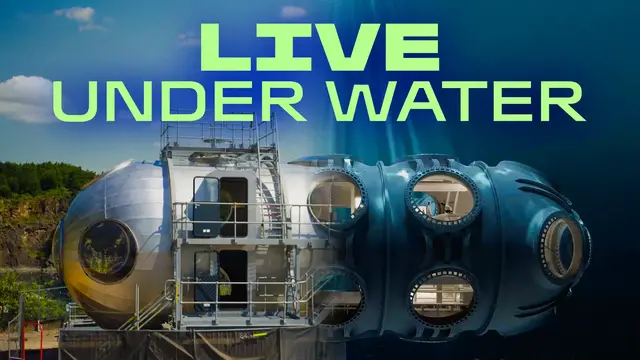
the company first habitat called Sentinel still sits on dry land So in our kind of primary layout that we often describe You have the great hall here You have your staircase that comes up and you have a dry lab So you have different lab equipment that coming through here so as you kind of did your work out in the water you bring it back you can go through some sampling sequencing whatever it might be
1:58
You always have connectivity to your colleagues in the bricks and mortar, so we'd have a Starlink communications buoy that would be connected at the surface, and again, allow you to kind of collaborate
2:07
You can do your zoom and kind of share these findings. And then in that setup, you'd be walking down a hallway here and you'd have
2:15
accommodations, so single bunks on each side. And that's important. Soundproof rooms, because everyone needs their private time
2:24
The history of deep sea habitats can be traced back to the 1960s and Captain
2:30
Jacques Cousteau's pioneering project Continental Shelf Station, or Con Shelf. In 1962, he designed the first continental shelf station called Con Shelf 1, a cabin
2:43
with compressed air where two divers lived 35 feet deep for 69 hours
2:49
And though technology has changed a lot in the 60 years since, Kusta's work has made
2:53
projects like DEEP possible in the first place. But when you look at those, whilst they were a massive leap in terms of humans' capabilities
3:01
to operate and have a permanent presence subsea, they were quite limited
3:07
The last habitat that was built was in 1986. That's a long time ago. I like to think that humans have gotten a bit smarter
3:14
when it comes to engineering, a bit better with technology. If you look at how deep habitats are built
3:20
you'll see exactly how far the technology has come. The key element is that they're modular
3:25
Think like Legos. So when you see the renderings you see these giant apertures two meters wide in diameter Those are also the connected points In situ which means that when it deployed beneath the surface of the ocean you can reconfigure that top deck
3:39
You can turn it into a lab, a communications hub, a meeting room
3:43
whatever you'd like to do. The habitats are also 3D printed. Conventional manufacturing techniques are subtractive
3:51
You take a large block of metal and you break it down. Energy intensive, very wasteful
3:55
With additive manufacturing, you're building it up. Importantly as well, is you're able to go and work with novel shapes
4:02
That's allowed us to unlock this unique shape of Sentinel. To 3D print their habitats, Deep use a team of six robots, or a HEX bot
4:11
And while usually 3D printing robots will be fixed in one place, the HEX bot moves around
4:16
Which, Sean says, makes the manufacturing process more flexible. Sentinel is meant to be the ocean's version of the International Space Station
4:25
allowing scientists to do all their fieldwork underwater. There's a ton of science that gets unlocked once we're able to live undersea
4:32
Things like restoration efforts, coral restoration, especially if you're thinking about deeper types of coral restoration projects
4:40
other types of species restoration in areas where different species have been decimated
4:44
because of changes to the ocean. And so now thinking about being able to process samples
4:50
And being able to see that sample in situ, like in that environment that it's meant to be in
4:57
instead of looking at the sample after you brought it up from being under pressure
5:01
and there's a long period of time before it gets to the place where it needs to be yzed, is really exciting
5:05
And I think it's going to really open up our eyes to how humans are responding to that environment in real time
5:11
And then also some of the changes or some of the different signatures that are associated with those animals or different species that live subsea The ocean covers nearly 70 of Earth surface Yet humans have only explored a tiny fraction of it
5:26
And a study from early 2025 suggests that humans actually have come to know as little as 0.001
5:34
of the ocean floor. Besides the technological restrictions the deep is trying to overcome
5:40
the company says its work is also about getting the next generation excited about the ocean
5:46
So you go back to the 60s and 70s, you had both interspace, which is what we call the ocean
5:51
and outer space, both on the ascendancy in terms of that innovation, that access and really kind of bringing technology to the forefront
5:57
and human exploration and drive was there. Then you saw a few decades where they both kind of calmed down
6:04
But then around 2000, again, November 2000, when the International Space Station went up
6:08
You start to see space kind of go up on the ascendancy. You haven't seen a pickup in investment so much in the ocean
6:14
And we could do so in terms of bringing that cohort, the K-12 up to the university level
6:20
to want to study marine science, to want to study marine engineering, to want to explore
6:26
We have this fascination with getting off of our planet, yet we have this alien world here
6:32
We really want to open up this ability to live undersea to everyone, right
6:36
not just to researchers, not just to, you know, explorers or folks that are working in the military
6:41
or commercial diving industry. We want other people to be able to experience that and understand what that environment looks like
6:46
and really become attached to it and have that human consciousness that's associated with the ocean
6:53
Would you live in one of those habitats? And do you think access to the deep ocean should be democratized
7:00
Let us know in the comments. Yeah
Celebrities & Entertainment News
Ecology & Environment
Engineering & Technology