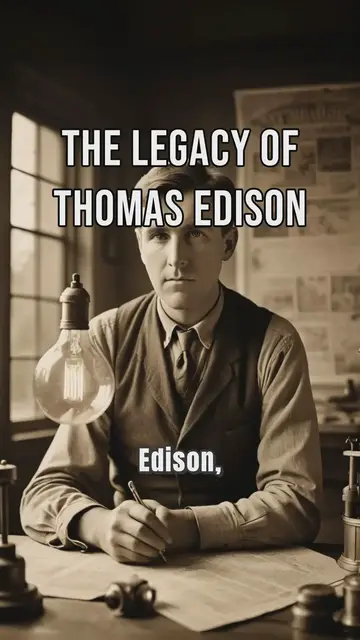

The Legacy of Thomas Edison
Dec 31, 2024

Thomas Alva Edison, born in 1847, was a prolific inventor with over 1,000 patents, including the phonograph and the practical incandescent light bulb. His work revolutionized daily life and laid the groundwork for modern electric power distribution. Despite facing competition from Tesla and Westinghouse, Edison's relentless work ethic and innovative approach set new standards for inventors. He passed away in 1931, leaving a lasting legacy in technology and society.
#innovation #invention #Edison #technology #history
Thomas Alva Edison, born on February 11, 1847, in Milan, Ohio, was one of the most prolific inventors in history.
His inventions had a profound impact on modern life, and he was credited with over 1,000 patents.
Edison was not only a skilled inventor but also a successful entrepreneur, forming several successful companies, including General Electric, which remains one of the largest publicly traded companies in the world.
Edison's early life was marked by curiosity and a strong propensity for learning, although he had only three months of formal schooling.
He was largely self-educated and read voraciously.
His interest in telegraphy, after a stint working as a telegraph operator, led him to many of his early inventions.
One of his most notable inventions was the phonograph in 1877, which revolutionized the way people consumed music.
Following closely was the improvement of the incandescent light bulb, which he patented in 1879.
While not the first to invent the light bulb, Edison's version was the first practical and long-lasting variant, significantly impacting daily life by extending the hours people could work and play.
Edison's work ethic was legendary, often working long hours in his lab, Menlo Park, which was dubbed an 'invention factory.'
There, he and his team developed many devices that cemented his legacy.
In addition to the phonograph and light bulb, Edison invented the motion picture camera, leading to the birth of the film industry.
His team also worked on the development of the electric power distribution system, making it possible to bring electricity to homes and businesses.
Despite his many achievements, Edison faced significant challenges and competition, most notably from Nikola Tesla and George Westinghouse during the 'War of Currents' over whether direct current (DC) or alternating current (AC) would become the standard for electric power.
Ultimately, alternating current, championed by Tesla and Westinghouse, became the standard, but Edison's contributions to electric power distribution remain invaluable.
Edison held a philosophy of practical application over theory.
He famously said, 'Genius is one percent inspiration and ninety-nine percent perspiration.'
His impact on modern civilization extends beyond his inventions.
Edison's approach to innovation and his establishment of an organized research facility set new standards for future inventors and industries.
Thomas Edison passed away on October 18, 1931, in West Orange, New Jersey, but his legacy lives on through his contributions to technology and society.
His life serves as an inspiring example of how creativity, ingenuity, and relentless determination can lead to monumental achievements that transform the world.
Introduce the life and achievement of Thomas Edison
Show More Show Less