Up next in 10



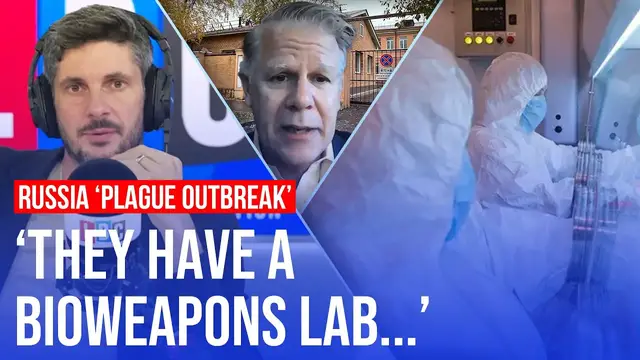
Russian authorities say they have quarantined a hospital and are monitoring contacts of an employee from a plague research institute in Siberia who contracted pneumonia from an "unknown" cause.
They say they have found no evidence her illness was caused by any of the pathogens she worked with, but media reports suggest she may have died of pneumonic plague.
Darya Shipilova, 28, worked at the Irkutsk Anti-Plague Research Institute of Siberia and the Far East in Irkutsk, south-eastern Siberia.
Tom Swarbrick speaks to Major General Dr Paul Friedrichs, Former Director of the White House Office of Pandemic Preparedness and Response Policy.
#tomswarbrick #plague #russia #pandemic #pandemic #worldnews #outbreak #lbc
LBC is the home of live debate around news and current affairs in the UK.
Join in the conversation and listen at https://www.lbc.co.uk/
Sign up to LBC's weekly newsletter here: https://l-bc.co/signup
Show More Show Less View Video Transcript
0:00
It's being reported that a second person has died following a lab leak of what is likely to be the
0:06
pneumonic plague at a research institute in Siberia. Hundreds of people that had come into
0:13
contact with Daria Sheplova, 28, who worked at the lab, had been placed in quarantine after it was
0:19
said that she had accidentally broken a test tube holding live bacteria at the Iqqutsk Anti-Plague
0:26
Institute in Siberia. The President of the United States says they are watching the situation
0:32
carefully. Major General Dr Paul Friedrichs is Senior Biopreparedness Fellow at the RAND
0:39
Research Institute and a former Director of the White House Office of Pandemic Preparedness and
0:44
Response Policy. Very good to see you, Major General. Thank you very much indeed for coming on. Can I get, please, your reaction to when you heard that this story had broken first? Plague
0:54
broken lab bottle, someone dead. So thanks, Tom, for inviting me. And my first reaction was
1:01
human error continues to be the most common cause of something going wrong in any lab like this
1:08
And so that is a plausible explanation that a worker doing public health research
1:16
made a mistake and unfortunately became infected and died. And I think many of us would have
1:22
accepted that if the Russians had been able to tell the same story twice in a row. But they have
1:28
muddied the waters repeatedly with conflicting statements. And now, as you said, there's a report
1:35
unconfirmed of a potential second case. I think what we know for a fact is that this lab has been
1:41
there since 1935. It has done research on a variety of organisms that cause infections in Siberia
1:49
Those are things that we've known for many years. We know that this lab worker died, and that's very unfortunate
1:59
Beyond that there a lot of uncertainty We heard reports of up to 200 people being quarantined not entirely inappropriate in a case like this if you not sure what going on But what really puzzling is if this is plague it can be treated with antibiotics
2:15
And the Russians have made no mention of doing so. If this is not plague, what is it? And the
2:22
Russians have not been forthcoming about that either. So I think, you know, that we could put
2:27
all of this to rest very quickly if the Russians were more forthcoming, as any responsible country
2:34
should be. There must be a way of sharing details of what this is. Presumably, it has been sequenced
2:42
in the people that have sadly either got it or died from it or both, that allows the rest of the
2:46
world to see what this is, whether it's novel or whether it's known. So you're exactly right that
2:52
if the lab or the hospital where the person who died was able to obtain a specimen from her and
3:02
culture some organism, by this point in time, they should have been able to sequence it
3:07
Now, there is a rare chance, and I've seen this personally in my career, that indeed there can be
3:12
a very serious pneumonia in which we never actually are able to culture the organism that caused it
3:19
I've seen that once in 40 years. So it is remotely possible once in 40 years, taking care of thousands of patients, that that could happen
3:28
But it really does stretch the limits of plausibility to insist that that's the case
3:35
And this is where the Russians should be accepting the offers of help or they should be posting the results of the tests that they've run
3:42
obviously people's senses around this are heightened by what happened in Wuhan
3:49
some six odd years ago when it was quite it took quite a long time so I remember rightly for the
3:55
Chinese government to be able to give information about the novel flu that they thought was causing
4:03
damage to people lungs that were spreading around people and killing people are we in a similar situation Well we in a similar situation from the standpoint of transparency and openness
4:14
I do not think that we're on the verge of another pandemic here, unless the Russians are very
4:20
successfully concealing something that's radically different than anything that's been reported so
4:25
far. We're not on the verge of another pandemic. And, you know, the concern that you describe is
4:33
one that is very understandable. Almost all of us have lived through that COVID pandemic
4:39
Again, if this is plague, we have very good antibiotics that can treat it. If this is not
4:45
plague and it were spreading rapidly through the population there in Irkutsk, we would expect to
4:51
have seen more reports about that by now. And there's airlines that fly from Irkutsk that go
4:57
all over that part of the world. We have not seen any reports of similar cases anywhere else
5:03
So I think, you know, for people who are saying we're on the verge of a pandemic, I would love to understand the logic behind that. But for your listeners right now, I think the most important point is that we don't seem to be on the verge of a pandemic
5:16
Why are various institutions, there will be a better phrase than this, Major General, but why are various institutions playing around with vials of the Black Death
5:26
so it turns out that there's about 2 000 people a year who still die of plague around the world
5:35
and of those about 15 die of this particular version which is the most serious version
5:42
and the reason that researchers continue to play around with it to use your terms
5:47
is we want to find better treatments uh we want to find better tests uh this is one of the great
5:53
things that new technologies allow us to do is to continue to try and find more effective
5:59
and safer ways to treat known problems that have afflicted mankind, like with the plague
6:06
for centuries. So there is a responsible reason for doing research on how to better protect people from known health problems and there a right way to do it it does not appear no quite certainly if someone has died
6:20
as a result if uh in the next few days major general it emerges that um to borrow uh
6:27
some of the covid language as it were if a fury and cleavage had been inserted into the uh to the
6:33
virus that was left, you know, if this had been in some way modified by humans, how much more
6:39
worried would you be? Well, look, we've had reporting the United States State Department
6:46
under the Trump administration last year put out a compliance report which said that they were
6:51
concerned that the Russians continue to be working on an offensive bioweapons program
6:56
There's ample indication that the Russians have had a bioweapons program since the 1920s
7:02
that is a true statement. And if we were to find some indication of that, that would be very
7:09
concerning. I think that all the evidence that we have so far, though, does not point in that
7:15
direction. And what I would encourage everyone, including those who are speculating about this to
7:25
do, is to continue to be very clear about what we know to be true and what we don't yet know
7:30
We don't yet know exactly what this pathogen is. We could put that to rest immediately if President Trump or any other leader called Putin and said, tell us what you got. That has not happened yet. And that could put this whole issue to bed quickly if that discussion happened. Absent that, we're going to have to wait for the dribs and drabs of information and continue to pressure the Russians to be more forthcoming
7:55
really appreciate your time thank you very much indeed for coming on major general to paul
7:59
dr paul friedrichs is senior bio preparedness fellow at the rand research institute former
8:04
director of the white house office of pandemic preparedness and response policy so don't worry
8:08
should be fine i think we know what this is but we don't yet know what this is because no one
8:13
the russians aren't saying you worried a bit
news