Up next in 10



Is Britain prepared for an increasingly dangerous world and what happens if the UK can no longer rely on the United States?
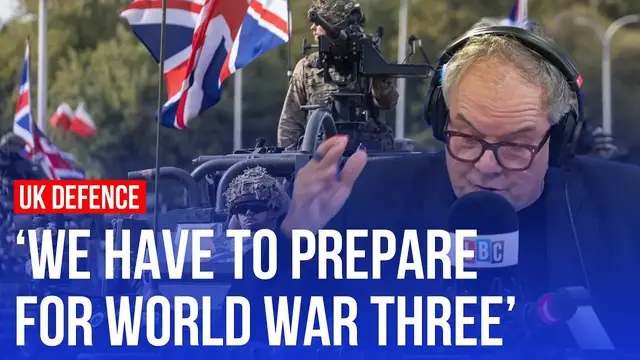
Lieutenant Colonel Stuart Crawford, former British Army officer and defence analyst, warns that while he does not believe the world is on the brink of World War Three, Britain must prepare for the possibility of a major conflict if it wants to maintain peace.
Alicia Kearns, Shadow Minister for National Security & Foreign Affairs, then joins the discussion to examine Britain's support for Ukraine, Donald Trump's approach to Russia and the prospect of the US shifting its focus away from Europe.
She warns that Britain must prepare for a future in which American priorities may no longer align with its own, while strengthening its relationships with NATO and European allies.
00:00 | Is the world becoming more dangerous?
03:30 | Is the Defence Secretary the right person for the job?
06:25 | Whose side is Donald Trump really on?
08:58 | Could China invade Taiwan?
10:30 | What if US and British interests no longer align?
13:50 | Is NATO still strong enough to protect Britain?
Listen to the full show on the all-new LBC App: https://app.af.lbc.co.uk/btnc/thenewlbcapp
#mattfrei #ukdefence #britisharmy #ukpolitics #uknews #donaldtrump #trump #wesstreeting #nato #ukraine #zelenskyy #russiaukrainewar #putin #news #war #defencespending #budget #LBC
LBC is the home of live debate around news and current affairs in the UK.
Join in the conversation and listen at https://www.lbc.co.uk/
Sign up to LBC's weekly newsletter here: https://l-bc.co/signup
Show More Show Less View Video Transcript
0:00
Drone technology is helping Gulf states protect itself against Iran
0:03
Chinese and Russian technology is helping Iran fight America. North Korean soldiers are fighting for Moscow and eastern Ukraine
0:12
President Trump continues to threaten Greenland and Canada. No, this is not World War III yet
0:17
but it is a world increasingly at war and across continents. Are we at all prepared
0:24
Let's bring in Lieutenant Colonel Stuart Crawford, former British Army officer and prominent defence yst
0:29
Good morning, Lieutenant Colonel. Good morning, good morning. I mean, that was a fairly grim assessment of the world as it is
0:36
but I think we are, it seems to me, as if we're in the foothills of something quite serious
0:41
Well, I don't think there's any doubt that the world is a more dangerous price
0:45
and all the aspects which you have just listed are very real
0:52
I'm an optimist. I don't think we're on the brink of World War III
0:56
But I think that we have to prepare for World War III
1:01
And if I could remember the old Latin saying, I would repeat it
1:06
But we've got to be ready for war if we want to maintain peace. Right. But that's the tricky one, isn't it
1:11
Because for a government to tell its people, and let's face it, this is a country that, you know, with a few blips
1:17
has lived in peace and relative prosperity for decades, to tell this country that they have to get ready for something
1:25
in order to avoid it happening is a very, very difficult argument
1:28
for a politician who's already got very little money to make. Absolutely. Everything tends to come back to funding in the end
1:37
And we live with a government which seems unable or perhaps unwilling
1:43
to realistically fund our armed forces. I'm constantly reminded that the welfare budget, annual budget
1:52
is six times that of the defence budget. and I think the balance there is wrong and something has to give
1:58
We'll find out when John Healy brings his budget to Parliament on the 28th of this month
2:06
And I think some radical changes need to be made, but I don't think they're going to touch the welfare budget
2:12
and I don't think the defence budget is going to get the uplift
2:16
that it needs quickly enough. And it's ironic since John Healy, the current Chancellor of Exchequer
2:21
resigned as Defence Secretary over precisely the issue that you've just outlined
2:25
But it's more than just about spending more money on defence or even economic growth through bombs
2:32
which is kind of what the government seems to be, the manufacturing of bombs, which is what the government seems to be advocating
2:37
But it's also about the mindset, isn't it? How do you prepare a nation like ours for something
2:43
you know, for the worst case scenario that none of us hope will ever happen? Well, it's very difficult
2:48
And I think that the recent poll, I can't remember who carried it out
2:52
indicated that less than 50% of the population would be prepared to fight for the UK should push
3:00
come to shove. I would just say that is an easy thing to say in the abstract and probably a more
3:07
difficult thing to say if your family home has just been flattened or your friends and family
3:13
have been killed by some sort of attack. So I think that we're not close enough to the reality
3:19
yet for people to react in the appropriate manner. But I have no doubt that if we do end up in war
3:27
which I sincerely hope we never do again, that the population will rise to the occasion
3:32
Okay, but that is quite a hope, isn't it? And rising to the occasion is something that we've done
3:35
in the past and we may have to do it again But if you can rise to the occasion with a degree of preparedness that occasion will be a more pleasant experience than otherwise I just wonder whether you think that West Streeting the former health secretary who now the defence secretary
3:50
is the right person for this job at this time? Well, the answer to that is no, with no disrespect to him as an individual. But I can't think of
4:00
anybody who is the appropriate person to fill the job of defence secretary in any political party
4:08
And that is the conundrum. Where do we find the right person for the right hour amongst the
4:15
political community? And I can't think of anybody at all. But he is a good communicator. The Prime
4:22
Minister is a very good communicator. Between them, they might be able to send the message that
4:27
you want to hear? Well, absolutely. And I think that General Sir Raleigh Walker's address
4:33
to the Caterhick troops earlier this week was quite an interesting one
4:38
The service chiefs have, as well-known fact, have been muzzled by Number 10 Downing Street
4:42
and have allowed themselves to be infantilised and demeaned in this way for a considerable time
4:50
Walker was let off the leash, I think, in Caterhick. There's no doubt that his address to the troops
4:55
was cleared by 10 Downing Street. But he drifted into what one might say
5:02
is political propaganda by not only telling the troops they might be required
5:06
which is absolutely the right thing for him to do, but also to issue this sort of call to arms
5:11
to the citizenry in general, which I think is very odd. What extent should we, Britain
5:17
be prepared to support Ukraine financially, militarily, without the US, if the US decides, you know
5:24
more permanently to side with Russia on this. And the question of whether they are
5:28
I think, is a very open one, and it's a very opposite one. Let's speak to Alicia Kearns
5:34
Conservative Member of Parliament for Rutland and Stanford and Shadow Minister for National Security and Foreign Affairs
5:40
Alicia, it's good to have you on the programme. Thanks for having me. I mean, we're in a bit of a quandary, aren't we
5:45
Because on one hand, there are questions about, you know, whose side Trump is on
5:51
And, you know, you talk to European leaders and they will quietly tell you that they now think, based on all the evidence before them, that he is more on Russia's side than he's on Ukraine's side
6:01
plus the stuff that he's been saying quite publicly. Then you have a potential military conflict here where the Ukrainians are attacking the refineries in Russia
6:12
that Trump thinks he's relying on in order to lower the price of diesel
6:17
And some of that may be done with our military help or with weapons that we supply
6:22
I mean, this is a real fix for us, isn't it? How do we get out of it
6:27
It is an enormous fix. And I think some people think it's just some distant question of geopolitics
6:32
But as you said, this is about cost of living. And of course, it's about our security. I think when it comes to President Trump
6:37
we have to recognise that ultimately he's on the side of whatever deal he thinks he can do and the place that puts him in the record books
6:44
And I think that's really fundamentally where he comes down. When it comes to the energy ceasefire
6:49
I have been very clear that it is a complete and utter sham. I mean, the idea that this is about
6:54
anything other than protecting Russia's oil refineries is a nonsense, because all but one
6:58
of Ukraine's oil refineries have already been destroyed. Russia wants to make sure that it's
7:03
art so it can keep doing deals with China, Iran, and now obviously the US. But the reality is
7:08
the risk is that the continued attacks on Ukraine's power grid, and that means that
7:13
they're not having water for many hours a day, even their bigger cities, electricity, sewage are
7:17
all going down And there is a real risk of a serious health epidemic in Ukraine this winter Right But just again you know the question again perhaps in a slightly different way if the Russians are attacking Ukraine energy infrastructure and the Ukrainians are attacking Russian oil refineries and Trump has basically told Zelensky not to do that or else
7:41
where does that leave us we're supporting ukraine and we have a special relationship with washington
7:49
there's two sides there so there's words that leave us our priorities to therefore support
7:54
ukraine however we can and that means getting large-scale power generators out there so they
7:58
don't have a health crisis when it comes to trump it's about recognizing that regardless of who is
8:04
in the white house and who is in number 10 that relationship is enduring when i have gone to the
8:09
United States multiple times over the last few years as Foreign Affairs Committee chair and then
8:13
an opposition. It has been the UK that is most blunt with its allies. And we have to be that
8:18
voice. Andy Burnham can't be the voice of hope when it comes to Trump. He needs to recognise that
8:23
the UK alone has the ability to speak really frankly and honestly quite brutally to its
8:28
partners. And what happens if Trump turns out and says, well, I hear what you're saying, but I don't
8:33
care. And broadly, do you actually trust Trump, trust him to stick to a friendly word towards the
8:42
UK if he has one? Look, I have to trust that if we make the case and we make the case to him
8:48
repeatedly why this is in the US's best interest, that he will do what is right for the US. And we
8:53
know what is right for the US and Ukraine is the same as the UK. But we have a responsibility
8:57
therefore, to look at alternatives. I've often talked about the fact that there is the reality
9:01
of the fact that we are facing potentially an invasion of Taiwan next year. If that was to
9:06
happen, the US would shift its entire focus to the Indo-Pacific. So for about three years now
9:11
I've been warning that we need to be ready for if the US does move its entire focus from Ukraine
9:16
obviously with the Middle East at the moment, to the Indo-Pacific. And for us, that means focusing
9:21
on things like the Joint Expeditionary Force. That's our partners in the Baltics and the Nordics
9:25
making sure that we step up intelligence sharing, where the US is obviously currently withdrawing it
9:29
looking at how we can backfill. Now, because there aren't masses of Ukraine and any foreign
9:34
troops on the ground in Ukraine, the ability for us to step up and backfill is much better
9:40
than if, for example, we were in overt war, where, of course, not having the US with us
9:44
would be catastrophic. But your assumption is that the United States will put its attention
9:51
around Taiwan and Asia if the Chinese were to attack or blockade Taiwan. I wonder if that's
9:57
not an assumption too far, because in a world where, you know, might makes right, as Trump
10:02
and his advisers have repeatedly said, a world that is divided into hemispheres that, you know
10:07
the strong men control, Trump may not care about democracy and self-determination in Taiwan
10:13
But ultimately, again, but that is, again, the same conundrum for us, right? You know
10:19
if his interests and the interests of Washington at the moment, for another two years at least
10:25
do not align with our interests, where we are facing a real aggressor on European soil
10:32
And, you know, plus all the hybrid stuff that's going on with cables and everything else
10:37
You know, that puts us in a really, really difficult position where we have to make a choice that none of us want to make
10:43
You're absolutely right. And look, I often say this, there is nothing, without hope in optimism, foreign policy
10:49
you have no hope. But essentially you have to have an optimism, but you also be..
10:54
the strategy. No, no, but forgive me, that's where I'm getting to. So this was exactly my point about David Cameron and his approach on China You can be optimistic and hopeful that China will turn to us that China won invade Taiwan But you have to have a pragmatic protective process in place to protect
11:10
yourself and your interests at the same time for if your aspirations and hopes fall apart. And that's
11:16
what we're not seeing at the moment. We need a radical approach at home where we educate the
11:20
public about the threats that we face. For the last two decades, people have said to our country
11:25
don't you worry your heads about national security and foreign policy. That's all for the politicians
11:30
for diplomats to deal with. That is not the case. And when I go to the Baltics and the Nordic
11:34
countries, every citizen recognises their responsibility. So the number one thing, if we want to be prepared for wherever Trump goes or whatever happens in China
11:42
is getting our public educated on threat and recognising their responsibilities. And the
11:47
second, as I said, is investing in relationships like the Joint Expeditionary Force, because our
11:52
Baltic and Nordic partners, they are very forward leading on defence. We have this new relationship
11:56
We need to expand it and see where else it can go. But let's also be honest, Alicia Kearns
12:01
the drawing down of the defence budgets of this country happened over decades under both Tory and Labour governments
12:08
Yes, and you will see that I have been outspoken since the day I was elected. And I think, as you know, when my party was in power
12:14
I think I gave them a pretty hard time. So I'm very clear on my record on this
12:18
and the need for us to do more. But now we are putting forward that. There has been a shift in Parliament
12:23
It's like when you look at China. I may have been clanging the bell of warning before I was an MP as far back as 2014
12:29
It took Parliament until 2020 to recognise the threat from China. And there has been a shift
12:34
We are now in the same place on defence where people are moving and recognising it
12:38
And we need to bring the public with us because, of course, we govern through consent
12:42
We police through consent. We defend through consent in this country. There is a shift
12:46
It takes time. I think I've been fortunate that I've been ahead of it on it. But I will keep fighting on it because we have to get this right
12:53
What about the Britannia shield, I think, as it's called, that Kemi Baden-Ock suggested during her party conference, a sort of iron dome for Britain
13:00
I mean, this is, you know, on paper, it sounds like a great idea, but it's not been taken very seriously because the amount of money it involves, the amount of technical expertise that's required, the time that's required simply isn't a realistic option
13:14
We think this is realistic and Kemi has set up very clearly funding, but this is about recognising the threats we face, which is interceptor missiles and drone attacks
13:23
And yes, it may be a decade long programme, but we need to govern when it comes to defence and security, as you well have argued many times in this programme, not from political cycle to political cycle, but in the long term
13:34
So, yes, we do need an up-to-date radar system. We do need to better tackle drones and missiles, because realistically, those are the kinetic threats we face
13:42
Although, as you know, I spend a lot of my time on what people want to call cyber attacks and hybrid attacks that we also face
13:49
Just finally and briefly, I mean, we're out of the European Union, although there may be moves to get back in again. The NATO alliance looks more brittle and frayed than it's ever looked, frankly. America's gone rogue. Russia's aggressive. China's overbearing. It feels pretty lonely on our island at the moment, doesn't it? We're without a gang
14:07
We don't think we're that gang. The European Union was never about defence or foreign policy, and they are completely unable to come to a united position on that
14:16
What I've always said from the very moment again that I was elected was we need a constellation of alliances
14:21
So AUKUS, the Joint Expeditionary Force, we need to look more at what Kanzek can do
14:26
NATO remains our front guard. It remains our foremost protection. And the reality is that NATO is still doing its job. And that is why we do not see NATO allies under attack
14:35
Russia will not cross that threshold because NATO remains firm. Even if because we're democracies, we're very transparent and the public discourse is very brittle, the realities of NATO remain strong
news