0:00
It's going okay. The Iran situation is going pretty good
0:03
Going pretty good, so says Donald Trump, the US President, Iran and the United States will hold more negotiations next week over Tehran's rapidly advancing nuclear program
0:12
Let's bring into the conversation Dr. Efrat Sofa, who is a security yst and chair of the Board of Advisors at the Esri Center for Iran and Gulf States Research
0:22
Thank you very much for joining us. Do we know what has been discussed at this particular meeting? Good morning
0:27
Good morning, Henry. Thank you so much for having me on. As far as we know, what has been discussed has been kind of the framework of the discussions going forward. As far as I understand, what has been agreed is that they will meet next Saturday again
0:44
I think what we need to watch here is where the positions are of Iran and the U.S. more than the content of the talks
0:54
I think symbolically the fact that the Iranians insisted that the talks not be direct, as in they would be sitting in different rooms
1:06
And only at the end did both parties kind of meet, leaving the meetings
1:15
It's interesting to see, though, where each side is coming from. I think the Iranian regime at the moment and we saw this in the New York Times reports that the Supreme Leader has given specific instructions to say anything that will
1:33
help to maintain the regime. The regime is on its knees at the moment. Its economy is flatlining
1:39
its own people want to overthrow the regime. And so the regime will say pretty much anything
1:46
to get it through. Now, that's important because the regime is more likely
1:54
to cross the nuclear threshold the more desperate it becomes. So that's why these talks are so important
2:01
And it's also important to watch the Iranians to see what they do
2:04
rather than what they say. How do you imagine the talks have gone down in both countries
2:10
Because clearly the fact that there were no photographs taken at the Iranian request I read, or the Iranian government's request
2:16
and they were in separate rooms. They only crossed over very briefly, as you say
2:20
when there was a mediator from Oman there. I mean, how will it go down in either country
2:26
Because I imagine hardliners on both sides just simply would not be happy with any talks
2:31
Exactly. I think, ironically, the hardliners at the moment in Iran are really encouraging the talks
2:39
because they see that this is a good opportunity for them to buy time
2:45
I'm pretty convinced that while these talks are going on, Iran is continuing with its nuclear program continuing to enrich uranium And so this is where the regime is seeing it I think they stopped you are correct they stopped the visuals from going forward
3:02
because the Iranian people themselves are very frustrated with the regime. And so that's where
3:08
the regime is very vulnerable. In the US, I think the US administration is seeing the danger that
3:16
Iran poses not only to Israel, but also to Europe and to the Gulf states, Oman, Saudi Arabia, the UAE
3:25
So both are seeing it from very different angles. It's going to be super interesting to see how it
3:30
develops. Now, the backdrop of this, we know that Donald Trump pulled the US out of the nuclear deal
3:36
during his first term, the 2015 nuclear deal. Well, that's due to expire this year. So imagine
3:41
they're trying to get a bit of a wiggle on when it comes to these talks. Yes, I think when we compare it to where the Iran nuclear deal was in 2018 when the US
3:52
exited, we need to see where we are today. Today, Iran has 16 times the amount of enriched uranium
3:58
that was permitted under the IAEA and under the Iran deal. So Iran has gone above and beyond
4:05
the threshold where it would have been allowed under any deal. And we can also see through Iran's use of ballistic missiles and drones
4:16
that Iran is nearer to being able to deliver a nuclear capability which is very very dangerous And so this is what we need to look at where we are now rather than where we were before And to see that Iran does
4:32
not become a nuclear power state, that would be very dangerous for the whole system
4:38
Lastly, how worried should we be about Iran's capabilities in terms of nuclear? I mean
4:43
I was reading, for example, on highly enriched uranium. The deal in 2015 allowed them to enrich 3.67% purity
4:52
And it turns out that they've got stockpiled uranium enriched to 60% and could move to 90%
4:58
I mean, they're not even holding to this deal at the moment. Exactly right. You're absolutely right
5:03
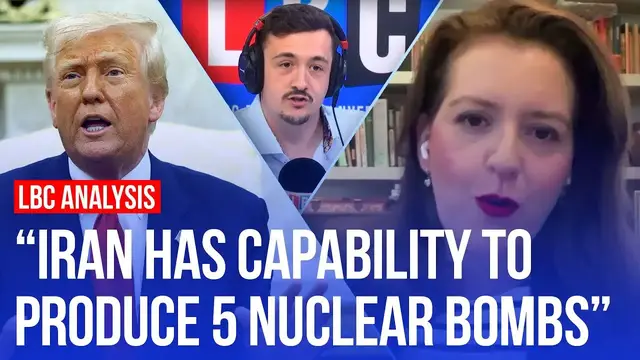
Iran's enriched uranium is at about the 60% mark. It has capability of producing about five to six nuclear bombs at the present time
5:14
And at some stage within the past few years, Iran did reach 82 to 83 percent of enriched uranium
5:22
So Iran is saying all sorts of niceties about reconciliation, but on the ground is very dangerous
5:29
And we need to look at that from the British perspective as well because of Iran's non-nuclear capability
5:37
What the IRGC, for example, and the Ministry of Intelligence has been doing in the UK to map out dissidents, to attack journalists in broad daylight is something that we need to keep a very close eye on