Up next in 10



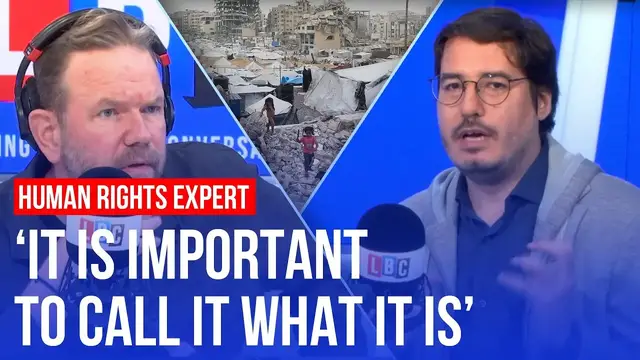
Dr. Alonso Gurmendi, a Fellow in Human Rights at LSE's Department of Sociology explains to James O'Brien why, in his view, Israel is committing a genocide in Gaza under international law.
Earlier this week, hundreds of UK-based and internationally qualified legal professionals, including former Supreme Court judges, signed an open letter urging the UK government to take decisive action to halt the violence in Gaza.
They warned "genocide is being perpetrated in Gaza" from Israel's blockade of food and aid and its new military offensive, which has killed hundreds of Palestinians there in the past fortnight.
Listen to the full show on the all-new LBC App: https://app.af.lbc.co.uk/btnc/thenewlbcapp
#jamesobrien #palestine #gaza #israel #LBC
LBC is the home of live debate around news and current affairs in the UK.
Join in the conversation and listen at https://www.lbc.co.uk/
Sign up to LBC’s weekly newsletter here: https://l-bc.co/signup
Show More Show Less View Video Transcript
0:00
And conscious though I am of how inflammatory this particular word is, and understandably and correctly so, we may have time to examine that element of the conversation shortly
0:09
But we will begin, Alonso, if we may, with what you describe as a consensus
0:14
What underpins this consensus now that the word is appropriate? Yeah, thank you for having me
0:20
And also, I'm a lawyer by training. I was one of the signatories of that letter. No, I realize that
0:23
Sorry, I should have said. No, it is important, I think, to call things what they are, I think
0:30
And there's a broader debate to have, and we can talk about it later. But I think what's important is to notice that genocide is a specific typified conduct
0:40
It's something that you do with a specific intent. And when that happens, it's important to call it that
0:46
And I think from the ysis that me and I think most of the people that study genocide have concluded
0:54
Israel has committed the conduct, and it has demonstrated expressly the intent to destroy the people of Palestine, of Gaza
1:01
So when you add those two, you get genocide. That's basically it
1:06
And it can be both remove and extinguish. It doesn't have to be kill
1:11
It can simply be... So one thing that is important to know is
1:15
technically, from the definition of genocide, you don't really need to kill anyone to commit genocide
1:19
Like, you can commit genocide just by transferring children from one group to another, and none of them die
1:24
So you're wiping out an identity, essentially. There is some debate as to what is the distinguishing factor
1:30
between ethnic cleansing and genocide. It's kind of a problem that was put in by the International Court of Justice
1:36
when it was dealing with Yugoslavia, the former Yugoslavia. But I think this idea that it is either ethnic cleansing or genocide
1:43
is not really very credible and not many people subscribe to it
1:48
Of course a campaign of ethnic cleansing can be genocidal if it committed with the intent to destroy the group And so if we had to put into two sentences what it is about the current blockade the latest blockade and the new military offensive that fulfills this criteria
2:03
in a way which those criteria were not being fulfilled necessarily, well, at all from the outset, what do we put in that box
2:13
Well, I think the clearest conduct, let's start with conduct and before we get into intent
2:19
the clearest conduct is the subjection of Palestinians in Gaza to conditions of life that will elicit their destruction as a group
2:27
They cannot exist as a group anymore in Gaza because there are no homes, there's no electricity
2:32
there's no hospitals, there's no universities, mosques are being blown out, entire neighborhoods are being flattened
2:37
not during hostilities, mind you, but when the hostilities end in controlled explosions
2:43
So I think that is the most clear act. Then there's also, of course, the disproportionate killing. I think even Israel's allies are concluding now that the killing of Palestinians in Gaza is completely disproportionate. It's done by AI software. It's done through kill zones. This idea that it is exclusively happening when there is someone underneath a hospital in a tunnel is not really true
3:06
And so there are more, but let's say those two things coupled with the continuous and throughout the entire hierarchy of Israel's state apparatus from head of state, ministers, military officers and soldiers, all repeating the same kind of language of there are no one involved civilians
3:30
We need to destroy the seat of Amalek from the world. And these are human animals. When you couple those two, you get a genocide
3:36
I mean for me that was an early stumbling point that the the likes of Smotrich and Ben Gavir and others in that administration were not even hiding their hopes that this kind of conduct would would occur And yet hoping for it doesn qualify as doing it
3:55
I mean, is it too crass to look for dates, to look for a pivotal point when a line was crossed
4:01
when genocide became applicable in ways that it hadn't been previously? I think we as humans are able to see when something is off
4:10
Didn't the Irish go there in February of 2024? I forget whether they used the word or whether they just ramped up the response to much higher levels than other Western countries had done at that
4:21
So I think the first one to say the word was Ras Segal
4:26
It was like 10 days after saying there was a textbook case of genocide
4:30
If you look at other genocides, it took Romeo Dallaire three days to send a letter to the United Nations saying there's going to be a genocide in Rwanda
4:39
Three days. He had a conversation with an informant on, I think, January 8th of 1994
4:46
And by January 11, he was warning the UN. The UN did not listen. And by April, there was a genocide
4:51
So it really, I don't think we should focus on like at what point
4:55
No, I know. But rather the whole process. This is important with like sharing isolated snippets of like the head of state or the head of government talking is also probably not enough
5:06
people say horrible things sometimes and that does not mean that a genocide is happening
5:10
But when you couple that with soldiers, with military officers, with the entire government saying the same things
5:16
over and over again repeatedly, then you need to start to listen. And these are the dots that you've joined together
5:21
in the film that you've posted on social media because there's a lot of moving parts to the argument
5:28
Why does it matter so much that this word, if indeed you think it does
5:32
I presume you do because you put so much work into justifying its use. Why does it matter so much that this incredibly inflammatory particularly for obvious reasons in the context of an Israeli government why does it matter so much that this word is in the vocabulary of public discourse Because I think it is important to accept that the international community
5:51
the global order that we have today, was pretty much born out of several genocides
5:56
The entire experience of colonialism was littered with genocides. And it took us until 1948 to sort of accept, yeah, this is a thing that happens
6:04
This is a thing that has happened in the past many times, not just during the Holocaust, but of course, during the Holocaust
6:10
and being in this situation where we know that genocide happens a lot
6:16
you cannot construct a definition of genocide that is continuously reduced in scope
6:23
The Balkan Wars were not a full genocide. Only Serbenica was a genocide
6:28
and with legal standards that now force us to try and reduce the amount of things
6:33
that we can call a genocide. That happens every time there's a genocide. There's people that try to narrow down the definition
6:39
so that their specific genocide is not a genocide. And every year or every genocide
6:44
we chip away a little bit of the word and a little bit of the word. And at the end of the day
6:47
if you have a definition of genocide that is so narrow that nothing is a genocide, arguably a lot of the Holocaust
6:53
would not even cover as a genocide because if genocide is only the systematic extermination of people
6:58
as of 1941 with the final solution, then Kristallnacht was not genocidal
7:02
And I fundamentally disagree with that. So we need a definition of genocide
7:07
that is workable, not designed from the perspective of how do I make this thing that we are committing that I don't want to be a genocide, not a genocide
7:14
and start looking at the whole process holistically, because genocide is an integral part of the history of the world
7:20
And this is, if you want to explore it further, exactly the subject of Alonso's video essay, which is on YouTube and indeed on Blue Sky, on his account, and indeed on mine
7:30
Thank you, Dr. Alonso Gomendi from the London School of Economics, Sociology Department
7:36
You also blog, I think, at Opinio Juris. Is that right? Yeah, I blog at Opinio Juris and I have a Twitch channel
Government
news
Human Rights & Liberties
Death & Tragedy
War & Conflict