Up next in 10



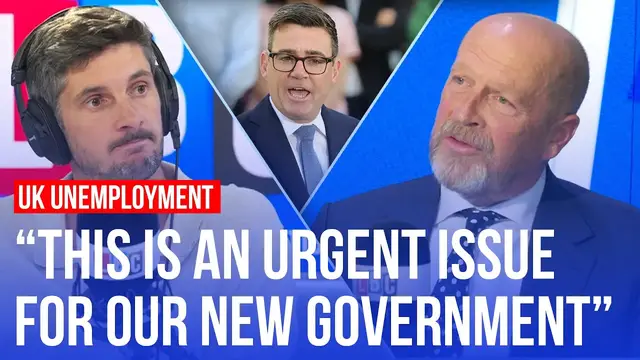
James Reed, CEO of Reed Recruitment joins Tom Swarbrick following the release of the latest ONS figures on unemployment and job vacancies. They discuss whether the new Prime Minister, Andy Burnham, can fix the UK economy. Figures showed there were 7,000 fewer vacancies in the three months to June at 712,000. Job vacancies have fallen back further as under-pressure small businesses rein in hiring in the face of rising costs and higher wage bills, according to official figures. The Office for National Statistics (ONS) said regular, average, wage growth in the private sector also fell below 3% for the first time since 2020, at 2.9% in the three months to May, down from an upwardly revised 3% in the previous three months. Listen to the full show on the all-new LBC App: https://app.af.lbc.co.uk/btnc/thenewlbcapp #TomSwarbrick #unemployment #youthempowerment #neetstrategy #jobvacancy #economy #LBC LBC is the home of live debate around news and current affairs in the UK. Join in the conversation and listen at https://www.lbc.co.uk/ Sign up to LBC’s weekly newsletter here: https://l-bc.co/signup
Show More Show Less View Video Transcript
0:00
There are now over 1 million young people in our country, not in education, employment or training
0:06
The jobs numbers are out and I'm here to tell you that employers cut the number of job vacancies last month
0:11
according to official figures that highlight the UK's, quote, fragile economic outlook amid the conflict in the Middle East
0:18
Job vacancies fell to 712,000. That is almost half the level in 2022
0:22
meantime the unemployment rate remained at the same level in may as in april at 4.9 percent but
0:30
the youth unemployment rate increased uh let us turn to jim reed james reed from uh reed.co.uk
0:37
one of the biggest recruiters in the world thank you very much indeed for coming on to the program
0:41
again um let's let's talk about these numbers first of all you're seeing job vacancies fall
0:45
you've told us before that the red light is flashing is it still yes i mean we've seen job
0:51
vacancies fall now for five years. As you said, the peak in 2022 feels a long time ago
0:57
And our vacancies are now down this year, year on year at read 12%. So we're still seeing that
1:03
And the official figures today confirm that there are only 712,000 vacancies in the whole economy
1:10
which is two and a half unemployed people per vacancy now. And then if you add in the inactive
1:16
the people who are inactive that's 15 people per vacancy so to get this economy going and to get
1:23
people working in any numbers is a huge challenge there's no room for complacency around this how
1:29
does that compare to post financial crash or i don't know any other uh post covid maybe 15 people
1:38
per job vacancy yeah i mean if everyone who's inactive wants to become active yeah yeah i mean
1:44
that is a similar picture to post the financial crisis. And it's getting worse still. So this is
1:53
a really urgent issue for our new government, our new Prime Minister to address. And we just
2:00
heard now a million young people not in education, employment or training. And young people are more
2:06
likely to be unemployed than the rest of us. 16.4%. I mean, that is catastrophic. Yeah
2:11
that is catastrophic. It has a lot of long-term consequences for those people. You know, they're
2:16
much more or less likely to have successful well jobs in the future if they have sustained periods of unemployment early in their lives Well let us take our cue from the Prime Minister and try and inject some hope into this James How would you go about what would you encourage the government to do to try and start turning
2:33
some of this around? Well I think the fact that there's been a change at the top does give me some hope because
2:39
the new leader and the new Chancellor have the opportunity to reverse some of the mistakes
2:46
made by their predecessors. Everyone's been terribly nice about what a success they were
2:52
but actually that's not the case. Putting taxes on jobs was a really bad idea
2:57
And they did that very damagingly. I would say it was a historic mistake back in 2024
3:05
The new Chancellor and the new Prime Minister have an opportunity to correct that
3:09
And I really welcome the fact that today they said they were going to do something about tax on living costs
3:15
on energy. Because if there's a desire to reduce costs and that goes across government and applies to business
3:25
and it is, after all, businesses who employ people, then that would be really welcome
3:29
because businesses are under a lot of pressure. In the statistics announced today
3:33
the chief statistician said smaller businesses were not employing people in the numbers they used to
3:39
because of increased employment costs and other what they called operational costs
3:43
by which you could read rates and fuel and energy costs. Minimal wage going up
3:50
Yeah, so the employment costs plus all these other costs. So businesses have just had endless costs increasing
3:56
and that makes it more expensive for consumers but also less likely that people are going to get jobs
4:00
So you would like to see some tax reductions there perhaps to ease that
4:04
Yeah, what a surprise. I'd like to see tax go the opposite direction for a change. It sounds very old-fashioned
4:09
It is old-fashioned. I'd like taxes to go down. I think they're at peak
4:13
We're at peak tax. Well, and yet we're talking in an environment where it seems very likely that taxes are going to go up
4:19
but particularly on other aspects of income, particularly on capital gains. Do you see the argument there that income taxes have risen, capital gains have not
4:29
People make a lot of money that are already wealthy, continue to become wealthier through the sale of these assets that are taxed at a much lower rate, equalise it
4:36
I can see why some people might feel that that is fair, but you are taxing very different activities
4:44
So if someone has a job they are given all sorts of protections and those protections have just increased with the Employment Rights Act while they in that job and they are paid regularly
4:55
and they have a steady income, typically. If you're an entrepreneur, and you start a business
5:01
you might be putting your home at risk, you might be putting your livelihood at risk
5:06
you might be working 80-100 hours a week, because you want to make your business succeed
5:11
And if that business grows and flourishes and you decide at some point you might want to sell it
5:16
I would say that's a different basis on which you should be taxed. And the key here is if income tax and capital gains tax are made the same
5:25
people won't transact. They won't sell their companies. They'll wait for a more benign environment in the future
5:32
I.e. until the prime minister's gone. Yeah, when this government has gone and a new government is more pro-enterprise says
5:37
we're going to reduce government. I mean, there was a time under the Labour government when capital gains tax was 10% under the Blair government
5:44
And the economy was doing a lot better then than it is now. So I think punishing enterprise through taxation is not a route to growing an economy and creating jobs
5:55
The government gives the signal, though, that taxes are going to have to go up
6:00
And it surely cannot be more tax on income. And there were some rumours flying around about the increase of the top rate of tax from 45p to 50p in the pound
6:09
back to where it was under Gordon Brown. Can't do that. Well, I think the problem with that tax and why it was reversed is it didn't collect any more money, ultimately
6:18
I mean, people left, people stopped working, people cut their salaries, people retired
6:21
So what are we going to do here? I mean, I think if you want to collect money, you've got to get a better, more vibrant economy going
6:27
And I'm all in favour of governments collecting money and delivering good public services. But taxing a smaller and smaller tax base with higher and higher rates is not the way out of this hole that we're in
6:38
Where would you start? I think, weirdly, you should cut some taxes
6:43
You know, make it attractive. This is heresy. Heresy. Make it attractive for people to start businesses
6:49
You know, say if you start a business in Britain, there won't be any capital gains tax if you build it and sell it
6:54
And there won't be any inheritance tax if you build it and sell it. We've got a farmer or a small business
6:58
Because then people will come here and they will stay here and they will build businesses
7:02
for generations. But that's, I just think the politics around all that has changed significantly in the
7:08
last few years. I mentioned it a couple of times but I noticed this language about wealth creation the idea of a billionaire as being some moral failing by the country in which that person is a billionaire You know there is wealth that is hoarded by wealthy people rich people They hoard wealth
7:27
Yeah, that's very unattractive. I agree. I mean, I feel that we can help people with their financial
7:32
obesity, as I call it, these hoarders of wealth, by making them into fabulous philanthropists
7:37
They should be giving it away and they should be engaging with our charity platform, Big Give
7:42
or becoming a philanthropy company and donating and shareholding to a charitable foundation like Reid has done
7:47
There are all sorts of things you can do to alleviate financial obesity
7:52
But I love this thing, a politician saying, we might be asking you for a little bit more tax
7:57
I mean, they don't ask. It's not optional. You were saying to the previous caller, if you want to give more, you can go on HMRC's website and give more
8:04
It's not optional. It's compulsory. And I think, you know, that needs to be clear
8:10
Do you think then that if we end up in a situation where the taxes go up, whatever it goes up on, we'll be into this, we'll stay in this sclerotic economic environment in which job vacancies continue to fall
8:21
Well, I think a lot of kites are being flown at the moment. You know, people are putting out ideas, people are rumoured, spreading rumours, people are saying someone said this, someone said that
8:30
We don't know what's going to be in the next budget yet. I would be making the case for a pro-business budget that will get the economy going again
8:37
And I think a particular focus should be on smaller businesses. You know, we hear about Manchesterism
8:42
You know, every town and city up and down the country where small businesses open every day
8:46
employ people, they should be front and centre of how we're going to approach the economy
8:50
And I really hope Mr Healy is listening. And I really hope that they do something pointedly different from the previous Chancellor and Prime Minister
8:58
Because they need to, especially if they want to get re-elected. Yes, although I think the last bloke called Healy who ran the Treasury, we had to go to the IMF for a bailout
9:04
So we hope that this one is rather different. Yeah, he is different. And the last one had the good sense to put in place this relief, business property relief on farms
9:16
so that they were not taxed when one generation died and the next took over
9:21
because he felt that family farms should continue. That was Dennis Healy who did that
9:26
I'm hoping that the current Healy will have a look at his predecessors. Good ideas
9:31
Great to see you again. Thank you so much for coming in. James Reid, CEO of Reid, Britain's biggest recruitment brand, where it's
9:36
fair to say, ladies and gentlemen, once again, that Mondays truly are working for me
#news