0:06
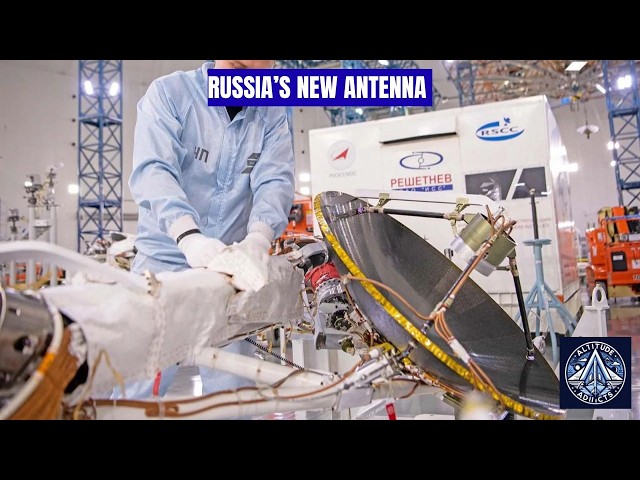
The successful assembly of the first
0:08
antenna systems for the advanced crude
0:10
spacecraft or marks an important step in
0:13
Russia's next generation human
0:17
These newly developed systems are
0:19
entirely domestic and are designed to
0:22
ensure reliable communication between
0:24
the spacecraft and mission control which
0:26
is absolutely critical for any crude
0:31
This milestone reflects not just
0:33
technical progress but also a broader
0:36
shift towards self-reliance in the
0:38
Russian space industry. And honestly,
0:41
this is where things start getting
0:43
interesting for us at Altitude Addicts
0:45
because communication systems rarely get
0:48
the spotlight they deserve.
0:52
Moving into April 2026, the first flight
0:55
ready antenna systems for the spacecraft
0:57
ORL were assembled and tested on the
1:00
ground by engineers at information
1:02
satellite systems Rashetv located in the
1:05
Kranoarsque region. These systems
1:08
represent years of development finally
1:10
coming together into something tangible.
1:14
Two flight versions of these antenna
1:16
systems were produced.
1:19
After completing groundbased testing
1:21
successfully, both units were delivered
1:23
to RSC Energia, the main organization
1:26
responsible for building the spacecraft.
1:30
This is a major milestone for a program
1:33
that has gone through years of redesign,
1:35
delays, and adaptation.
1:38
Not everything in space development is
1:40
smooth, and this program is proof of
1:45
Now when we shift focus to the technical
1:48
side, each antenna system is built
1:50
around a reflector dish measuring 940 mm
1:54
in diameter. That might not sound huge,
1:57
but in space engineering, every
1:59
millimeter and every gram matters.
2:03
The system itself is a complex
2:05
combination of mechanical and electronic
2:09
It includes temperature sensors and
2:11
rotation angle sensors which allow the
2:14
antenna to function accurately in
2:16
extreme conditions where both heat and
2:19
cold can push materials to their limits.
2:23
The antennas also include specialized
2:26
locking and deployment mechanisms.
2:28
During launch, they are tightly secured
2:30
to survive intense vibrations.
2:33
Once in orbit, they deploy automatically
2:36
and this part has to work perfectly. no
2:40
Because here's the thing, without
2:42
communication, a spacecraft is basically
2:47
And that's not a situation anyone wants,
2:50
especially with humans on board. These
2:53
antenna systems are designed to operate
2:55
across multiple frequency bands. This
2:59
allows continuous communication between
3:01
the spacecraft and mission control under
3:03
different conditions and mission phases.
3:08
Space communication goes far beyond just
3:10
voice. It includes telemetry data,
3:13
navigation updates, system diagnostics,
3:16
and even video transmission.
3:18
All of this needs to be handled
3:20
simultaneously without interruption.
3:24
So yes, this antenna is not just a dish,
3:27
it's the spacecraft's lifeline. And
3:30
that's something we always emphasize at
3:32
Altitude Addicts when breaking down real
3:38
These systems will support communication
3:41
throughout the mission from launch to
3:43
orbit and even during more complex
3:45
operations beyond Earth orbit. That
3:48
includes future deep space ambitions.
3:52
Now connecting this to the bigger
3:53
picture, the Orel spacecraft itself
3:56
represents Russia's next generation crew
3:58
transport system. It is designed to
4:01
replace the longerving Soyuse MS.
4:06
Compared to Soyos, Orrell is larger and
4:08
more advanced. It can carry between four
4:11
and six astronauts and is designed for
4:13
longer missions with improved automation
4:18
It is also partially reusable, which
4:20
aligns with global trends in reducing
4:22
mission costs. Though, yeah, reusability
4:26
always sounds simpler than it actually
4:30
A major turning point in the program
4:32
came after 2022 when the spacecraft had
4:35
to be redesigned to replace foreign
4:38
components with domestic ones. This
4:41
affected multiple systems including
4:43
electronics and communication
4:48
The transition caused delays, but it
4:50
also strengthened domestic capabilities.
4:53
The antenna systems we're talking about
4:55
right now are a direct result of that
5:00
As of spring 2026, the spacecraft is in
5:03
its final assembly stages.
5:07
The first launch is expected between
5:09
2028 and 2029, initially without a crew.
5:14
This uncrrewed mission will test all
5:16
onboard systems, especially the antenna
5:18
systems, under real conditions. Only
5:21
after that will crude missions begin.
5:26
Looking ahead, Orel is expected to
5:28
support missions to a future Russian
5:30
orbital station and even lunar missions
5:35
And yes, communication systems will be
5:37
even more critical at those distances.
5:40
The development of these antennas also
5:42
reflects strong collaboration between
5:45
major space organizations.
5:48
One focuses on communication systems,
5:51
the other on spacecraft design and
5:53
together they bring everything into a
5:57
In modern space missions, communication
6:00
systems are not optional. They are
6:02
essential. They ensure astronaut safety,
6:05
enable realtime monitoring, and allow
6:08
mission control to respond instantly.
6:12
As missions go farther into space,
6:14
communication becomes more challenging.
6:17
Signal delays increase and systems must
6:20
become more robust to maintain
6:24
The antenna systems developed for Ourel
6:26
are built to handle exactly these
6:29
They are designed for stability,
6:31
flexibility, and long-term performance.
6:35
And if we're being real for a second,
6:37
this is the kind of behind-the-scenes
6:39
tech that doesn't go viral, but it
6:46
The successful assembly and testing of
6:48
these antenna systems marks a
6:50
significant step forward.
6:52
There is still work ahead, including
6:54
integration and full flight validation,
6:57
but progress is clearly being made.
7:02
It also highlights a global trend toward
7:04
technological independence and advanced
7:07
communication capabilities in space
7:11
something we continue tracking closely
7:17
In conclusion, the completion of the
7:19
first antenna systems for the Orrell
7:21
spacecraft is not just a technical
7:25
It represents long-term planning,
7:27
adaptation, and the foundation for
7:32
As the spacecraft moves closer to
7:34
launch, these systems will play a
7:36
central role in mission success. Because
7:39
in space, staying connected is
7:45
If you like the video, please subscribe,
7:48
share and like. Also, please take the
7:50
membership of the channel to encourage