0:06
The Russian Indian partnership forming
0:09
around the Yakovv SJ 100 appears much
0:12
more ambitious than a straightforward
0:14
licensed assembly arrangement.
0:17
Discussions have evolved from local
0:19
production of Russia's regional jet in
0:21
India to exploring new aircraft
0:24
variants, including a stretched 130 seat
0:27
version that could significantly impact
0:30
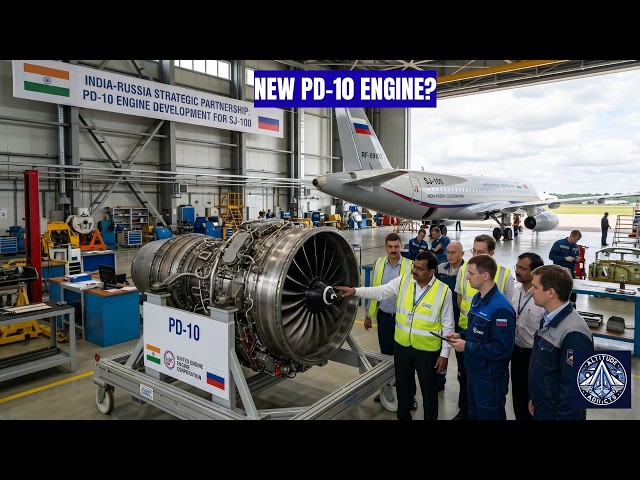
the Superjet program. The PD10 aircraft
0:33
engine, a recently debated engine
0:36
concept, is the focal point of that
0:38
discussion. According to recent Russian
0:40
reports and commentary from aviation
0:42
analyst Sergey Marzetski, India and
0:45
Russia may collaborate to develop a new
0:48
medium thrust turboan engine that
0:50
generates approximately 10 to 11 tons of
0:54
The proposal is becoming more closely
0:57
associated with the potential for an
0:59
extended SJ 100 that is specifically
1:02
designed to meet the needs of India.
1:05
The consequences are enormous.
1:08
The project may no longer be merely a
1:10
Russian regional aircraft assembled
1:12
abroad if India genuinely proceeds with
1:15
localized SJ-100 production through
1:18
Hindustan Aeronautics Limited.
1:21
Instead, it has the potential to
1:22
transform into a jointly adapted
1:25
aircraft family that includes Indian
1:27
defined specifications, Indian
1:29
industrial participation and potentially
1:31
a new jointly developed propulsion
1:35
Now before we go further, this is where
1:38
things start getting really interesting
1:40
because what began as a discussion about
1:42
assembling aircraft in India may
1:45
actually be turning into a conversation
1:47
about designing an entirely new
1:49
Indo-Russian passenger jet ecosystem
1:53
and honestly that is a very different
1:57
The SJ100 has been the subject of
2:00
monthsl long negotiations between Russia
2:02
and India regarding its localized
2:05
manufacturing in India. Russian industry
2:08
representatives have publicly expressed
2:10
their desire to eventually manufacture
2:13
up to 40 aircraft annually in India.
2:16
While officials from United Aircraft
2:18
Corporation and Hail have already signed
2:20
memorandums of cooperation regarding the
2:25
The significance of the recent
2:26
discussion is that Russian analysts are
2:29
no longer purely discussing the
2:31
production of the current aircraft
2:35
Instead, they are openly thinking about
2:37
the potential for India to reshape the
2:40
aircraft into various seating classes
2:42
that are specifically designed for
2:47
Marzetski made one of the most
2:49
remarkable claims, asserting that the
2:51
Superjet's evolution could follow its
2:54
own development course in India, which
2:56
could lead to aircraft variants with 75
2:59
and 130 passenger seats.
3:03
This assertion is important due to the
3:05
fact that the current SJ100 is
3:08
essentially a regional aircraft with a
3:10
capacity of 75 to 100 seats. Extending
3:15
the aircraft to the 130 seat category
3:18
would result in it being positioned in a
3:20
completely new operational and
3:23
commercial segment. This aircraft would
3:26
be more closely aligned with the lower
3:28
end of the narrow body market which is
3:30
currently occupied by the Airbus A220
3:33
and larger Embberer Ejet E2 variants.
3:37
Russia had previously investigated this
3:40
concept through the abandoned Superjet
3:45
In the past, there were intentions to
3:48
build an aircraft that was significantly
3:50
stretched, equipped with composite wings
3:53
and new generation engines.
3:55
Nevertheless, the concept was unable to
3:58
advance due to sanctions, funding
4:00
constraints, and program instability.
4:03
India may now unexpectedly revive the
4:05
concept in a different form. And this is
4:08
the part where altitude addicts should
4:11
probably pay close attention because the
4:14
timing of all this does not look
4:18
The current import substituted SJ100 is
4:21
powered by the PD8 aircraft engine, a
4:24
domestically developed power plant that
4:26
was designed to replace the
4:28
FrancoRussian SAM 146 engine that was
4:31
previously employed in superjets.
4:34
The PD8 is a significant technological
4:37
and industrial milestone for Russia as
4:39
it eliminates reliance on Western
4:41
suppliers following the disruption of
4:43
aerospace cooperation due to sanctions.
4:47
Nevertheless, the PD8 was developed in
4:50
accordance with the dimensions and
4:52
performance envelope of the current
4:57
The thrust class of this aircraft is
4:59
appropriate for a regional jet that can
5:01
accommodate approximately 100
5:03
passengers. However, a stretched 130
5:07
seat aircraft would likely necessitate
5:11
The aircraft's maximum takeoff weight,
5:14
passenger load, fuel requirements, and
5:16
operational stress would all be
5:18
increased by a longer fuselage.
5:20
In India, these challenges are
5:22
exacerbated by the fact that a large
5:24
number of airports are located at higher
5:27
elevations and in humid climates.
5:30
Airlines often ask for higher thrust
5:32
margins than operators in milder
5:35
climates due to the reduction in engine
5:37
efficiency and the increase in required
5:39
takeoff distances caused by high
5:43
This is the point at which the proposed
5:45
PD10 is introduced into the
5:50
Marzetski characterized the engine as
5:52
occupying the space between the PD8 and
5:55
the PD14 aircraft engines which were
5:58
used in the Urkut MC21.
6:01
The PD10 would be suitable for both
6:03
military and civilian applications as it
6:06
would generate approximately 10 to 11
6:08
tons of thrust. According to the
6:12
the thrust class in question is
6:14
remarkably consistent with the
6:16
requirements of a stretched superjet.
6:19
Not perfectly, but close enough that the
6:22
aerospace industry is clearly beginning
6:27
At present, there is a clear divide in
6:30
the capabilities of Russia's PD engine
6:32
family. The regional aircraft are
6:35
powered by the PD8, while the MC21 is
6:38
substantially larger and is powered by
6:42
The prospective PD35 aircraft engine is
6:45
designed to power widebody aircraft.
6:49
However, there is no mature Russian
6:51
engine that is specifically designed to
6:53
be optimized for aircraft in the 110 to
7:00
Consequently, a PD10 could serve as a
7:03
strategic bridge generator for multiple
7:05
programs at once. The berries B200 and
7:09
the proposed Ilushin IL2 have already
7:12
been mentioned in Russian reports as
7:14
potential applications.
7:17
However, the most powerful long-term
7:19
commercial logic may be associated with
7:22
a stretched Indian superjet because
7:25
India's aviation market is growing at a
7:27
pace that is honestly difficult to
7:31
In contrast to Russia's domestic market,
7:34
India has large development potential in
7:36
regional and secondary city aviation.
7:39
Indian airlines are increasingly in need
7:41
of aircraft that are larger than
7:43
conventional regional flights but
7:45
smaller and more cost-effective to
7:47
operate than full-size narrowbody
7:49
aircraft such as the Boeing 737 Max or
7:53
the Airbus A320 ENO family.
7:57
The space could be occupied by a 130
8:00
seat SJ100 derivative.
8:03
Such an aircraft could be appealing to
8:05
export customers who are seeking lowerc
8:08
cost alternatives outside the western
8:10
aerospace ecosystem as well as to India
8:13
if it is coupled with Indian
8:15
manufacturing and local supply chain
8:19
The cooperation model currently under
8:21
discussion is becoming more reminiscent
8:24
of the development of India's defense
8:26
industrial partnerships with Russia
8:28
rather than a conventional civil
8:30
aviation procurement agreement.
8:33
The earlier localization paradigm
8:35
employed for the Sukcoy SU30 MKI program
8:39
has been repeatedly referenced by
8:41
Russian sources when discussing the
8:45
That comparison is insightful.
8:48
India underwent a progressive
8:49
transformation from a customer to a
8:52
manufacturing and integration partner as
8:54
a result of the SU30 MKI program. India
8:58
implemented operational modifications,
9:01
localized systems and domestic
9:02
industrial participation as time
9:05
progressed. The SJ100 may experience a
9:08
comparable situation.
9:11
After decades of relying almost
9:12
exclusively on imported airliners, India
9:15
has long sought to reestablish its
9:17
domestic passenger aircraft
9:19
manufacturing capability.
9:21
The HAL UAC collaboration has the
9:24
potential to provide India with access
9:26
to a comprehensive aerospace ecosystem
9:28
which includes airframe production,
9:31
systems integration, engine maintenance
9:33
and potentially future engine
9:35
development participation.
9:38
India could acquire access to aircraft
9:41
fabrication and turboan engine
9:43
industrial expertise which are among the
9:45
most strategically sensitive
9:47
technologies in aerospace if the PD10
9:51
And yes, that would be a major shift in
9:54
India's civil aviation ambitions.
9:57
The notion of an enlarged Superjet is
9:59
not new. The Superjet 130NG, a 130 seat
10:05
derivative with enhanced aerodynamics,
10:07
composite wings, and new generation
10:09
engines, was investigated by Russia over
10:14
The initiative was intended to compete
10:16
directly against Bombardier and Embraer
10:19
aircraft at the time. Nevertheless, the
10:23
initiative was never developed beyond
10:27
The concept may be rendered more
10:29
realistic than it was previously.
10:31
Despite the irony of the current
10:33
geopolitical climate,
10:35
Russia was compelled to localize
10:37
aircraft production and engine
10:39
development in response to Western
10:43
Meanwhile, India has been striving to
10:45
achieve greater industrial self-reliance
10:48
through its make in India initiative.
10:51
The two pressures are currently
10:54
A future Indian Russian stretched SJ-100
10:58
could potentially rely on a domestically
11:00
developed PD10 rather than relying on
11:03
western engines such as Pratt and
11:05
Whitney power plants that were
11:07
originally envisioned for the 130NG.
11:12
This would result in the establishment
11:14
of a completely distinct industrial
11:16
model, one that is intended to eliminate
11:19
all reliance on Western aerospace
11:22
That sounds simple on paper. In reality,
11:26
it would be incredibly difficult, but
11:31
Although there is an increasing amount
11:32
of speculation, there are still several
11:35
significant caveats.
11:38
It does not appear that the PD10 is an
11:41
officially launched development program
11:43
at this time. There are currently no
11:46
publicly available prototype timelines,
11:49
certification schedules, or formal state
11:51
funding announcements.
11:54
Currently, the discourse is primarily
11:56
confined to industrial speculation and
12:01
Similarly, the Russian and Indian
12:03
governments have not officially
12:04
confirmed the 130 seat SJ100 variant.
12:10
Certification and serial production of
12:12
the baseline import substituted SJ 100
12:15
equipped with PD8 engines continue to be
12:18
Russia's current priority. The program
12:21
has already encountered technical
12:23
challenges and delays during the
12:25
certification of engines and the
12:27
replacement of systems.
12:30
Only after the baseline aircraft has
12:32
been stabilized would Russia be able to
12:34
realistically pursue an enlarged
12:38
Nevertheless, the strategic rationale
12:41
that underpins the concept is becoming
12:43
increasingly difficult to disregard.
12:46
And altitude addicts will probably
12:48
notice something else here too. Russia
12:51
is no longer talking only about
12:52
replacing western components.
12:55
It is increasingly discussing entirely
12:57
new aviation ecosystems outside the
13:00
western market structure.
13:03
India's eventual decision to pursue a
13:05
stretched SJ100 with a PD10 engine could
13:08
result in a much larger aircraft than a
13:10
modified regional aircraft.
13:13
The emergence of a new Eurasian civil
13:16
aviation infrastructure that is
13:18
constructed outside of the conventional
13:20
western aerospace structure could be
13:22
represented by this.
13:25
At a time when access to Europe and
13:27
North America is still restricted,
13:29
Russia would acquire a substantial
13:31
production and operating market. India
13:35
would acquire a domestically assembled
13:37
passenger aircraft ecosystem, aerospace
13:39
technology transfer and manufacturing
13:44
The most significant benefit would be
13:46
that both nations would achieve a
13:48
certain level of autonomy from Western
13:50
suppliers in a sector that has been
13:52
historically dominated by companies such
13:54
as Airbus, Boeing, Prattton Whitney, and
14:00
It is uncertain whether the PD10 will
14:03
ultimately become a reality.
14:05
However, the fact that Russian analysts
14:08
are now openly linking the engine to
14:10
India's evolving SJ100 ambitions
14:13
suggests that discussions within the
14:15
aerospace sector may already be
14:17
progressing beyond basic aircraft
14:21
The question is no longer whether India
14:23
will build only the SJ 100.
14:26
The actual question may concern whether
14:29
India and Russia are collaborating to
14:31
develop an entirely new aircraft family.
14:37
If you like this video, please like,
14:39
share and subscribe the channel. Please
14:42
also take the channel membership to