0:06
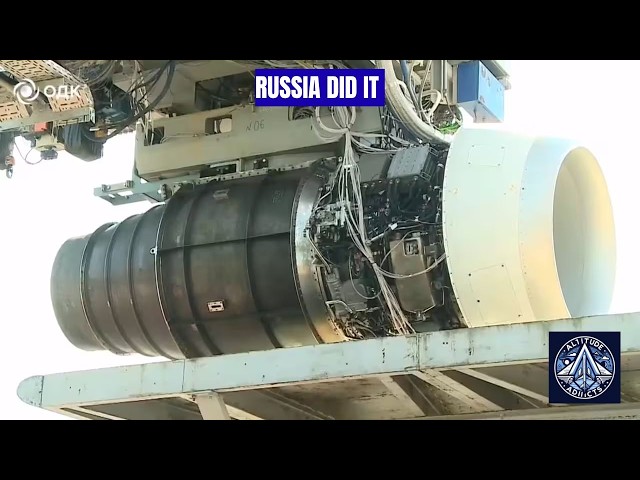
The PD-8 turbofan engine has nearly
0:09
achieved certification, marking a major
0:11
milestone for the Russian aviation
0:15
This program has progressed from early
0:17
skepticism to full technical validation.
0:21
The PD-8, developed by the United Engine
0:23
Corporation under Rostec, is now close
0:26
to becoming the foundation of Russia's
0:28
next-generation regional aviation fleet.
0:32
The engine faced serious challenges
0:34
along the way, especially concerns about
0:38
However, recent testing confirms those
0:41
issues have now been resolved, pushing
0:43
the engine toward full certification.
0:46
This transition from uncertainty to
0:48
readiness is not just about a single
0:51
It reflects a broader transformation in
0:53
Russia's aviation strategy, focused on
0:56
technological independence, faster
0:58
development cycles, and reduced reliance
1:01
on foreign suppliers.
1:03
And as Altitude Addicts would put it,
1:05
this is where engineering ambition meets
1:08
real-world validation.
1:10
Moving into the final certification
1:12
phase, the PD-8 engine has successfully
1:15
completed its core testing program.
1:18
These tests included some of the most
1:20
demanding evaluations required for civil
1:25
The engine demonstrated stable and
1:27
reliable performance in both
1:29
ground-based and in-flight conditions,
1:31
even under extreme environments.
1:34
One of the most critical parts of this
1:36
process was the icing trials conducted
1:39
at the Central Institute of Aviation
1:43
Over a period of 3 months, engineers
1:45
simulated real flight conditions by
1:47
deliberately forming ice on key
1:49
components such as the spinner, fan
1:52
blades, and compressor stages.
1:54
The goal was to observe how the engine
1:56
performs when ice builds up and then
1:59
breaks away during operation.
2:02
Despite these harsh conditions, the PD-8
2:04
maintained stable thrust and full
2:08
This is especially important because
2:10
icing scenarios are among the most
2:12
dangerous for aircraft engines.
2:15
The ability to operate without loss of
2:17
thrust or instability confirms the
2:20
engine's durability and design strength.
2:23
These results were further validated
2:26
through flight tests in the Arkhangelsk
2:29
Aircraft equipped with PD-8 engines were
2:32
flown into natural icing environments
2:35
where ice accumulation reached
2:39
Even in these real-world conditions, the
2:41
engine performed exactly as expected,
2:44
strengthening confidence in its
2:45
certification readiness.
2:48
As the program advanced, attention
2:50
shifted to the most debated issue, the
2:54
Earlier reports suggested that the
2:56
engine struggled to generate enough
2:58
power for fully loaded aircraft.
3:02
This raised serious doubts about its
3:04
commercial viability.
3:06
Now, that concern appears to be fully
3:10
The engine is delivering its intended
3:12
maximum takeoff thrust of approximately
3:18
This aligns with the original design
3:20
specifications and represents a decisive
3:23
improvement rather than a minor fix.
3:26
Solving the thrust issue was essential.
3:29
Engine performance directly affects
3:31
payload capacity, fuel efficiency, and
3:36
Without sufficient thrust, aircraft
3:38
cannot operate at full capacity.
3:41
By reaching the required performance
3:43
levels, the PD-8 has cleared one of the
3:45
final major barriers to certification.
3:49
This achievement also highlights the
3:51
adaptability of the engineering process.
3:55
Instead of requiring a complete
3:56
redesign, the solution appears to have
3:58
come from refinements in tuning,
4:00
materials, and control systems.
4:03
That points to the maturity of the
4:07
Altitude Addicts often highlight such
4:10
moments where iterative engineering
4:12
quietly delivers breakthrough results.
4:16
Looking at the development timeline, the
4:17
PD-8 stands out for its speed.
4:21
While earlier Russian engines like the
4:23
PS-90 and PD-14 took around 10 to 12
4:26
years to develop, the PD-8 reached this
4:29
stage in about 6 years.
4:32
This rapid progress was made possible by
4:37
First, the program reused proven
4:38
technologies from the PD-14, especially
4:41
in the core and gas generator.
4:44
This significantly reduced both risk and
4:49
Second, engineers relied heavily on
4:51
digital design tools and virtual
4:54
These methods allowed simulation of
4:56
real-world scenarios before physical
4:59
prototypes were even built.
5:01
As a result, the need for lengthy trial
5:04
and error cycles was reduced.
5:07
Third, the program followed a parallel
5:11
Instead of completing each stage one
5:13
after another, multiple phases of
5:15
design, testing, and refinement were
5:17
carried out simultaneously.
5:20
This approach helped compress timelines
5:23
without compromising quality.
5:25
The result is a program that not only
5:27
met deadlines, but also set a new
5:30
benchmark for efficiency in aerospace
5:34
Turning to its design and capabilities,
5:36
the PD-8 is a two-spool turbofan engine
5:39
built specifically for regional
5:42
It uses advanced materials and
5:44
manufacturing techniques developed
5:46
within Russia's domestic industry.
5:49
Production takes place at the UEC Saturn
5:52
facility in Rybinsk, a key hub for
5:54
engine manufacturing.
5:57
The engine is designed with reliability,
5:59
maintainability, and adaptability in
6:02
During testing, it underwent a wide
6:04
range of evaluations, including
6:06
endurance trials, foreign object damage
6:09
scenarios, and extreme weather
6:13
In foreign object damage tests, the
6:15
engine was exposed to simulated debris
6:17
such as bird impacts and blade failures.
6:21
The goal was not to prevent damage
6:22
entirely, but to ensure that any damage
6:25
would not lead to catastrophic failure.
6:28
The PD-8 passed these tests by
6:31
maintaining structural integrity and
6:33
allowing controlled shutdown or
6:35
continued safe operation.
6:38
Additional tests covered acoustic
6:39
performance, reverse thrust behavior,
6:42
and crosswind stability.
6:44
These factors are essential for meeting
6:47
international certification standards
6:49
and ensuring smooth airport operations.
6:53
Beyond technical performance, the PD-8
6:55
represents a major strategic shift.
6:58
Earlier versions of the Superjet relied
7:03
engine, developed with the French
7:06
While that partnership enabled quick
7:08
deployment, it also created long-term
7:11
dependence on foreign suppliers.
7:14
Over time, this dependence became a
7:16
vulnerability, especially as
7:18
geopolitical conditions affected supply
7:21
chains and service agreements.
7:23
The PD-8 eliminates this risk by
7:25
offering a fully domestic solution.
7:29
It is also expected to replace
7:30
Ukrainian-built D-436 engines on the
7:33
Be-200 amphibious aircraft.
7:37
This makes it a cross-platform engine,
7:39
increasing its strategic importance.
7:42
For Altitude Addicts, this is where
7:44
engineering meets geopolitics in a very
7:48
Looking ahead, the PD-8 is central to
7:51
the SJ-100 program, the fully localized
7:53
version of the Superjet.
7:56
Engine certification is expected in
7:58
April 2026, with aircraft certification
8:03
Once approved, the SJ-100 will enter
8:06
serial production as a fully domestic
8:11
aircraft powered entirely by Russian of
8:14
a long transition away from foreign
8:18
The success of the PD-8 also opens the
8:21
door for future engine programs.
8:24
It validates faster development models
8:26
and digital engineering methods that
8:28
could be applied to larger engines like
8:33
The testing program itself stands as
8:35
proof of reliability.
8:37
The engine was evaluated across a wide
8:39
range of temperatures, altitudes, and
8:42
environmental conditions.
8:44
Engineers tested both gradual ice
8:46
buildup and sudden ice shedding to
8:48
ensure stability in all scenarios.
8:52
In cold weather trials across northern
8:54
Russia, the engine maintained consistent
8:56
performance despite extreme
9:00
These results are crucial for operations
9:02
in harsh climates where reliability is
9:07
In summary, the PD-8 program has
9:09
delivered on its promise.
9:11
From early doubts about thrust to
9:13
successful certification testing, the
9:16
engine's journey reflects both technical
9:18
resilience and strategic intent.
9:21
Now, on the brink of certification, the
9:23
PD-8 meets performance requirements,
9:26
operates reliably under extreme
9:28
conditions, and aligns with broader
9:30
goals of technological independence.
9:34
More importantly, it represents a shift
9:36
in how modern aerospace systems are
9:38
designed and developed.
9:41
As it enters service, the PD-8 will not
9:45
It will symbolize a new phase in
9:47
aviation, defined by speed, innovation,
9:54
If you like the video, please subscribe,
9:58
Also, please take the membership of the
10:00
channel to encourage us.