live_tv
Livestream Starting Soon
00
Hours
:
00
Minutes
:
00
Seconds
Up next in 10


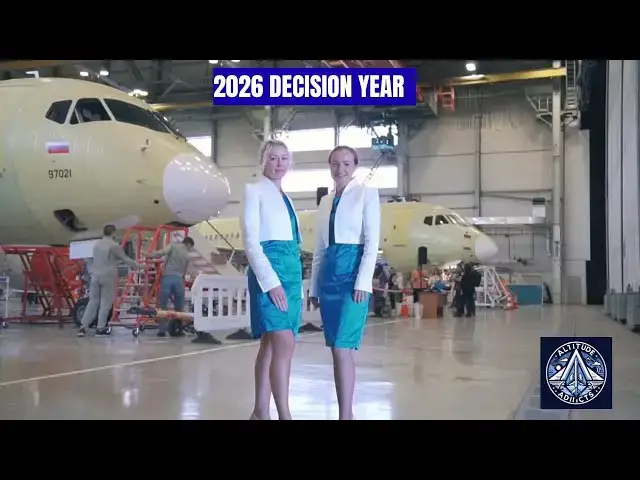
The Russian SJ-100 program is entering its most decisive year yet. After repeated expectations of certification in 2025, officials now point to early 2026 as the realistic window—largely due to ongoing PD-8 engine certification and final system testing.
In this video, we break down why deadlines shifted, what is actually delaying certification, and why these changes don’t necessarily mean failure. From import substitution and production readiness to flight testing in icing conditions, the SJ-100’s story is far more complex than headlines suggest.
We also examine what 2026 deliveries really mean for airlines, why pilot training could delay commercial service until late summer, and how this aircraft fits into Russia’s long-term aviation strategy.
Is the SJ-100 finally ready to fly passengers—or is 2026 another transition year?
Let’s separate speculation from technical reality.
#SJ100 #Superjet #RussianAviation #PD8 #Rostec #UEC #UAC #CivilAviation #AircraftCertification #ImportSubstitution #AviationNews #AviationAnalysis #AviationIndustry #RegionalJets #Aerospace
Be a Member for exclusive privileges - https://www.youtube.com/channel/UCviEFTf1xIPKsjmyF_zvFug/join
Twitter : https://x.com/AltitudeAddicts
Website: https://www.altitudeaddicts.com
Show More Show Less View Video Transcript
0:06
In late December, Rosstec chief
0:08
executive officer Sergey Chisovv stated
0:10
that the certification of the import
0:12
substituted Sukcoy SJ 100 was expected
0:16
to be finalized in early 2026 with
0:19
approximately 12 aircraft scheduled for
0:22
delivery during the year.
0:24
Shortly thereafter, additional
0:26
clarification was provided when the head
0:28
of the Federal Air Transport Agency
0:30
stated that the certification timeline
0:32
could be extended from late 2025 to
0:36
March 2026,
0:38
primarily due to the ongoing
0:40
certification process of the PD8 engine.
0:44
Although these statements may appear
0:46
contradictory, they illustrate the
0:48
dynamic nature of a complex aircraft
0:50
development program conducted under
0:53
unprecedented industrial and
0:55
geopolitical constraints.
0:58
The SJ100 is not merely a revised
1:00
version of an existing aircraft, but a
1:03
fundamentally re-engineered platform
1:05
built around domestically developed
1:07
systems and technologies.
1:10
As 2026 begins, the program reaches a
1:13
critical juncture between extended
1:15
testing and the transition toward
1:17
operational deployment.
1:19
Earlier public statements from Rosstec
1:21
and industry representatives
1:23
consistently indicated certification by
1:26
the end of 2025 with initial customer
1:29
deliveries expected to begin in early
1:32
2026.
1:34
This schedule was not arbitrary, but
1:37
reflected preliminary expectations based
1:39
on test progress, production readiness,
1:42
and the projected maturity of the PD8
1:44
engine program.
1:46
However, by October and again toward the
1:49
end of the year, Sergey Chemov's wording
1:51
became noticeably more cautious.
1:54
Rather than specifying a firm date, he
1:57
began indicating that certification
1:59
would be completed within the first
2:00
quarter of 2026.
2:04
This shift does not indicate failure or
2:06
program collapse.
2:08
Instead, it reflects a fundamental
2:10
principle of aircraft certification,
2:12
namely that schedules are always
2:14
subordinate to verified test results.
2:18
Certification deadlines are directly
2:20
dependent on flight test outcomes,
2:22
system validation, and industrial
2:24
readiness. In the case of the SJ100, the
2:29
rapid substitution of foreign components
2:31
with domestic alternatives significantly
2:33
altered the production and testing
2:35
environment.
2:37
Each localized system must undergo
2:39
qualification, integration, and
2:41
validation within the complete aircraft.
2:44
Even minor discrepancies discovered
2:46
during latestage testing may require
2:49
design changes and additional
2:51
verification flights.
2:53
As a result, the certification schedule
2:56
has evolved into a flexible process
2:58
rather than a fixed calendar milestone.
3:01
This adjustment reflects technical
3:03
reality rather than political or
3:05
industrial optimism.
3:08
The SJ100 program exists within the
3:11
broader framework of Russia's import
3:13
substitution strategy.
3:15
Restrictions on access to foreign
3:17
components forced manufacturers to
3:19
redesign key systems previously sourced
3:22
internationally, including engines,
3:24
avionics, auxiliary power units,
3:26
environmental control systems, and
3:29
elements of the flight control
3:30
architecture.
3:32
This shift has fundamentally reshaped
3:34
production chains.
3:36
Domestic suppliers had to be established
3:38
or expanded, manufacturing processes
3:41
refined, and certification documentation
3:44
created for components never before used
3:46
on a commercial passenger aircraft.
3:49
While this approach strengthens
3:51
long-term technological sovereignty, it
3:53
introduces additional short-term
3:55
complexity.
3:57
The pace at which the SJ100 is entering
4:00
service illustrates this reality. The
4:03
aircraft is not delayed due to
4:05
underperformance, but because it must
4:07
meet its objectives under significantly
4:10
more demanding conditions than initially
4:12
planned. Each substituted subsystem
4:16
increases independence while
4:18
simultaneously expanding the
4:19
certification workload.
4:22
The PD8 engine remains the most closely
4:25
scrutinized element of the SJ 100
4:27
program. Designed to replace the SAM
4:30
146, the PD8 is essential to the
4:33
aircraft's long-term operational
4:35
viability.
4:37
Official statements consistently confirm
4:39
that the engine has achieved its target
4:41
thrust of approximately 8,000 kg force
4:45
during bench and systems testing.
4:48
At the same time, some publications have
4:51
claimed without citing official
4:52
documentation that the engine has not
4:54
yet reached its full design capability
4:57
under all operational conditions,
5:00
particularly at maximum aircraft weight.
5:03
These claims suggest that further engine
5:05
refinements could be required,
5:07
potentially extending certification
5:09
timelines.
5:11
None of the principal stakeholders
5:13
including Rosstec, United Engine
5:15
Corporation, United Aircraft Corporation
5:18
or Rosaviatsia have publicly confirmed
5:20
such deficiencies.
5:23
Their consistent position is that
5:25
certification is proceeding according to
5:27
established regulatory procedures and
5:30
test results. The absence of official
5:33
comment on unverified claims is standard
5:35
practice in aerospace programs to
5:38
prevent distortion of public
5:39
expectations.
5:41
It is evident that the PD8 continues to
5:44
undergo flight testing across a wide
5:47
range of operating conditions.
5:49
Certification authorities must verify
5:51
not only maximum thrust, but also
5:53
reliability, fuel efficiency, thermal
5:56
stability, and performance under adverse
5:59
environmental conditions before approval
6:01
can be granted.
6:03
As of 2026, flight testing continues
6:06
with multiple experimental SJ100
6:09
aircraft based at the Rammenscoy
6:11
airfield in Jakovski.
6:13
These aircraft represent different
6:15
stages of import substitution and system
6:18
integration, allowing engineers to
6:20
validate both transitional and nearfal
6:23
configurations.
6:25
One aircraft remains equipped with SAM
6:28
146 engines and partial system
6:30
localization serving as a baseline
6:32
reference. Another aircraft uses PD8
6:36
engines combined with a mixture of
6:38
domestic and legacy systems. The most
6:41
advanced prototype incorporates PD8
6:44
engines and an almost complete
6:46
replacement of imported components
6:48
closely matching the intended production
6:50
standard.
6:52
A critical test phase planned for early
6:54
2026 involves flights in natural icing
6:58
conditions in the Arangelsk region.
7:01
These tests are mandatory for
7:03
certification and cannot be fully
7:05
replicated in laboratory environments.
7:08
Performance in icing conditions directly
7:11
affects flight safety and operational
7:13
reliability, making this phase both
7:15
essential and time-sensitive.
7:19
Certification alone does not ensure
7:21
timely deliveries.
7:23
Equally important is the readiness of
7:25
the production infrastructure to
7:27
manufacture engines and components at
7:29
scale. Rosstec has repeatedly emphasized
7:33
that delivery schedules depend on both
7:35
successful testing and industrial
7:37
capacity.
7:39
Establishing domestic production for
7:41
previously imported systems requires
7:43
more than physical manufacturing.
7:46
It involves quality assurance systems,
7:49
traceability, documentation, workforce
7:51
training, and regulatory oversight.
7:54
Delays in any of these areas can
7:56
postpone deliveries even after
7:58
certification is achieved.
8:01
At the same time, commercial standard SJ
8:04
100 aircraft are already being
8:06
assembled. This reflects confidence that
8:09
certification will be achieved within
8:11
the expected time frame. Conducting
8:14
production in parallel with testing
8:16
reduces the gap between certification
8:19
and initial deliveries.
8:21
Current baseline plans for 2026
8:24
anticipate the delivery of approximately
8:26
12 SJ100 aircraft.
8:30
This represents a controlled ramp up
8:32
consistent with the first year of
8:34
certified operations.
8:36
After certification, airlines will
8:38
require roughly 3 months to complete
8:41
training for pilots, cabin crew, and
8:43
maintenance personnel. The SJ100
8:47
incorporates systems and procedures that
8:49
differ from earlier Superjet versions,
8:51
necessitating updated training programs.
8:55
As a result, while deliveries may begin
8:58
earlier in the year, large-scale
9:00
commercial service is more likely to
9:02
commence toward the end of summer 2026.
9:06
This phased introduction reduces
9:08
operational risk and allows airlines to
9:11
integrate the aircraft gradually.
9:14
For the regional aviation sector, the SJ
9:17
100 plays a strategically important
9:19
role. Delays in its entry into service
9:22
have forced airlines to extend the use
9:24
of older aircraft and adjust fleet
9:27
renewal plans. Once operational,
9:30
however, the SJ100 provides a
9:32
domestically supported aircraft tailored
9:35
to Russia's route structure and
9:36
infrastructure.
9:38
Its significance extends beyond
9:40
immediate commercial considerations.
9:43
The aircraft serves as a benchmark for
9:45
Russia's ability to sustain a modern
9:47
civil aviation industry under conditions
9:50
of technological isolation.
9:52
Success with the SJ 100 will directly
9:55
influence confidence in future programs
9:58
and broader industry restructuring.
10:01
The outlook for the SJ 100 in 2026 is
10:05
defined not by missed deadlines, but by
10:08
the complexity of rebuilding an aircraft
10:10
ecosystem from within. Certification
10:13
timelines shifted from late 2025 to
10:16
early 2026 due to testing requirements,
10:20
industrial readiness, and regulatory
10:22
compliance rather than any loss of
10:25
program momentum.
10:27
If certification of both the SJ100 and
10:30
the PD8 engine is achieved in the first
10:33
quarter of 2026
10:36
and if production infrastructure
10:38
continues to mature in parallel, the
10:40
aircraft is positioned to enter
10:41
commercial service by mid to late 2026.
10:46
In doing so, it will mark a significant
10:48
milestone for Russian civil aviation and
10:51
the long-term viability of domestically
10:53
produced passenger aircraft.
10:58
If you like the video, please subscribe,
11:00
share and like. Also, please take the
11:03
memberships to encourage us.
#News
#Aviation Industry