Up next in 10


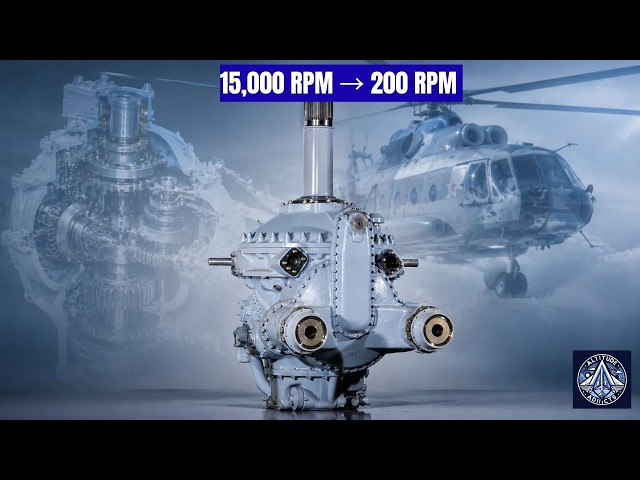
Russian helicopter engines can spin at an astonishing 15,000 revolutions per minute — but the rotor blades above them rotate at barely 200 RPM. So how does that power get transformed into stable flight without destroying the aircraft?
In this video, we dive deep inside Russian helicopter gearbox technology and explore the hidden mechanical system that powers legendary aircraft such as the Mi-8, Mi-24, Mi-28, Ka-27, and Ka-52. Following recent explanations from United Engine Corporation (UEC), part of Rostec, we break down how these massive reduction gearboxes convert extreme turbine speeds into usable rotor motion.
The video explores the engineering behind the TV3-117 turboshaft engine family, the role of multi-stage reduction gears, and why helicopter transmissions are among the most mechanically stressed systems in aviation. We also examine the famous VR-14 gearbox used in the Mi-8 series and explain how Russian helicopters distribute power not only to the rotor system, but also to tail rotors, hydraulic pumps, generators, and critical onboard systems.
From Soviet-era helicopter engineering philosophy to modern Russian aerospace manufacturing, this is the hidden technology that makes rotary-wing flight possible.
If you’ve ever wondered why helicopter rotors don’t spin at engine speed — this video explains everything.
#Russia #Helicopter #Mi8 #Mi24 #RussianHelicopters #UEC #Rostec #Aviation #MilitaryTechnology #Gearbox #HelicopterTechnology #RussianMilitary #AircraftEngineering #Rotorcraft #DefenseTechnology #TV3117 #Aerospace #Engineering #MilitaryAviation #HelicopterGearbox
Be a Member for exclusive privileges - https://www.youtube.com/channel/UCviEFTf1xIPKsjmyF_zvFug/join
Twitter : https://x.com/AltitudeAddicts
Website: https://www.altitudeaddicts.com
Show More Show Less View Video Transcript
0:04
The gearbox is one of the most critical
0:07
technologies concealed within every
0:09
rotary wing aircraft.
0:11
Modern helicopters are usually
0:13
associated with engines, rotor blades,
0:15
or combat power.
0:18
But without the gearbox, even the most
0:19
powerful helicopter engine on Earth
0:21
would become completely useless.
0:25
Russia's United Engine Corporation or
0:27
UEC, which operates under Rostec,
0:30
recently pulled back the curtain on this
0:31
often overlooked system.
0:34
The company explained how Russian
0:36
helicopter transmissions convert turbine
0:38
speeds reaching 15,000 revolutions per
0:41
minute into the carefully controlled
0:43
rotor speeds required for stable flight.
0:47
And honestly, this is one of those
0:49
systems most people never think about
0:52
until they realize the entire helicopter
0:54
depends on it.
0:57
The explanation offers a rare glimpse
0:59
into one of the most mechanically
1:01
demanding areas of Russian aerospace
1:03
engineering.
1:05
Russian helicopters rely on highly
1:07
specialized reduction gear systems that
1:09
form the foundation of the aircraft's
1:12
entire power architecture.
1:15
From the legendary Mi-8 transport
1:16
helicopter to the heavily armed Mi-24
1:19
gunship and advanced Kamov rotorcraft,
1:22
the gearbox quietly sits at the center
1:24
of everything.
1:27
Now, this is where the real engineering
1:28
challenge begins.
1:31
The issue starts with the helicopter
1:32
power plant itself.
1:35
Russian helicopters powered by
1:36
turboshaft engines, such as the TV3-117,
1:40
operate at extremely high internal
1:42
rotational speeds.
1:44
Inside the engine, the free turbine
1:46
section spins at approximately 12,000 to
1:49
15,000 revolutions per minute.
1:53
These enormous speeds are necessary
1:55
because gas turbine engines produce
1:57
their best efficiency and maximum power
1:59
output when rotating incredibly fast.
2:03
But helicopter rotor systems simply
2:05
cannot operate anywhere close to those
2:07
speeds.
2:09
The main rotor blades of helicopters
2:11
like the Mi-8 rotate at roughly 192
2:15
revolutions per minute.
2:17
Meanwhile, attack helicopters such as
2:19
the Mi-24 operated around 240 RPM.
2:24
That creates a massive gap between
2:26
engine output speed and rotor operating
2:28
speed.
2:30
If rotor blades were connected directly
2:32
to the engine, the consequences would be
2:34
catastrophic.
2:36
Within seconds, the blades would face
2:39
uncontrollable centrifugal forces,
2:41
violent aerodynamic instability, and
2:43
eventual structural destruction.
2:46
Rotor tip speeds would rapidly approach
2:49
the speed of sound.
2:50
Shock waves, severe vibration, and
2:53
immense stress on the airframe would
2:55
follow almost immediately.
2:58
This is why helicopters require a
3:00
sophisticated transmission system
3:02
between the engine and the rotor
3:04
assembly.
3:05
In Russian helicopter engineering, that
3:08
responsibility falls to the main
3:10
reduction gearbox.
3:12
It sounds simple when said quickly.
3:15
But the amount of mechanical precision
3:17
involved here is honestly insane.
3:20
The gearbox is far more complex than a
3:23
simple speed reducer.
3:25
In Russian helicopter design philosophy,
3:27
the transmission system acts as the
3:29
central mechanical hub of the entire
3:31
aircraft.
3:33
Its first job is reducing rotational
3:35
speed from turbine levels down to safe
3:37
rotor operating speeds.
3:40
But equally important, it converts
3:42
high-speed engine output into enormous
3:44
torque capable of rotating large rotor
3:47
blades under heavy aerodynamic loads.
3:50
Russian helicopter transmissions
3:52
accomplish this through multi-stage gear
3:55
reduction systems.
3:57
Inside the transmission are multiple
3:59
interconnected gears with carefully
4:01
calculated diameters and tooth ratios.
4:05
Smaller high-speed gears drive larger
4:07
gears in successive stages.
4:09
RPM gradually decreases while torque
4:12
multiplies.
4:13
The reduction ratios involved are
4:15
extraordinary.
4:17
To bring turbine speeds down from around
4:19
15,000 RPM to roughly 200 RPM requires a
4:23
reduction ratio exceeding 70 to 1.
4:27
Achieving that consistently inside a
4:29
combat or transport helicopter operating
4:32
in extreme environments is one of the
4:34
biggest challenges in aerospace
4:36
mechanical engineering.
4:38
At Altitude Addicts, this is exactly the
4:41
kind of hidden engineering that makes
4:43
aviation so fascinating.
4:46
Unlike automotive transmissions,
4:48
helicopter gearboxes operate under
4:50
constant heavy load.
4:52
Every maneuver, climb, descent, and
4:55
pilot control input sends enormous
4:57
forces through the transmission system.
5:00
Russian engineers therefore design these
5:02
systems to survive continuous stress,
5:04
thermal expansion, vibration, and abrupt
5:07
power changes during combat maneuvers or
5:09
heavy cargo operations.
5:12
A major part of modern Russian
5:14
helicopter gearbox technology evolved
5:16
alongside the famous TV3-117
5:19
turboshaft engine family.
5:21
Developed by the Klimov Design Bureau
5:24
during the Soviet era, the engine became
5:26
one of the most successful helicopter
5:28
power plants ever created.
5:31
The TV3-117
5:33
powered a huge range of Soviet and later
5:35
Russian helicopters.
5:37
That includes the Mi-8, Mi-17, Mi-24,
5:41
Mi-28, Ka-27, Ka-32, Ka-50, and 52
5:45
families.
5:47
Over decades of service, the engine
5:49
became the backbone of Soviet and
5:51
Russian helicopter aviation.
5:54
But transmission technology was equally
5:56
important to the engine's success.
5:59
Soviet engineers understood that
6:01
increasing engine power without
6:03
improving transmission capability would
6:05
create dangerous mechanical limitations.
6:09
As engine output increased, gearboxes
6:12
had to handle greater torque loads while
6:13
maintaining manageable vibration levels
6:16
and long-term reliability.
6:19
That challenge led to highly specialized
6:21
transmission families such as the VR-14
6:24
and VR-24 gearboxes.
6:27
These systems became central to Russian
6:29
helicopter architecture and remain
6:31
extremely important even today.
6:34
The VR-14 gearbox family became one of
6:37
the most important helicopter
6:39
transmissions ever designed in the
6:41
Soviet Union.
6:43
Created for medium transport helicopters
6:45
like the Mi-8 and Mi-17 series, it
6:48
eventually became one of the most widely
6:51
used helicopter gearboxes in the world.
6:54
TV3-117
6:56
engines feed power into the VR-14
6:58
gearbox.
7:00
The transmission then distributes that
7:02
power to the main rotor system, tail
7:04
rotor drive shaft, and numerous onboard
7:07
auxiliary systems.
7:09
It continues operating under enormous
7:11
mechanical stress while delivering
7:13
stable power in environments ranging
7:15
from Arctic cold to desert heat.
7:19
The Mi-8 family itself became one of the
7:21
most successful helicopters ever
7:24
produced.
7:25
It served military, rescue,
7:27
firefighting, transport, and civilian
7:29
roles across dozens of countries.
7:32
And weirdly enough, a lot of that
7:34
reputation comes down to gearbox
7:36
durability more than people realize.
7:39
Russian helicopter doctrine historically
7:42
emphasized ruggedness and field
7:44
operability.
7:45
That philosophy heavily influenced
7:47
gearbox design.
7:49
Transmission systems needed to survive
7:51
prolonged heavy load operations,
7:54
inconsistent maintenance conditions, and
7:56
harsh operating environments.
7:59
As a result, Russian gearboxes developed
8:02
a reputation for toughness.
8:04
Though in many cases, that durability
8:06
came with increased weight compared to
8:09
certain Western systems.
8:11
UEC also emphasized that helicopter
8:14
gearboxes do far more than reduce rotor
8:16
speed.
8:17
The main transmission effectively acts
8:20
as the primary mechanical power
8:22
distribution center of the aircraft.
8:25
The transmission supplies power to the
8:27
tail rotor, which counteracts torque
8:30
generated by the main rotor.
8:32
It also powers generators, hydraulic
8:34
pumps, fuel pumps, cooling systems, and
8:37
other critical onboard equipment.
8:40
That places the gearbox at the center of
8:42
the aircraft's electrical and hydraulic
8:45
infrastructure in addition to its flight
8:47
role.
8:49
If the transmission fails, multiple
8:51
helicopter systems can fail
8:52
simultaneously.
8:54
And that is exactly why gearbox
8:56
reliability is treated so seriously in
8:58
military aviation.
9:01
Hydraulic systems controlling flight
9:03
surfaces, lubrication circulation,
9:05
avionics power generation, and rotor
9:07
stabilization all depend on mechanical
9:10
energy routed through the gearbox
9:12
assembly.
9:13
So yes, this giant chunk of spinning
9:16
metal is basically the helicopter's
9:18
hidden nervous system.
9:20
One of the most revealing parts of UEC's
9:23
explanation involved manufacturing
9:25
precision.
9:27
Russian engineers stressed that gearbox
9:29
quality directly affects vibration
9:31
levels, engine lifespan, and overall
9:33
flight safety.
9:35
Inside a helicopter transmission, gears
9:38
operate under immense pressure.
9:41
Even tiny imperfections in gear geometry
9:43
can generate vibration harmonics capable
9:46
of damaging shafts, bearings, and rotor
9:48
systems over time.
9:50
This is why Russian aerospace firms
9:53
invest heavily in precision machining
9:55
and thermal treatment technologies.
9:58
Gear teeth must be produced with
10:00
extremely tight tolerances while also
10:03
being hardened enough to survive years
10:05
of operational stress.
10:08
Facilities involved in gearbox
10:09
manufacturing, including Krasny Oktyabr,
10:12
specialize in advanced metalworking,
10:14
precision grinding, and heat treatment
10:16
processes.
10:18
At Altitude Addicts, these are exactly
10:20
the kinds of hidden industrial details
10:23
that reveal how complex aerospace
10:25
manufacturing really is.
10:28
Thermal treatment becomes especially
10:30
important because gearbox components
10:32
must balance rigidity and flexibility.
10:35
If gears become too brittle, they may
10:37
crack under shock loads.
10:40
If they become too soft, they wear out
10:42
rapidly under constant stress.
10:45
The challenge becomes even more intense
10:47
in military helicopters.
10:50
These transmissions must tolerate
10:51
aggressive maneuvering, weapons
10:53
vibration, rapid power changes, and
10:56
severe climatic conditions.
10:59
The gearbox systems developed by Soviet
11:01
and Russian engineers reflect a broader
11:03
aviation philosophy centered on
11:05
endurance and survivability.
11:08
Western helicopter manufacturers often
11:11
prioritize lightweight composite
11:13
structures and highly optimized systems.
11:16
Russian aerospace engineering
11:18
historically focused more on ruggedness,
11:20
redundancy, and operational resilience.
11:24
That philosophy becomes very obvious in
11:27
transmission design.
11:29
Russian gearboxes are engineered to keep
11:31
functioning in dust exposure, extreme
11:33
temperatures, and even battlefield
11:35
conditions.
11:37
The importance of gearbox durability
11:39
became especially clear during Soviet
11:42
operations in Afghanistan.
11:44
Helicopters operated in high altitude
11:47
and brutally hot conditions that placed
11:49
massive stress on engines and
11:51
transmissions alike.
11:54
Lessons from those operations strongly
11:56
influenced future Russian helicopter
11:58
powertrain development.
12:01
Engineers continued refining gearbox
12:03
reliability, lubrication systems, and
12:05
thermal resistance for future helicopter
12:08
generations.
12:10
Gearbox technology remains a major focus
12:12
today as Russia develops newer
12:14
helicopter engines like the VK-2500
12:17
and future high-power turboshaft
12:19
platforms.
12:21
More powerful engines generate larger
12:23
torque loads, forcing future
12:25
transmissions to handle even greater
12:27
stress while reducing vibration and
12:30
maintaining reliability.
12:32
Russian aerospace firms are therefore
12:35
investing in advanced metallurgy,
12:37
digital manufacturing technologies, and
12:39
improved lubrication systems.
12:42
Future helicopters may also incorporate
12:44
smarter monitoring systems capable of
12:46
detecting imbalance or wear before
12:49
mechanical failure occurs.
12:52
But despite all these technological
12:53
changes, one principle remains
12:55
unchanged.
12:57
Helicopter engines and rotor systems
12:59
operate in completely different speed
13:02
regimes,
13:03
and the gearbox remains the
13:05
indispensable bridge between them.
13:08
To most passengers and even many
13:10
aviation enthusiasts, the gearbox
13:12
remains largely invisible.
13:15
Hidden beneath rotor hubs and protective
13:17
housings, it is overshadowed by engines,
13:19
blades, and weapon systems.
13:23
Yet in reality, the gearbox is one of
13:25
the most important technologies inside
13:27
any helicopter.
13:29
It converts unusable turbine speeds into
13:31
controlled rotor motion.
13:34
It distributes power throughout the
13:36
aircraft.
13:37
And it allows the entire helicopter to
13:40
function as a single coherent machine.
13:43
Russia's recent explanation through UEC
13:46
highlights just how central transmission
13:48
engineering remains in modern aerospace
13:51
technology.
13:52
Behind every Mi-8 lifting cargo, every
13:55
Mi-24 maneuvering at low altitude, and
13:57
every K-series helicopter operating in
14:00
harsh Arctic conditions, is a precisely
14:02
engineered gearbox quietly converting
14:04
15,000 RPM into stable controlled
14:07
flight.
14:10
And honestly, after hearing all this,
14:12
the gearbox might be the most underrated
14:14
machine in military aviation.
14:17
And Altitude Addicts, it is exactly
14:19
these hidden systems that make aerospace
14:21
engineering feel so much bigger than
14:24
just engines and weapons.
14:29
If you like this video, please like,
14:31
share, and subscribe the channel.
14:33
Please also take the channel membership
14:35
to encourage us.
14:37
Last but not least, please hype this
14:39
video if you're watching on a mobile
14:41
device.
#Science