Up next in 10

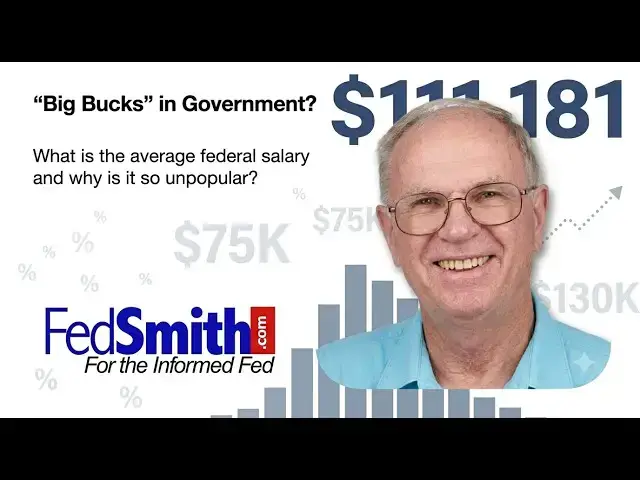
Average Federal Salary Hits $111,181 — Why So Many Federal Employees Don't Believe It
Jun 9, 2026

The average federal salary as of April 2026 is $111,181 — a number that surprises and frustrates many federal employees who feel it doesn't reflect their own pay. In this video, Ralph Smith, co-founder of FedSmith.com, breaks down where that figure comes from, why it's accurate even if it doesn't match your paycheck, and how smaller high-paying agencies like the SEC and NCUA pull the average up.
He also walks through federal salary distribution, GS grade breakdowns, locality pay, and why the average dropped nearly $900 in a single month as senior employees retired or departed.
📰 Read more at FedSmith.com:
Federal Employee Pay Has Reached Record Levels—But the Story Is More Complicated Than It Appears
https://www.fedsmith.com/2026/06/05/federal-employee-pay-complicated-than-appears/
0:00 Introduction
1:22 Topics covered
2:29 What is the average federal salary?
3:03 Comments from federal employees on average federal salary
8:15 Salary distribution ranges
8:58 Average salaries of federal employees at higher-paying agencies
9:37 Why are these agencies paying higher salaries?
11:57 Concluding thoughts
Show More Show Less View Video Transcript
0:00
My name is Ralph Smith, and I'm a
0:03
co-founder of fitsmith.com.
0:06
And I've been writing about topics on
0:08
federal human resources,
0:11
or personnel as it used to be called,
0:13
for several decades.
0:15
And one of the topics that always draws
0:18
attention, not that it's popular, in
0:20
fact, you know, what it's probably
0:21
unpopular in many respects, uh is the
0:24
average federal salary figure. And I've
0:27
labeled this presentation Big Bucks in
0:29
Government. And I picked the term Big
0:31
Bucks because
0:34
it's amorphous. Nobody really knows what
0:36
that means. It's probably means
0:37
something different to every person.
0:40
Uh but when people look at the average
0:42
federal salary figure, some people will
0:44
say, "Well, that is an unrealistic
0:46
figure.
0:47
It's not correct. It can't be correct
0:50
because I don't make that much, and I
0:52
don't know anybody who makes that much
0:54
in my organization." That doesn't mean
0:56
that the person is wrong.
0:58
And they look at it and say, "Well,
1:00
these
1:01
people making the big bucks must work
1:03
elsewhere because I don't know them, and
1:05
I just don't think that that's
1:06
accurate." The average annual salary
1:09
figure is unpopular, at least as some
1:12
people would say, and I'll show you some
1:13
examples in a few minutes.
1:15
But it's useful. It
1:17
nice to see, or it's interesting to see,
1:20
how much is the government paying its
1:21
employees. Throughout this presentation,
1:24
what I'm going to talk about is
1:26
obviously average federal salary. And
1:28
then secondly, dig down a little bit
1:31
into federal federal salary
1:33
distribution. How does
1:35
the government pay its employees in
1:37
different agencies, and how is this
1:39
average federal salary figure derived?
1:43
Some of the higher-paying agencies, a
1:45
lot of federal employees work in one
1:46
agency throughout their entire career.
1:48
That's what they know. To them, that is
1:51
the federal government. But there are
1:53
many agencies in government. There are
1:55
over 2 million employees.
1:57
Some of them pay much higher salaries
1:59
than others.
2:00
Uh the other thing we'll look at is SEC
2:03
salary distributions. SEC stands for
2:07
Securities and Exchange Commission. It
2:09
is not the highest-paying federal
2:11
agency, but it's one of them. And I'll
2:13
look at how they break down in their
2:15
salary distribution and how agencies
2:17
like this contribute to the overall
2:20
average federal employee salary. Why do
2:23
the agencies pay more and why do the
2:25
larger agencies often pay less?
2:29
The average federal salary, and this is
2:31
as of April 30th, uh 2026, is $111,181.
2:39
Now, some people will look at that and
2:40
say that's way too much. I don't make
2:43
that much. Uh when I actually did an
2:46
article [snorts] on FedSmith a couple
2:47
weeks ago, and the average federal
2:49
salary at that time was just over
2:51
112,000, so it's gone down a little bit.
2:55
Uh but, OPM now publishes the
2:58
information about once a month, so it
3:01
changes. It can go up, it can go down.
3:03
Here are some comments on the federal
3:05
salary average, and these are fairly
3:07
common. The first time I did an article
3:09
on the average federal salary, I was a
3:12
little bit surprised at the reaction I
3:14
got because I thought it might be
3:17
popular. I thought it would be of
3:18
interest. That's why I wrote the
3:19
article. I was surprised at some of the
3:22
emotions that seemed to come out when
3:24
they see the figure.
3:26
And I guess when you look at it
3:28
objectively, money is an emotional
3:30
topic.
3:31
Uh
3:32
somebody makes more money than I do,
3:34
they're making the big bucks, I'm not
3:36
making the big bucks. Why is that? Am I
3:38
being treated fairly? Is this unfair?
3:40
How'd the other person get the
3:41
higher-paying job? So, these are the
3:44
comments that tend to come out. I picked
3:46
these from the latest article, but
3:48
they're fairly typical of the articles
3:50
that we see every time we do
3:52
one on this particular topic.
3:55
First of all, I'm not quite sure how to
3:56
pronounce this, but I'm going to give it
3:58
a shot. Bahaha, who makes even 70,000?
4:02
Where are you getting your figures from?
4:04
Well,
4:05
the quick answer is the Office of
4:07
Personnel Management. Now, I worked at
4:09
Office of Personnel Management one time
4:11
at some time in the distant past, but
4:15
this is a information that's available
4:17
to the public, published by OPM. I
4:19
didn't sit around over a glass of wine
4:21
or a bottle of wine and come up with
4:23
this figure because it sounded good.
4:25
It's from OPM. This is hilarious. This
4:29
federal employee isn't making those
4:30
numbers.
4:32
Let's assume the person is absolutely
4:34
correct. I'm sure he knows how much he
4:36
how much he makes or doesn't make. And I
4:38
guess he's saying it's hilarious because
4:40
perhaps because he doesn't believe it.
4:43
As I said, it's not made up. That is an
4:45
average figure. We'll break that down a
4:47
little bit more in a few minutes.
4:49
Lies. Pay is still way behind the
4:52
private sector.
4:53
And I think the reason articles or
4:56
rather comments like this come out,
4:58
federal salary council every year
4:59
publishes that the federal employees
5:01
make roughly 20 to 30% less than what
5:05
they would make in the private sector.
5:07
And we see a number of comments from
5:08
people who say, "I could leave the
5:09
government today and make 25, 30% more
5:13
going into the private sector." Maybe
5:15
that's true. Maybe it's not. There's
5:17
also disadvantages in working in the
5:19
private sector. And I suspect it
5:21
involves getting a job with a larger
5:23
company, would it be a smaller company?
5:25
How specialized is it? What's your
5:27
educational background? What do you
5:30
bring to that company that would just
5:31
justify the salary that they're going to
5:33
pay? A lot of factors go into that.
5:37
I never came remotely close to those
5:39
numbers.
5:40
Okay, that's probably true. I'm sure the
5:42
person knows how much he makes or she
5:44
makes.
5:45
But that doesn't mean the average is
5:47
incorrect, just that the person doesn't
5:49
believe it apparently.
5:51
Nothing compared to the contracts as
5:53
civil service employees end up managing,
5:56
especially in Washington, D.C. And
5:58
clearly that is true in some cases. Some
6:01
of the senior managers in the larger
6:02
companies uh that work for the
6:04
government as a contractor make big
6:07
bucks, whatever that amounts to, but
6:09
more than this person makes clearly. Uh
6:12
there's also disadvantages working for a
6:14
big contractor or small contractor. I I
6:16
owned a contracting company. And in some
6:19
cases they find themselves working at a
6:21
high salary and then the next week
6:23
they're out of a job. They lost a
6:24
contract for whatever reason. Uh that's
6:27
a risk that you take. Sometimes you get
6:29
paid more because of that risk.
6:31
Otherwise, perhaps it's just unfair. I
6:33
don't know. But that's a common comment.
6:36
Mhm, no. I wish. In other words, the
6:39
person I think is saying uh this average
6:42
isn't correct. I wish I made that much.
6:44
I'm an average federal employee. I
6:46
don't. This figure is not correct.
6:48
Those of us in the RUS, that stands for
6:51
the rest of the US under the locality
6:53
pay system,
6:54
are sure as hell behind the average. And
6:57
the stars mean that there was another
6:59
word that the person added that I didn't
7:01
care to put in the chart because it
7:02
would probably be offensive.
7:05
Rest of the US does make less under the
7:08
locality pay system than employees who
7:10
are in a locality pay area. And the
7:13
number of people in locality pay areas
7:15
has expanded rapidly in the last few
7:18
years, especially especially under the
7:20
Biden administration. If you're not in a
7:22
locality pay area, in some cases people
7:25
were actually working at home outside
7:28
the locality pay area, but they were
7:30
collecting the locality pay just as if
7:32
they were reporting to the office in the
7:35
downtown metropolitan area where it's
7:37
close, reasonably close. Uh
7:40
but I don't think Congress has taken
7:42
action to prevent that, although I hope
7:44
PM I think is trying to crack down on it
7:46
some.
7:47
But, in our US, rest of the US, you do
7:50
make less than in the locality pay area.
7:53
That is absolutely true.
7:55
If the average salary is 112,000, that
7:57
means the average worker is a GS-12.
8:00
Who's doing the work? So, the person
8:02
obviously is saying the GS-12 is a
8:04
supervisor or manager supervising other
8:07
people who are doing most of the work.
8:10
And actually, as it turns out, he's
8:13
pretty close to accurate. If you look at
8:15
the salary distribution, the biggest
8:18
category of people is are those making
8:21
$129,999
8:26
to $130,000.
8:29
So,
8:30
I'm sorry, $130,000 to $160,000. That's
8:34
the biggest category. That's roughly a
8:36
GS-12 for many cases depending upon the
8:40
uh where they stand in the steps for
8:42
their particular grade. So, that comes
8:46
out to be a pretty high average. Uh
8:49
but, as he points out, that's the GS-12
8:53
is the largest single category of
8:55
federal employees. And that is a
8:57
surprise to some people.
9:00
The average pay some higher paying
9:02
agencies. A lot of people have worked in
9:04
the same agency throughout their
9:05
government career. In fact, it's pretty
9:07
common.
9:08
What they may not realize is there are a
9:10
lot of smaller agencies and some of
9:12
these agencies you probably never heard
9:14
of. But, they do pay more money. These
9:16
are the approximate average salaries for
9:19
these agencies. These are not the
9:21
highest paying ones, they're some of the
9:22
highest paying ones. I think the highest
9:25
one in the government is the National
9:26
Credit Union Administration or NCUA.
9:30
Their approximate average salary is
9:33
$315,000.
9:35
Obviously, that's a yearly figure.
9:38
Why are these agencies paying that much
9:40
more? There's a couple of reasons for
9:42
it.
9:42
Now, this example is SEC, Securities and
9:45
Exchange Commission.
9:47
Now, that's a small agency. This their
9:49
total employees at the time this chart
9:51
was created was about 3,800 people. Now,
9:55
for a lot of agencies, 3,800 people is a
9:58
small percentage of a big division in
10:00
that agency. This is their entire
10:02
agency.
10:03
But, if you look at 160,000 and above,
10:06
most of their employees are making over
10:09
160,000.
10:11
These are all federal employees. Their
10:12
salaries go into calculating that
10:15
average for the entire workforce. It's a
10:17
small agency. My personal opinion,
10:20
160,000 probably qualifies as big bucks.
10:24
So, that goes into calculating that
10:26
overall average. Why the hell higher
10:28
salary level? They're smaller agencies.
10:31
They're highly specialized.
10:33
In
10:34
most cases, they have special pay
10:36
authority from Congress. And one of the
10:38
common comments or common uh complaints
10:42
that are made by federal employees is
10:44
that we're supposed to be paid roughly
10:46
the same as we would get in the private
10:47
sector. But, that's never happened. In
10:50
some cases, it clearly has happened in
10:52
these
10:53
small agencies, Congress has given them
10:56
special pay authority to pay higher
10:59
amounts. And the reason is it's a highly
11:01
specialized workforce. They have
11:03
specialized mission requirements, higher
11:06
educational requirements, and they're
11:08
competing with the private sector
11:09
positions. So, the SEC, which is the
11:13
example I just used, they're involved in
11:15
regulating uh overseeing a lot of big
11:19
companies, highly specialized, high
11:22
salaries. You can't regulate, you can't
11:25
oversee this industry if you don't have
11:27
the right people. So, to get the people
11:29
to work for the SEC, they pay these
11:32
higher salaries. That's why their
11:34
average salary is so high. They have a
11:37
greater concentration of senior
11:38
professional positions.
11:40
A lot of the big agencies with many more
11:42
employees don't have that
11:45
special pay authority. They probably
11:47
don't have generally that highly
11:50
specialized workforce. They've got a
11:51
large number of people doing less
11:54
specialized work that doesn't justify
11:56
the higher salaries. That's how we come
11:59
to this the end of this in describing
12:03
what is the average federal salary and
12:05
why is it so high? Uh as I said earlier,
12:09
a month ago it was over 112,000, now
12:11
it's over 111,000.
12:13
But working in government you realize
12:15
that something like several hundred
12:17
thousand people have left. A lot of
12:19
people have retired as well as left.
12:21
Some went to work for private companies.
12:23
Maybe they're searching for maybe they
12:25
found that they make 25 or 30% higher
12:28
and they've left. But these senior
12:30
people are leaving that are retiring
12:32
tend to be older and at the higher end
12:35
of the salary scales. A lot of them
12:37
left. You could FitzSmith did an article
12:39
uh just this week on the backlog
12:43
that OPM has in processing retirement
12:45
applications. That number is going down.
12:48
They're processing a lot of them. So a
12:49
lot of people have left and they're at
12:51
the higher end of the pay scale. For
12:53
that reason, at least in this one-month
12:56
period, the average federal salary for
12:59
went down uh close to about $900. That's
13:03
how the system's going to work. Uh I
13:05
suspect it'll start going up again in
13:07
the very near future.
13:08
I appreciate you watching this video. I
13:10
hope it's been useful. I hope it
13:12
explained something about how this
13:14
average federal salary sit
13:16
figure comes to be. Uh it's not me. It's
13:19
not FitzSmith. It's from the Office of
13:21
Personnel Management that's releasing
13:23
the figures. We hope that you'll
13:24
continue to read the FitzSmith articles.
13:27
We look forward to having you watch this
13:29
and similar videos, reading our
13:31
articles, taking the time to submit the
13:33
comments. We read the comments. We like
13:35
people to communicate with us. Tell us
13:37
what you like, what you don't like, how
13:39
we can do better, what you really like.
13:41
That's helpful. Thank you very much for
13:43
watching.
13:45
We wish you the best of luck.
#Government
#News