0:00
Hello everyone. I'm Ian Smith here with
0:04
Wanted to talk to you today about the
0:06
2027 federal pay raise. I know it's only
0:09
February. 2027 is still quite a ways
0:12
away, but would you believe the 2027 pay
0:15
raise is already being discussed in
0:17
Congress. How would a 4.1% pay raise
0:20
next year sound to you if you're a
0:22
current federal employee? That's the
0:24
number that's been proposed. This is
0:26
part of the fair act and that stands for
0:29
federal adjustment of income rates and
0:33
it's become an annual tradition. It
0:36
started I believe back in 2014.
0:39
It was introduced every year in the
0:41
Senate by Senator Brian Shatz, a
0:43
Democrat from Hawaii and Congressman
0:46
Jerry Connelly, a Democrat from
0:50
And they would introduce it every year
0:51
about this time, January, February,
0:54
somewhere around there. But of course,
0:55
Congressman Connelly passed away not too
0:57
long ago, and I wasn't sure if the Fair
0:59
Act would continue being introduced as a
1:01
result of that, but it has been, and
1:04
it's been taken over by Congressman
1:06
James Walkenshaw, a Democrat from
1:09
And here is what the Fair Act is
1:12
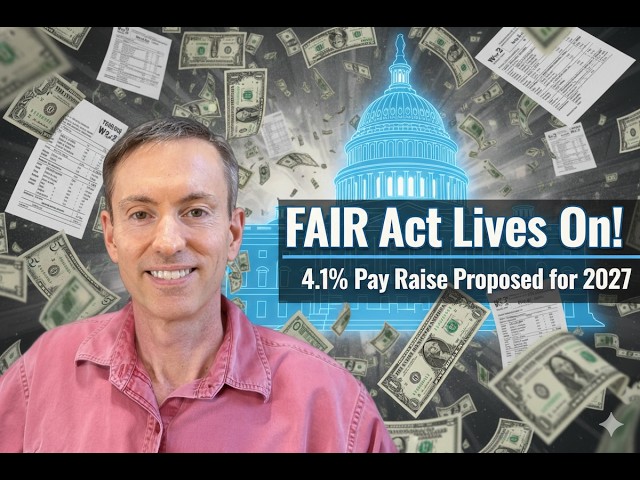
proposing for 2027. It would be a total
1:15
4.1% pay raise for current federal
1:19
employees. That would be a 3.1%
1:22
acrosstheboard average pay increase and
1:25
1% average locality pay adjustment.
1:29
And obviously locality pay varies
1:32
depending on what area of the country
1:33
you're in, but those are the average
1:37
And the rationale behind the fair act,
1:40
it it um it always proposes a raise
1:43
higher than what federal employees are
1:45
likely to get otherwise. The pay raise
1:47
is almost always determined by the White
1:50
House, the president. Congress can get
1:52
involved, but it's unusual. Typically,
1:55
what will happen is the White House will
1:57
propose a pay raise each year in the
2:00
budget proposal for the coming year.
2:02
That usually happens in the spring.
2:06
Throughout the year, Congress could get
2:07
involved. So, something like the Fair
2:09
Act, if it were to become law, would
2:11
enact a pay raise for the coming year.
2:13
Usually though, it would get um if if
2:16
Congress does get involved, it's going
2:17
to become part of a larger spending
2:19
bill. That would probably be more
2:21
typical. And so, if Congress did
2:23
override what the president proposes,
2:25
that would be the pay raise. But that's
2:27
pretty unusual. In August, the president
2:30
issues an alternative pay plan letter is
2:32
what it's called, and that that's kind
2:34
of the next step in the process. That's
2:36
where he formally outlines his request
2:38
for what he thinks the pay raise should
2:39
be for the coming year. And then it gets
2:42
finalized in December when an executive
2:43
order is issued and the Office of
2:45
Personnel Management issues uh pay
2:48
tables shortly thereafter to finalize
2:50
the raise. That's the typical process.
2:53
Before you get too excited about getting
2:55
a 4.1% pay raise next year, I want to
2:57
emphasize it's very unlikely that this
2:59
is going to become law. The Fair Act has
3:01
never become law throughout its history.
3:04
But it does signal congressional
3:05
priorities. It gets the the process
3:08
going. As I said, it keeps pressure on
3:11
the White House, but it it does help to
3:13
shape the uh public and political
3:16
conversation about federal pay. And one
3:18
last thing that's important to note, uh
3:21
this is different from a COLA, the cost
3:23
of living adjustment. This what we're
3:26
talking about here today is a pay raise
3:28
for current federal employees. This
3:30
would not impact retired federal
3:32
employees in any way. The COLA is
3:34
determined by an automatic formula. It
3:36
never changes. It's based on inflation.
3:38
The pay raise is determined by a
3:40
political process. As I briefly outlined
3:42
in this video, it's not based on
3:44
inflation like the COLA is, at least not
3:46
directly. If inflation's running higher,
3:49
federal employees might be likely to get
3:51
a higher pay raise than they would other
3:53
otherwise just from the political
3:55
pressure that's created by uh the fact
3:58
that inflation's higher. But that's a a
4:00
basic update on the situation. I hope
4:02
you found this helpful. Um it is still
4:05
very early on in the process. We don't
4:06
have a final number for what the 20 27
4:09
pay raise will be yet, but as the
4:12
process unfolds throughout the year,
4:14
stay tuned to FedSmith here on this
4:16
channel. You can like and subscribe for
4:18
updates and also visit our website,
4:20
fedsmith.com, because we will be
4:22
providing updates as they become
4:24
available on what your pay raise is
4:26
likely to be in the coming year. Have a