0:00
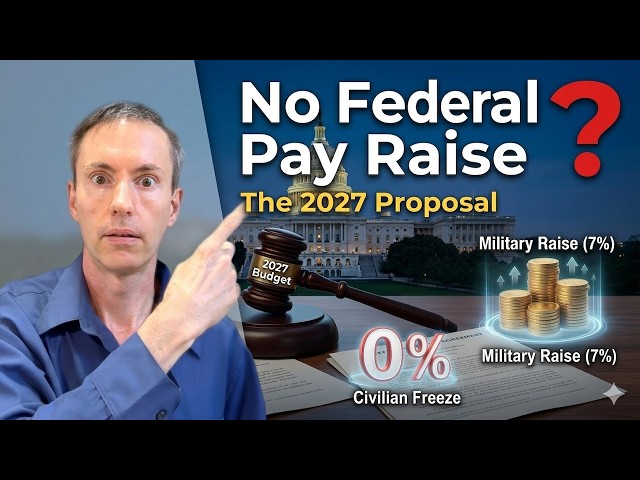
The 2027 White House budget proposal has
0:03
proposed a 7% pay raise for members of
0:06
the military, but no pay raise for
0:07
civilian federal employees. If that
0:10
ultimately comes to pass, that would be
0:12
a stark departure from traditional pay
0:15
parody between those two groups. Let's
0:17
talk about the details.
0:19
Hello everyone, I'm Ian Smith with
0:21
fedsmith.com and I wanted to bring an
0:23
update to you today about the White
0:25
House's 2027 budget proposal that was
0:27
just released at the end of last week.
0:29
I'm recording this on Saturday, April
0:32
4th. Happy Easter weekend to you. Um,
0:35
and the the budget proposal came out and
0:38
as I said, it proposed a 7% pay raise in
0:40
2027 for members of the military, but it
0:43
was silent on the matter of a pay raise
0:45
for civilian federal employees. That
0:48
doesn't mean that's ultimately for sure
0:49
what's going to come to pass, but it it
0:52
certainly looks like that's what the
0:54
White House is proposing. So what this
0:57
um lack of a pay raise signals is three
1:01
things primarily. Fiscal restraint and
1:03
that is that the administration is
1:05
prioritizing cost cutting or shifting
1:07
funds elsewhere namely the military in
1:10
this case. Um it's also not a high
1:12
priority. Civilian pay is is not a
1:15
near-term policy focus for the Trump
1:17
administration. And also it would be the
1:21
default. So unless Congress steps in to
1:24
authorize a pay raise on their own, then
1:26
what will happen as part of the annual
1:28
pay raise process is it will default to
1:30
whatever the president has proposed or
1:32
not proposed in this case. Now, if you
1:34
take a look at this table, this is the
1:36
pay raise for the military and federal
1:39
employees for the last few years. And it
1:41
shows how the the pay gap between
1:44
military and current federal employees
1:46
is widening. In 2024, you can see the
1:49
pay raises were equal, but in 2025, a
1:52
clear gap begins to emerge between the
1:54
two. Um, and in 2026, it widened even
1:57
further, as you can see, 3.8 versus 1%.
2:00
And then again, if the 2027 proposal
2:02
were to come to pass, then that would be
2:04
the largest gap yet. And the impact of
2:07
course of this is it it leads to pay
2:09
compression and can hurt morale among
2:11
the federal workforce. Congress so far
2:13
is not silent on the matter of a pay
2:16
raise. The Fair Act was introduced again
2:18
this year. That's a bill that has been
2:21
proposed every year for about a decade
2:23
now. Historically was proposed by
2:25
Senator Brian Shatz, a Democrat from
2:28
Hawaii, and Congressman Jerry Connelly,
2:30
a Democrat from Virginia. And
2:32
Congressman Connelly, of course, passed
2:34
away not that long ago, but another
2:37
congressman has taken up introducing the
2:41
since that time. And it wasn't
2:43
introduced again this year. And the
2:45
proposal was for an average 4.1% pay
2:48
raise. It would be a 3.1% acrosstheboard
2:51
raise plus 1% average locality pay
2:54
increase. So it's at least a starting
2:58
point for a negotiation. I did another
3:01
video on the Fair Act. I'll leave a link
3:03
to that in the description if you'd like
3:05
more details. I've also got an article
3:07
about it on the fedsmith.com website.
3:10
Like I said, it's a starting point. The
3:12
Fair Act has never become law and the
3:14
raise is usually lower than what's
3:16
proposed in the Fair Act. It shows some
3:18
interest on the part of Congress and
3:20
it's possible Congress might step in
3:23
sometime during the year and enact
3:24
legislation for a pay raise for federal
3:27
employees. Certainly with a gap as big
3:29
as 7% versus 0% that's an argument in
3:33
favor of pay par. That's an argument
3:36
you'll hear. Well, if the military is
3:38
getting this amount, then federal
3:40
employees should get a higher amount for
3:42
equality sake. So, what are the likely
3:44
2027 scenarios as a result of this?
3:48
Well, one possibility is um if Congress
3:52
happens to defer to the president's
3:54
budget, namely that they don't take any
3:57
action and there is that becomes the
3:59
default raise. Another possibility
4:01
that's probably most likely is some kind
4:05
of compromise. And um also, President
4:09
Trump as part of that, he could offer us
4:10
a surprise. Last year, for instance, the
4:13
same thing happened. When the White
4:14
House's budget proposal came out in the
4:16
spring, it was silent on the matter of a
4:19
pay raise. But then in August, when
4:21
President Trump issued his annual pay
4:22
plan letter, there was a surprise in it,
4:25
and he proposed a 1% pay raise for most
4:27
federal employees. And that's what ended
4:29
up happening. And some federal employees
4:32
did end up getting a higher pay raise in
4:34
federal employees in law enforcement.
4:37
But um that could happen again. There
4:39
could be a surprise or um Congress could
4:42
step in, negotiate it, pass some kind of
4:44
legislation. And another possibility is
4:47
that um there's enough political
4:50
pressure or a major shift in economic
4:52
conditions and you end up with like a 3
4:53
to 4% raise. Um, that's unlikely, but
4:57
it's it's certainly a possibility. And I
4:59
I forgot to mention in the the second
5:03
a 1 to 2% raise would probably be the
5:06
most likely in that scenario. And again,
5:08
that's what happened last year. One
5:09
other point I'd like to make on this.
5:11
This is not a COLA. We're talking about
5:13
the pay raise here for current federal
5:15
employees. COLA stands for cost of
5:17
living adjustment, and that only applies
5:19
to retired federal employees. When this
5:21
topic comes up, a question we often will
5:23
get is,"Well, what about retired federal
5:25
employees? Will we get this raise also?"
5:27
The answer is no. This is only
5:29
applicable to current federal employees.
5:32
And even for current federal employees,
5:34
as I said, this process plays out during
5:36
the year. It's a political process. But
5:38
if you're a retired federal employee,
5:40
you get a a cost of living adjustment, a
5:42
COLA. It's determined by an automatic
5:44
formula every year, but we'll find out
5:46
what the COLA will be in October. So,
5:48
that's a general overview of the
5:50
situation. As I said, the budget
5:52
proposal was silent on the matter of a
5:54
raise for federal employees, but it did
5:56
propose a 7% pay raise for the military.
5:58
How that will ultimately play out for
6:00
both groups is yet to be determined, but
6:04
this is a starting point in the process
6:06
and we'll of course continue to keep you
6:08
updated on this as more information
6:10
becomes available. So, stay tuned here
6:12
to our YouTube channel and also visit
6:13
the fedsmith.com website because we have
6:15
articles on this and other topics. And
6:17
we have written an article on this
6:19
particular topic and I'll be sure to
6:20
leave a link in the description to that
6:23
if you'd like more information. So,
6:25
thank you for watching and have a happy