Up next in 10


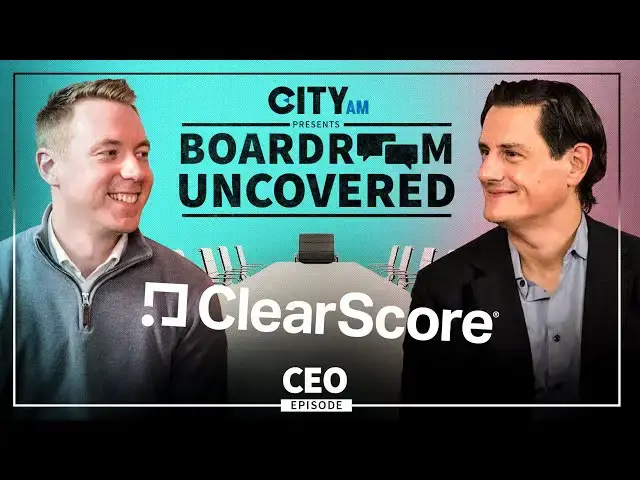
In the latest episode of Boardroom Uncovered, City AM's UK Editor Jon Robinson delves into issues of tax fairness with ClearScore CEO Justin Basini, who describes it as “unforgivable” that large companies can avoid paying their due tax in the UK.
Basini also reveals his ambition to float ClearScore in London, calling it the “signature achievement” he hopes to deliver for the business.
He argues that the capital is the “natural home” for the company, given its UK‐centric operations and brand familiarity.
More from Boardroom Uncovered here 👇
https://linktr.ee/boardroomuncovered
#fintech #economy #news #business #politics #uk #uknews
Show More Show Less View Video Transcript
0:00
setting up a business uh for yourself,
0:02
the chances are it's going to fail.
0:04
Credit scores were just becoming so
0:06
important to people's lives. You know,
0:08
you walk into a mobile phone shop and
0:10
you want to get a contract, you're going
0:12
to be credit scored. You want to rent a
0:14
flat, you're going to be credit scored.
0:15
If you work for a bank, you're probably
0:17
going to be credit scored. And that's
0:18
even before you think about applying for
0:20
credit cards and personal loans and all
0:22
of that. It's not about how wealthy you
0:23
are. It's about how you have uh behaved
0:27
when people have lent you money. You
0:28
have to be resilient and optimistic
0:30
because you know setting up a business
0:33
uh for yourself the chances are it's
0:35
going to fail.
0:36
Hello and welcome to another edition of
0:38
city's boardroom uncovered with me John
0:40
Robinson. My guest for this episode is
0:42
Justin Bassini the CEO of Clear Score.
0:45
Basini co-founded the business in 2015
0:48
which is now in the early stages of
0:49
drawing up plans to become a public
0:51
company. But what will it take for the
0:53
London Stock Exchange to convince Clear
0:55
Score to not follow so many UK tech
0:58
firms and choose New York instead? And
1:00
what's the secret behind making credit
1:02
scores interesting? Without any further
1:05
delay, let's dive in. Well, Justin,
1:07
thank you very much for coming in to
1:08
recover. It's great to have you here.
1:10
It's great to be here. Thanks for
1:11
inviting me, John.
1:12
I think the only place to start is this.
1:14
How on earth do you make credit scores
1:17
interesting?
1:18
Well, credit scores are incredibly
1:20
interesting. Don't you find them
1:21
interesting? I can't believe you don't,
1:24
John. I'm sure you've got an amazing
1:26
credit score.
1:26
Well,
1:27
but basically, you know, the the reason
1:28
I set Clear Score up was because I saw
1:30
when I worked at Capital One, the credit
1:32
card company, how credit scores were
1:34
just becoming so important to people's
1:36
lives. You know, you walk into a mobile
1:38
phone shop and you want to get a
1:40
contract, you're going to be credit
1:41
scored. You want to rent a flat, you're
1:43
going to be credit scored. If you work
1:44
for a bank, you're probably going to be
1:46
credit scored. And that's even before
1:48
you think about applying for credit
1:49
cards and personal loans and all of
1:51
that. So I think they're endlessly
1:52
fascinating and I think everybody should
1:54
basically be in charge of their own
1:56
credit score and that's why we set up
1:57
Clear Score.
1:58
Yeah. You say about I've got a good
2:00
credit score. I actually when I was
2:01
applying for a mortgage with my now
2:03
wife. We obviously checked our credit
2:05
score to make sure it was okay. And mine
2:07
was ever so slightly better than hers.
2:08
Yes.
2:09
And I still don't let her forget that.
2:11
Right. How did she feel though?
2:12
Oh, she was mad. She was absolutely mad.
2:14
Hers was good as well, don't get me
2:16
wrong, but mine was ever so slightly
2:17
better.
2:17
Yeah. The competition around credit
2:19
scores. People, human beings just love
2:21
scores. And so that's why the product is
2:23
so engaging because people love being
2:25
judged and knowing what's going on. So
2:27
what we try and do is we try and give
2:29
people access to that so that they can
2:30
improve their credit score. You know, on
2:32
average, people who log into Clear Score
2:35
um regularly improve their credit score
2:37
by about 80 points.
2:38
80 points. Yeah. So the average credit
2:40
score is about like a 380. And so
2:43
somebody who's in doing the things that
2:44
we recommend, registering for the
2:46
electoral role, all of that sort of
2:47
stuff, they'll see their score go up.
2:49
And what that means is they get access
2:50
to the credit that they deserve and it's
2:52
cheaper prices. So it really makes a
2:54
difference.
2:54
This is probably the perfect point for a
2:56
little explainer if you could. What is a
2:58
credit score? Why is it important? What
3:00
do you use it for?
3:01
Right. So a credit score is a very
3:03
simple thing. What it does is it is a
3:05
score typically out of a thousand um
3:08
which tells a lender um how likely you
3:11
are to pay back the money that they lend
3:14
you in 18 months time.
3:16
That's what it is. Okay. And so it uses
3:18
all of the historical data that is about
3:20
you and so your behavior. Have you had a
3:23
credit card? Have you had a loan? Have
3:25
you had a mortgage? Have you had a
3:27
utility? And have you paid all of those
3:29
things? And of course, if you have paid
3:31
all of those things, then a lender will
3:33
assume that you're going to pay in the
3:35
future. And so therefore, you have a
3:36
high credit score and you're more likely
3:38
to get credit at a lower price. If you
3:41
have missed payments or actually if you
3:44
haven't had very much credit or no
3:46
credit, you're not going to have a
3:47
score. So I always joke that, you know,
3:49
probably the the king's credit score is
3:51
zero because he doesn't borrow any
3:53
money, right? It's so it's not about how
3:55
wealthy you are, it's about how you have
3:58
uh behaved when people have lent you
4:00
money.
4:00
And it is incredibly important as well,
4:02
but you don't really get taught about it
4:03
in school. You know, I didn't really
4:06
know what a credit score was until I
4:07
actually needed it for a mortgage.
4:10
Yeah, you don't you don't get taught
4:11
about these things. One of the things I
4:12
do apart from Clear Score is I chair the
4:14
money charity which goes into schools
4:17
trying to educate PE kids on how money
4:19
works. And one of the things we talk
4:21
about is credit scores and how you
4:23
should stay on top of it and what you
4:25
should do and how you should feel
4:26
confident. Uh what you should watch for
4:28
when you borrow money. You know, a lot
4:30
of people get a bit confused about
4:32
interest rates and things like that. So,
4:33
it's all about basically building a
4:35
really healthy financial life.
4:37
I'm going to admit something now,
4:39
Justin, and I can't believe I'm doing
4:41
this on camera, but my wife and I, our
4:43
guilty pleasure is watching Married at
4:45
First Sight on E4.
4:47
Whose isn't? Well, I mean, you know, she
4:50
likes turning to me and goes, you know,
4:51
at least I'm not as mad as some of the
4:53
people on that show.
4:54
Yes. Yes. I'm very grateful. Um, but
4:56
what's I bring that up because Clear
4:59
Score sponsored the coverage in the UK
5:01
for a couple of years. I'm interested to
5:03
know why you were going after targeting
5:06
that demographic.
5:08
Well, we we don't really target any
5:09
demographic in the sense of like we're
5:11
an every man every person product,
5:13
right? So, around the world, we have 26
5:16
million users. In the UK, I have 15
5:18
million. So, I have affluent people and
5:20
less affluent people and I have good
5:22
credit scores and not good credit
5:24
scores. You know, we really are for
5:25
average people across the UK. Um, one of
5:28
the things that we always want to do is
5:30
just build our brand and get our name
5:31
out there and Married at First Sight is
5:34
a uh, you know, great program. Uh, we we
5:37
sponsored it and it worked really well
5:39
for us to drive that brand awareness.
5:40
Do you watch it?
5:41
I do.
5:42
Oh, there we go. So, it's not just me.
5:43
Yeah. Married at First Sight Australia.
5:46
So my wife is a big fan of that. We
5:47
always watch that. And um and Married at
5:50
First UK less. So my wife watches that,
5:52
but I don't really.
5:53
Okay. Fantastic. I feel a little bit
5:55
better now for seing that.
5:56
Yeah. Don't be embarrassed.
5:59
Was a guilty pleasure for a reason.
6:01
Right. There's a bit of guilt attached.
6:03
Talk to me about co-founding Clear
6:05
Score. How have you got to this position
6:06
now? You're about 10 years old now as
6:08
well. Tell me about your career, how you
6:10
got to this stage.
6:10
Yeah. So I started my career with uh
6:12
Proctor and Gamble. They're a big
6:14
consumer packaged goods company, US
6:16
company. They make things like Pampers,
6:18
nappies, and aerial and Pantene shampoo.
6:21
And what I learned there was I learned
6:23
really product development and building
6:24
big brands, which is what Proch Gamble
6:26
does really, really well. Um, then I
6:28
left there and I set my first startup
6:30
up. This was the uh dot boom. And so I
6:33
was going to be a millionaire by the
6:34
time I was 30. It was going to be
6:35
incredible. And as the market went up,
6:37
it was brilliant. And as the market
6:39
crashed, it was not so good. Lost some
6:41
money, that business went down. took
6:43
that quite hard really like started to
6:46
think about you know what I wanted to do
6:47
next. I needed to make this money back
6:49
that I'd lost and so I managed to black
6:52
my way into Deutsche Bank. Um and I
6:55
spent four years pretending to be an
6:56
investment banker. Um and uh you know in
7:00
the city it was very useful for the
7:02
perspective of learning how money works
7:05
you know and obviously we're sitting in
7:06
the city now and you know seeing all
7:08
those capital markets and how it works I
7:10
think is is has been good preparation
7:12
for being an entrepreneur. Then I went
7:15
to Capital One and Capital One a big
7:17
credit card company US um and I learned
7:20
consumer credit and that's where I saw
7:21
the power of the credit score and I saw
7:23
the power of like credit and and helping
7:25
people access credit in a fair way in an
7:28
affordable way in a way that they
7:31
understand. That's really what I wanted
7:32
to do there. learned that and then uh in
7:35
2014 I came up with the idea of uh clear
7:38
score and founded the business in 2015
7:41
and as you say we're 10 years old this
7:43
year.
7:44
How did you get the confidence to quit
7:46
your job and start a business from
7:48
scratch? Obviously you did you do boom
7:51
and you had that experience. You must
7:53
have had some scars and some trepidation
7:55
from that experience going into clear
7:56
score.
7:57
Yeah, definitely. And I just I when I
7:59
left cat one I set up one for a couple
8:01
of years and I sold that and that was
8:03
quite difficult because raising money so
8:05
clear school was my third time lucky if
8:07
you like and and I think that that's
8:09
often a hallmark of um you know
8:13
successful entrepreneurs that you have
8:16
to be resilient you know the the chance
8:18
you have to be resilient and optimistic
8:20
because you know setting up a business
8:22
uh for yourself the chances are it's
8:25
going to fail that the math the maths is
8:27
underlying iable, right? You know, it's
8:29
like one in a thousand businesses
8:31
survives survives its first year. If you
8:33
track that forward, it's like a
8:34
minuscule percentage of businesses that
8:36
actually succeed. And so, you have to be
8:39
optimistic. You have to believe that
8:41
you're going to be in that 1% that that
8:42
that group that's going to work. And you
8:45
have to keep going because the chances
8:47
are you will have a go and it might not
8:50
work. And then you've got to like dust
8:52
yourself off. You've got to think again
8:54
and you've got to go again. And
8:56
successful entrepreneurs often do that.
8:58
And so all of these sort of like
8:59
overnight successes often have been the
9:02
result of, you know, often decades of
9:05
hard work, resilience, having a go,
9:08
failing and then starting again. I often
9:10
say to entrepreneurs, you know, we we we
9:12
focus a bit too much on the Googles and
9:14
the Facebooks and the Elon Musks and
9:16
they're the exceptions, you know,
9:18
amazing stories, but they're the
9:19
exceptions. The rule is resilience. The
9:23
rule is like keeping going. The rule is
9:26
starting and failing, starting and
9:28
failing, starting and then having a
9:30
success. And that's the thing that we
9:32
really need to like praise and
9:34
encourage, I think.
9:35
Do you think the UK is very good at
9:36
championing entrepreneurs and
9:38
encouraging particularly younger people
9:40
to take that leap of faith?
9:42
I think we're quite good at it. Yeah. I
9:44
mean if you look at some of the things
9:46
that were have been established over the
9:48
last 20 years um you know that it's it's
9:51
relatively easy now to raise startup
9:54
capital with EIS and SEIS schemes.
9:58
There's quite a lot of founder and angel
9:59
networks and things like that. If you go
10:02
to schools people will talk a lot about
10:04
you know setting up businesses and
10:05
entrepreneurialism. And it's
10:07
fundamentally easy to set a business up.
10:10
you know you can go to company's house
10:11
within a couple of weeks you can have a
10:13
business right that's very different to
10:14
if you go to other markets it's much
10:17
more complicated so I think that startup
10:19
ecosystem is relatively strong it's a
10:23
little bit too much focused on the
10:25
southeast and London um and so I think
10:28
some of the uh initiatives to broaden it
10:31
across the country and into the devolved
10:33
nations I think is really is really
10:34
great um the challenge for the UK is
10:37
scaleups and so how do you take the 1 2%
10:41
of companies that really can become
10:44
global and national winners and really
10:46
support them. Um, and that's the thing
10:48
that I think the the economy needs to do
10:51
now.
10:51
Okay, Justin, we've got some quickfire
10:53
questions for you now. Are you ready?
10:54
Great.
11:00
Okay, first up, what was your first job?
11:02
My first job was ride operator at
11:04
Chestington World of Adventures.
11:05
I mean, tell me more than that. What was
11:07
the ride? So, um, so I used to operate
11:10
all of the rides. So, I used to go in
11:13
and, uh, I had a red shirt on and blue
11:15
trousers and we used to go all loads of
11:17
young people and you'd get trained up to
11:19
operate what is essentially big
11:21
machinery. So, I used to operate the
11:23
vampire ride, bubble works. Uh, I spent
11:28
months and months and months on the
11:29
magic carpet ride. So, yes, that was my
11:32
first job.
11:33
That's probably the best answer that
11:34
we've had so far. That's amazing. Um,
11:37
who inspires you?
11:38
At the moment, I'm going to say my wife
11:40
inspires me. So, um, my wife is, uh, a
11:45
novelist, journalist, podcaster, and she
11:47
is just super productive. She is
11:50
handling a load of pressure with the
11:51
launch of her new novel, and I just
11:53
really admire the way that she handles
11:55
herself.
11:56
Okay. Uh, if you had to appoint a
11:58
celebrity to your board, who would it
12:00
be, and why?
12:01
Uh, I think I'd like to appoint somebody
12:04
like Lewis Hamilton. Okay.
12:06
Love his story.
12:08
Um, you know, obviously came from, you
12:10
know, pretty humble beginnings, real
12:12
technology, real performance. And I
12:15
think what he's done
12:16
and we we'll see whether he go whether
12:18
he does this at Ferrari, but that
12:20
creating a performance environment of
12:22
optimization is something that I think
12:25
every digital business needs to do and I
12:27
think he would have some insights in
12:28
that space and it would be cool to have
12:29
him on the board.
12:30
Absolutely. What's the best thing about
12:32
your job? Best thing about my job is the
12:35
impact that I have on users around the
12:37
world. So 26 million users. I love the
12:41
fact that I can we've got a business
12:43
down in South Africa and I land at at
12:46
Cape Town. I'll jump into an Uber. I'll
12:48
generally talk to the cab because I love
12:51
talking to cabbies about you know money
12:52
and stuff. Great insight and and they
12:55
will know clear score. Might have it on
12:57
their phone. That's the best thing about
12:59
my job. And if you weren't doing this,
13:01
what would you be doing?
13:03
Uh, I think I would be uh a chef.
13:08
A chef? What kind of chef?
13:09
Probably Italian food. My grandmother
13:12
taught me how to um make Italian food
13:15
and I love that. And so that's something
13:17
that gives me great joy.
13:18
Yeah. And if you were prime minister for
13:20
the day, what would you do? If I was
13:22
prime minister for the day, I would uh
13:25
pass a law that every big company needs
13:28
to pay the tax that they uh generate
13:31
based on their revenue in that nation.
13:34
And that's obviously something in your
13:35
opinion that the government of all
13:37
colors haven't done properly. Can you
13:39
expand on that? Yes, it was um you know
13:41
I think it's uh frankly unforgivable to
13:45
operate large businesses in a nation and
13:47
then optimize your tax position so that
13:49
you don't pay money in that you don't
13:52
pay tax in that uh in that nation. Um it
13:56
you know Biden nearly pulled off a
13:59
global sort of tax deal that I think
14:01
would have guaranteed like 15% tax being
14:04
paid. um with the change in the White
14:07
House that's gone. But I think that's a
14:09
really important thing. You know,
14:10
there's a social contract in my mind
14:12
between having a shop on every corner
14:16
and paying some tax to the
14:18
infrastructure and to the people and to
14:20
the education system and to the and to
14:22
the health service that is keeping that
14:24
business ultimately going.
14:25
Do you think it's likely that the
14:27
current occupiers of uh number 10 and
14:30
number 11 Downing Street would look at
14:31
that? Oh, I think they would be very um
14:34
keen on it, but it requires global
14:36
coordination and unfortunately we're in
14:38
an age where global coordination is
14:40
slightly less common than it was
14:42
previously.
14:42
Indeed, we obviously got the budget
14:44
coming up on the 26th of November. If
14:47
you could ring up Rachel Reeves now,
14:48
what would you be asking to appear in
14:50
that budget?
14:51
I think there are a few things that I
14:52
would ask for. Um the first is to her to
14:55
to continue um her efforts to unlock the
14:58
huge amount of capital that is sitting
15:00
on the sidelines. You know um there is a
15:03
lot of money sitting there waiting to be
15:05
invested. Um I think it needs to come to
15:07
UK capital markets. I think it needs to
15:09
come to UK companies. Um so all of the
15:12
Mansion House Accords that she put out,
15:15
you know, encouraging pension funds to
15:16
invest in great UK companies, listed UK
15:19
companies, I would be really encouraging
15:21
of that. And then I would also be
15:23
encouraging of getting retail investors
15:25
to um start to see uh the long-term
15:29
potential of backing UK businesses. So
15:32
um you know when my my dad was a teacher
15:36
uh but I remember him uh um with the Tel
15:40
Sid campaign in the 1980s you know
15:42
buying shares in British Gas and British
15:44
Telecom. Um, and what what he did was
15:48
infranchised him into, you know, oh, I'm
15:51
I'm paying for my telephone with British
15:52
Telecom. Well, I am a shareholder of
15:54
that. And I think we need to get back to
15:56
some of that. You know, all of this
15:57
retail money sitting mostly in cash.
16:00
Um, especially when people can uh, you
16:03
know, have time to ride out the ups and
16:06
downs of the stock market, they will get
16:08
better returns. Um, and uh, UK
16:11
businesses get the backing that they
16:12
need. Certainly when I was growing up,
16:14
you were just told about cash ISIS. That
16:16
that was basically the extent of any
16:18
financial education. That's what you do.
16:21
You got your current account, you got
16:22
your savings account with with your re
16:24
with your high street bank, and then you
16:25
might have a cash iser and that's it.
16:28
Investing seemed
16:30
something that generally people didn't
16:33
do.
16:33
Yeah. Maybe it was a bad thing that it
16:35
was too risky.
16:36
Yeah. Too risky.
16:36
You shouldn't do it. Absolutely. But
16:38
actually over the long term, especially
16:40
with younger people, um, investing in
16:43
equities is the route to get a a better
16:46
return than just keeping it in cash.
16:49
And, and we've got to have these
16:50
conversations with people and we've got
16:51
to start to think about that and get the
16:53
money flowing back into backing UK
16:56
business. Um, it'll be good for uh,
16:59
savers in the long run. It will be good
17:01
for pension funds and it will be good
17:02
for British business
17:04
and it'll be good for the London Stock
17:05
Exchange as well, which maybe you're
17:07
looking at joining in the next few
17:08
years.
17:09
Yeah, we we're not slavish about it, but
17:11
definitely um an IPO would be an
17:14
incredible um would be an incredible
17:16
achievement, you know, to go from uh you
17:19
know, a piece of paper, a business plan
17:21
10 years ago through to an IPO uh in
17:24
London would be a signature achievement
17:26
of my career and my team's career. And
17:29
so we're very we're interested in it. Of
17:31
course, we're looking at lots of
17:32
different options. Um, but yeah, it's
17:34
something that I think a lot about.
17:36
What would it take for the stock London
17:37
Stock Exchange to convince you to list
17:39
here rather than maybe follow your tech
17:42
competitors to New York?
17:44
Well, I think there's three or four
17:45
things that mean that, you know, London
17:48
is the natural home for a company like
17:50
Clear Score. You know, we have a
17:51
nationally recognized brand. Uh, 75% of
17:54
my business is here. I have 15 million
17:57
users. So all of that, you know, means
18:00
that London is a natural home. But I
18:02
also think there's a a thing which is
18:04
important to recognize is that, you
18:06
know, the US market, public markets are
18:08
just so so large.
18:11
And so uh I was at a a session with
18:14
NASDAQ in New York a few months ago and
18:18
one of the things that I took away from
18:20
that was they said the market doesn't
18:21
really open up until you're over 10
18:23
billion in market capitalization. Like
18:25
just 10 billion.
18:26
Just 10 billion. tiny.
18:28
The reality is that there aren't many UK
18:32
fintech companies that can get to that
18:34
valuation. You know, there's the
18:36
Revolutes and all of that and that's
18:38
fantastic, but the the vast majority of
18:40
us running great businesses u nationally
18:44
uh you know, competing in the UK and
18:46
then starting to build our international
18:48
uh businesses, you know, they they would
18:50
not get that sort of valuation and we're
18:53
not known in the US. And so for me uh
18:56
the UK is a natural home because I would
18:58
get the coverage. I would still get
18:59
access to all of the best investors in
19:01
the world and uh retail hopefully retail
19:04
investors would see the uh IPO. They
19:07
know our brand and would want to get
19:09
involved.
19:09
Last couple of years London Stock
19:11
Exchange has been a bit gloomy. At least
19:13
the narrative around it has been gloomy.
19:15
Does that concern you at all? I I think
19:18
the general level of gloom and pessimism
19:23
about our nation and our economy
19:25
generally is a bad thing, right? Um you
19:28
know the reality is that consumer
19:30
confidence, markets opening, business
19:34
confidence,
19:36
confidence in government, confidence in
19:38
democracy, all of those things are
19:40
linked together. And so, uh, what I'm
19:43
hoping over the next few years is that
19:46
we start to get a bit more positivity.
19:48
We get to start to get a bit more
19:49
momentum in all of those five areas. And
19:52
then it starts to feed on each other and
19:54
you start to get a really positive
19:56
dynamic happening. That requires uh that
19:59
requires uh multiple things to happen.
20:02
It requires uh you know money to start
20:05
flowing us to back British businesses
20:07
continued success of British businesses
20:10
the deregulation that the government's
20:11
doing all of those things need to come
20:13
in and some of the things that I think
20:15
the government are doing at the moment
20:16
to unlock invest investment in uh you
20:20
know electricity infrastructure in um
20:23
you know the climate change all of those
20:25
things will mean that inward investment
20:28
increases that creates hopefully more
20:31
momentum
20:32
mansion house accords keeps momentum
20:35
going and then you start to get more
20:36
positivity and that's ultimately what we
20:38
need. We need this country to be
20:40
successful. Whether you like the
20:41
government or don't like the government,
20:43
it's better to have a successful
20:44
government than a not successful
20:46
government. Right? That's my attitude
20:48
is, you know, I want this government to
20:49
succeed because we it's much better for
20:53
all of us if it is successful. Right?
20:55
And so, you know, I'm optimistic that
20:57
some of those things will start to play
20:59
out.
20:59
I suppose some people might find that
21:00
difficult. It makes complete logical
21:02
sense, but it's like a Man United
21:03
supporter rooting for Liverpool to win
21:05
the Premier League. might be good for
21:07
the Premier League overall maybe, but if
21:10
I can stretch that analogy that way, but
21:12
it's very difficult for them to cheer
21:14
for the other team if you're a
21:15
conservativeleaning voter or reform or
21:18
or or live dem it's it's quite difficult
21:20
to for many people to sit where you're
21:23
sitting, I suppose.
21:24
Yeah, I'm I'm sure that's right. You
21:25
know, and I'm not talking about it
21:26
necessarily from a party political
21:28
perspective. I'm talking about it from a
21:31
national perspective,
21:33
UK PLC. you know, I want this country to
21:36
be successful. I want our businesses to
21:38
be successful. I want uh employment to
21:42
continue to flourish. I want lots of job
21:44
opportunities. And though that that that
21:46
will only happen as the country gets
21:48
more confidence and that consumer
21:50
confidence goes up, consumer spending
21:52
starts to go up. That unlocks investment
21:55
and so the cycle continues. We're at a
21:57
particularly pessimistic time now and I
22:00
don't think that helps anybody. Boris
22:01
Johnson wants hit out of the gloomsters
22:04
and the doomsters, doesn't he? Does that
22:07
do they frustrate you in the same way as
22:08
maybe they frustrated him? Well, I think
22:11
it's frustrating uh when there's so much
22:14
uh good stuff happening in the UK, you
22:16
know, like I see the company that I run,
22:19
the people that I employ, um you know,
22:22
my my fellow fintech entrepreneurs, you
22:25
know, there's so much good uh business
22:27
being created, growth being created, um
22:31
you know, hugely talented people coming
22:33
out of universities. um an ability to
22:36
raise money and to create and to set
22:38
companies up uh pretty easily access to
22:41
capital you know it's maybe not as good
22:44
as the US where there's huge resources
22:47
and huge capital etc etc but if you look
22:50
at many many many many parts of the
22:53
world I would say most parts of the
22:54
world the UK still has a huge amount of
22:57
strengths and we need to play to those
22:58
strengths
22:59
yeah put the IP possible IPO to one side
23:02
tell me about the future of clear school
23:04
what are your plans
23:06
Uh we we're sort of the way I think
23:07
about it as I stood in front of my team
23:10
um in the middle of the year, you know,
23:12
celebrating our 10 years, you know, my
23:14
my reflection was that we're sort of at
23:16
the end of the beginning. We're only at
23:18
the end of that first chapter of Clear
23:20
Score. Clear Score still has a huge
23:21
amount of growth still to go and that
23:23
growth will come from continued
23:25
acquisition of customers. So more people
23:28
downloading Clear Score, getting in
23:29
control of their credit score and
23:31
report. Um, but it will also be about
23:34
continuing to take our technology into
23:36
financial marketplaces. That's really
23:38
the business is a financial marketplace
23:41
business. So, we set up a new app called
23:43
Drive Score a couple of years ago that
23:44
takes our technology and puts it into
23:46
car insurance so that you can prove
23:48
you're a good driver and save £450 on
23:51
your on your car insurance. So, we're
23:53
starting to move verticals and then
23:55
being able to expand our geographic
23:56
footprint. So moving from our UK, South
23:59
Africa, Australia, New Zealand, and
24:01
Canada base into other markets around
24:03
the world and that will continue to
24:05
power the growth of Clear Score over the
24:07
next decade, compounding hopefully at 20
24:09
to 25% growth a year and then starting
24:12
to see our profitability rise as well.
24:14
Sounds like you got your IPO pitch
24:15
already half written.
24:17
Well, you know, you've soft preparation,
24:19
John. Soft preparation.
24:20
You mentioned in the quickfire questions
24:23
about who inspires you, and you very
24:25
diplomatically said your wife.
24:26
Yeah. Um, I want to know who your
24:28
business idol is.
24:30
Uh, probably my business idol is
24:35
uh I know it's a bit of a cliche having
24:38
listened to a few previous episodes, but
24:40
I I I am I have studied a lot Steve Jobs
24:44
and I'm fundamentally a product
24:46
marketing guy, which I think he was as
24:48
well. Um and so yeah I find uh the
24:52
products that Apple have created that he
24:54
created which have created incredible
24:57
amount of growth around the world very
24:59
inspiring.
24:59
Not tempted by a black turtleneck then?
25:02
Uh no I wear the odd black t-shirt but
25:05
uh not a turtleneck yet anyway. Not yet.
25:07
Not yet.
25:08
I want to finish up with this question.
25:10
Justin,
25:11
what does it take to be a good CEO?
25:16
Um, that's a great question, John. Um,
25:21
I don't think there's a formula
25:26
um, necessarily. I think all the CEOs
25:29
that I have admired or
25:32
um spend time with have our own sort of
25:34
strengths and weaknesses, but I think
25:37
it's being able to understand those
25:39
strengths and weaknesses and create a
25:41
team that um a team that sort of creates
25:46
that balance. I think probably at the
25:49
heart of it though is an ability to
25:52
um communicate something that is at the
25:56
core of your business. And it doesn't it
25:58
doesn't necessarily need to necessarily
26:00
be vision or mission. It can be just
26:02
making money or whatever. For us at
26:04
Clear Score Group, it's all about the
26:05
mission of trying to have impact on
26:07
users. But I think having a CEO who owns
26:10
that and in their own way, whether
26:12
that's extroverted or introverted or
26:14
through the numbers or through stories,
26:17
can communicate that uh motivationally
26:20
to a group of people, whether that's
26:22
employees or customers or investors. I
26:26
think that's a pretty important part of
26:28
the job.
26:28
Great. Justin, thank you very much for
26:30
your time.
26:30
Thank you, John. Been great to be here.
Business Finance
Credit & Lending
News