Up next in 10

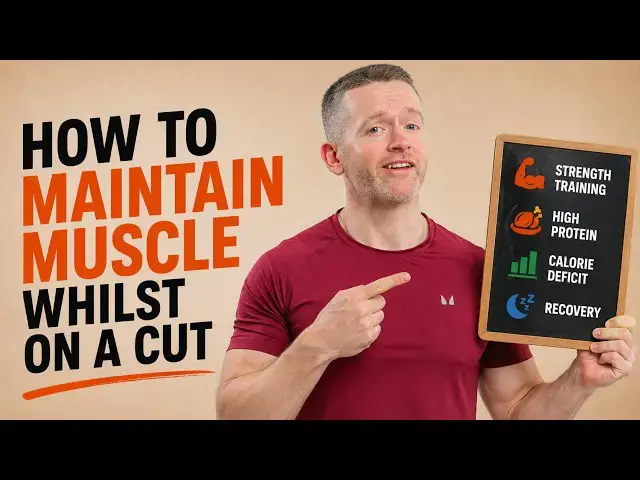
How to maintain muscle whilst on a cut!
Jun 29, 2026


Want to lose body fat without sacrificing the muscle you've worked hard to build?
In this video, expert nutritionist Dr Richie Kirwan explains how to maintain muscle while on a calorie deficit and the key nutrition and training strategies that make the biggest difference.
Dr Richie Kirwan answers some important questions like, how much protein should you eat while cutting? Can you build muscle and lose fat at the same time? And what are the biggest mistakes people make that lead to muscle loss during a cut?
There are a lot of myths surrounding fat loss and muscle retention, and Richie breaks down the science behind preserving lean muscle so you can achieve a leaner physique without compromising your hard-earned progress.
Show More Show Less View Video Transcript
0:00
Most people who lose weight by dieting
0:02
end up losing [music] a significant
0:03
amount of muscle, too. Here's how to
0:05
make sure you're not one of them.
0:10
How's it going, guys? My name is Richie
0:11
Kirwan. I'm a registered nutritionist, a
0:13
researcher, and a university lecturer in
0:14
nutrition and exercise physiology.
0:17
Today, we're going to talk about why
0:19
maintaining muscle during weight loss
0:20
matters so much and exactly what you
0:23
need to do to make sure it happens.
0:25
We'll cover the most important thing
0:27
[music] you can do in the gym, how much
0:29
protein you actually need, and a few
0:31
other practical strategies that make a
0:33
real difference. Let's get into it. So,
0:36
let's start with the question of why
0:38
this even matters. When you go on a diet
0:41
and lose [music] weight, what exactly
0:42
are you losing? The answer,
0:44
unfortunately, is not purely fat. A
0:47
systematic review looking at the effect
0:48
of calorie restriction found that
0:50
roughly 24%
0:52
a quarter of the weight loss during
0:54
dieting alone, without any exercise, is
0:57
lean tissue, which is mostly muscle. So,
1:00
for every kilogram you lose, around 240
1:03
g of that is muscle mass. Lose 10 kg and
1:05
you potentially [music]
1:06
lost nearly 2 and 1/2 kg of muscle along
1:10
with the fat.
1:11
That's [music] a lot.
1:13
Now, why does that matter?
1:15
There's a few reasons. The first is
1:16
pretty obvious. If you lose a lot of
1:18
muscle while you're losing fat, you end
1:20
up with what people sometimes call a
1:22
skinny fat physique. Lower body weight
1:24
on the scale, but soft with very little
1:27
shape or definition. Because the lean,
1:29
defined look [music] most people are
1:30
actually going for requires muscle
1:32
underneath a lower level of body fat.
1:35
Without the muscle, just looks smaller,
1:37
not better.
1:38
The second reason is your metabolism.
1:40
Muscle is a metabolically active tissue,
1:43
meaning it [music] burns energy even at
1:44
rest. When you lose muscle during your
1:47
diet, your resting metabolic rate drops,
1:49
[music] which makes it progressively
1:50
harder to keep losing fat and much
1:53
easier to regain weight afterwards. This
1:56
is one of the reasons so many people
1:57
find that weight just piles back on
1:59
after a diet ends. And the third reason
2:02
is your health. Your muscles are one of
2:04
the primary sites in the body for taking
2:07
up [music] and using blood glucose.
2:10
More muscle means better blood sugar
2:12
control and better insulin sensitivity.
2:14
Lower muscle mass, on the other hand, is
2:16
associated with a lot of different
2:19
negative health outcomes, from
2:21
cardiovascular disease to type 2
2:23
diabetes. So, this isn't just an
2:25
aesthetic issue. It genuinely matters
2:28
for your long-term health. The good news
2:30
is that with the right approach, you can
2:32
lose fat and hold on to almost all of
2:34
your muscle.
2:35
So, let's talk about how you do that.
2:38
When you go on a diet and lose weight,
2:39
what exactly are you losing? Because the
2:41
answer isn't purely fat. Research shows
2:44
that when people diet without doing any
2:46
exercise, somewhere around 25% of the
2:49
weight that they lose comes from lean
2:51
tissue, which is mostly muscle.
2:53
So, for every kilogram you lose, roughly
2:56
1/4 of that is muscle.
2:59
Lose 10 kg and you've potentially lost 2
3:01
and 1/2 kg of muscle along with the fat.
3:05
That's a lot, considering how hard it is
3:07
to build muscle. We're all seeing a very
3:10
real-world example of this playing out
3:12
right now with GLP-1 medications. Things
3:15
like Ozempic and Wegovy have become
3:17
incredibly popular for weight loss
3:20
because they work.
3:22
But, there's been a lot of concern, and
3:23
rightly so, about the amount of muscle
3:25
people lose while using them. Studies on
3:28
semaglutide have reported that somewhere
3:30
between 25 and 40% of total weight loss
3:33
can come from lean mass, which is a lot.
3:37
>> [music]
3:37
>> But, the important thing to understand
3:38
here is that the muscle loss isn't
3:40
caused by the medication itself.
3:43
GLP-1 drugs work primarily by
3:45
suppressing appetite, which puts people
3:47
into a significant calorie deficit.
3:50
>> [music]
3:51
>> And most of the time, they're not doing
3:53
much exercise.
3:54
It's that combination [music]
3:55
of a big calorie deficit with no
3:57
resistance training that causes the
3:59
muscle loss.
4:01
Now, muscle matters for a few reasons,
4:03
and I'm not even going to pretend that
4:06
aesthetics don't matter to you because
4:08
they matter to a lot of people.
4:10
Muscle affects how you actually look.
4:12
Losing muscle and fat together can give
4:14
people that deflated, skinny fat
4:17
appearance rather than the lean, defined
4:20
look most [music] people are after.
4:22
And with the amount of work people put
4:23
into building muscle in the gym, the
4:25
last thing you want to do is lose it.
4:28
Losing muscle alongside fat can also
4:30
affect your metabolism because muscle is
4:33
a metabolically active tissue that burns
4:35
energy at rest.
4:37
Lose enough of it, and your resting
4:39
metabolic rate can drop, making it
4:41
progressively harder to keep losing fat
4:44
and much easier to regain weight once
4:46
the diet ends.
4:48
And beyond aesthetics, and most
4:49
importantly in my opinion, muscle plays
4:51
an enormous role in long-term health,
4:54
helping lower your risk of metabolic
4:56
syndrome, diabetes, [music]
4:57
cardiovascular disease, and helping you
5:00
age better overall.
5:02
The good news is that it is entirely
5:04
preventable with the right [music]
5:05
approach, and that's what the rest of
5:08
this video is about. So, if muscle loss
5:10
during a calorie deficit is largely the
5:12
result of dieting without exercise, the
5:14
obvious next question is,
5:16
>> [music]
5:16
>> what kind of exercise actually fixes it?
5:19
And the answer, without a shadow of a
5:21
doubt, is resistance training. [music]
5:24
Not cardio, not walking, it's moving
5:27
against [music] resistance. Your body
5:30
only holds onto muscle when it has a
5:31
good reason to do so, and that reason is
5:34
the mechanical stimulus of lifting
5:36
weights. When you challenge your muscles
5:39
consistently, you send a clear signal to
5:41
your body that this tissue is needed
5:43
[music] and worth maintaining
5:45
even when calories are restricted.
5:48
Without that signal, there's no real
5:49
reason for your body to prioritize
5:51
muscle over other energy sources when
5:54
you're in a deficit. The research on
5:55
this is really convincing, too.
5:58
One large meta-analysis of randomized
6:00
controlled trials including young adults
6:02
specifically found that lean mass was
6:05
effectively maintained in groups
6:07
combining resistance training with
6:09
calorie restriction. Whereas groups only
6:12
dieting lost significant amounts of
6:15
muscle. Now, this doesn't mean you need
6:17
to train like a competitive bodybuilder.
6:19
Training each muscle group a few times a
6:21
week with enough effort to genuinely
6:23
challenge yourself, and by that I mean
6:24
training close to failure, is enough to
6:27
hold on to muscle during a cut. The
6:29
keyword here though is effort.
6:31
>> [music]
6:31
>> Going through the motions just won't cut
6:32
it. You need to be pushing close to your
6:35
limits on your sets [music]
6:36
and consistently trying to do a little
6:38
more over time.
6:40
So, if you do one thing to protect your
6:42
muscle while losing fat,
6:45
lift some damn weights.
6:47
>> [music]
6:47
>> It's way more important than anything
6:50
else I'm going to mention after this.
6:52
The second most important thing you can
6:53
do to protect your muscle during a cut,
6:55
and probably the thing people focus
6:56
[music] on a little too much, is eating
6:59
enough protein.
7:00
And I'm going to be honest with you
7:01
here. Most people in the gym massively
7:04
overestimate how much they need.
7:07
When it comes to muscle growth, we know
7:09
that around 1.6 g of protein per
7:11
kilogram of body weight per day appears
7:13
to be sufficient to support muscle mass
7:16
during resistance training.
7:18
So, for an 80 kg person, that's 128 g of
7:21
protein [music] a day. To a lot of you,
7:23
that probably doesn't sound like much at
7:25
all.
7:26
Chicken breast, a few eggs, some Greek
7:28
yogurt, and a protein shake, and you're
7:30
basically [music] there. That's it.
7:32
We're not necessarily talking about
7:33
muscle growth.
7:34
Just holding onto muscle while losing
7:37
body fat.
7:38
Now, even if you're not doing resistance
7:40
training, which you should be by the
7:42
way, and you're just dieting to lose
7:44
fat, protein still matters.
7:47
One meta-analysis of 24 randomized
7:49
controlled trials found that people
7:51
eating a higher protein diet during
7:52
calorie restriction lost significantly
7:54
more fat and held onto significantly
7:57
more lean mass compared to those on a
7:59
lower [music] protein diet
8:01
even without structured exercise. The
8:04
amount of protein was actually really
8:05
modest, too, around 1.25 g per kilogram
8:09
of body weight per day
8:10
versus around 0.7 g per kilogram [music]
8:13
of body weight per day. For an 80 kg
8:15
person, that's just 100 g of protein a
8:17
day. So, protein is doing something
8:20
useful here, regardless of whether
8:21
you're lifting or not. [music]
8:23
It's just that lifting makes it even
8:25
better. That said, there are situations
8:27
where you might need more protein than
8:29
the standard recommendations. If you're
8:31
already quite lean and you're pushing
8:33
yourself into a more aggressive calorie
8:35
deficit, [music]
8:36
the evidence suggests your protein needs
8:38
may go up. Another systematic review
8:40
looking specifically at lean,
8:43
resistance-trained athletes in a calorie
8:45
deficit concluded that protein intakes
8:48
of around 1.8 to even 2.7 [music]
8:50
g per kilogram of body weight per day
8:53
were used for preserving lean [music]
8:55
mass under those conditions. The leaner
8:57
you are,
8:58
the bigger your deficit, and the longer
9:01
you're dieting for, the more your body
9:03
is inclined to break down muscle tissue.
9:06
And higher protein intakes may help to
9:08
counteract that.
9:10
Now, if you think about it, that pretty
9:11
much describes someone getting ready for
9:13
a bodybuilding show, which brings up an
9:15
important question [music]
9:16
to ask yourself.
9:18
Is that you? Most people aren't trying
9:20
to, [music] or shouldn't be trying to,
9:22
get stage lean, which means you don't
9:25
need [music] to go to those extremes.
9:27
Now, just to show you what's actually
9:29
possible when you combine high protein
9:31
with resistance training in a deficit,
9:33
>> [music]
9:33
>> one really well-designed study put young
9:35
men into a 40% calorie deficit for 4
9:39
weeks. And they found [music]
9:40
that the group eating 2.4 g of protein
9:43
per kilogram of body weight per day
9:44
actually gained 1.2 kg of lean mass and
9:49
lost 4.8 kg of fat. [music] The lower
9:52
protein group, which was eating 1.2 g
9:54
per kilogram per day, lost a similar
9:56
amount of fat but didn't gain any lean
9:58
mass. So, doubling the protein intake in
10:01
the context of a pretty aggressive
10:02
deficit produced a seriously different
10:05
[music] outcome for muscle mass.
10:07
That's a pretty compelling result.
10:10
But, something that's really important
10:12
here is that the participants were
10:14
classed as recreationally active young
10:16
men. But, importantly, they weren't
10:18
[music]
10:19
doing regular resistance training. This
10:22
means that these were kind of like
10:24
newbie gains and you wouldn't see that
10:26
much muscle gain in a well-trained
10:28
lifter.
10:29
That said, the practical takeaway here
10:31
is pretty easy.
10:32
If you're a regular gym-goer doing a
10:34
moderate cut, aiming for around 1.2 to
10:37
1.6 g of protein per kilogram of body
10:40
weight per day will help you maintain
10:42
muscle. If you're really lean already
10:45
and pushing a harder deficit,
10:47
maybe nudge that higher towards the 1.8
10:49
to even 2.7 g per kilogram mark. Spread
10:53
it across your meals,
10:54
prioritize whole food sources, and use a
10:57
protein supplement if you're struggling
10:58
to hit your targets from food alone. And
11:01
if you try to get a really high protein
11:02
intake on top of that, then you'll be
11:05
further limiting the other foods in your
11:07
diet. Nobody wants to get to a stage in
11:10
their diet where they're just eating
11:12
grilled chicken breast and nothing else.
11:14
Not only is it boring, but it also means
11:16
you're missing out on lots of other
11:18
nutrients that [music] are important for
11:19
your health. It also makes the diet
11:21
really hard to stick to for a useful
11:23
duration. That's why for the majority of
11:26
gym-goers who aren't trying to get stage
11:29
lean, that 1.2 to 1.6 g per kilogram
11:32
range is probably fine. So, if you're
11:35
lifting weights and eating enough
11:36
protein, the next question is how big
11:39
your calorie deficit should actually be.
11:41
Because that probably matters more than
11:43
most people realize. The evidence base
11:45
for this suggests that aiming for a rate
11:47
of weight loss of around 0.5 to 1% of
11:50
your body weight per week [music]
11:51
strikes the best balance between losing
11:53
fat and holding onto muscle. So, [music]
11:56
for an 80 kg person, that's roughly 0.4
11:59
to 0.8 kg per [music] week, which
12:02
translates to a daily deficit of
12:03
somewhere between 300 and 600 calories.
12:06
Slower than that and you're probably
12:07
going so slow it'll affect your
12:08
motivation.
12:10
Faster than that and you start
12:11
increasing the risk of muscle loss even
12:13
if your training and protein are on
12:15
point. The bigger the deficit, the
12:17
harder it can be for your body to
12:19
maintain muscle tissue, which is why
12:21
crash dieting can produce such poor body
12:24
composition outcomes.
12:26
>> [music]
12:26
>> Now, what about cardio? Because it comes
12:28
up a lot. The honest answer is that
12:30
cardio isn't necessary for fat loss.
12:33
All you need for that is a calorie
12:35
deficit and you can achieve that
12:36
entirely through diet if you want.
12:39
But, cardio can contribute to that
12:41
deficit without [music] requiring you to
12:43
cut food as aggressively. A bit of
12:45
cardio on top of your resistance
12:47
training is [music] absolutely fine and
12:49
has obvious health benefits beyond fat
12:51
loss.
12:52
The issue is when people do really high
12:54
amounts of cardio thinking it'll
12:55
accelerate results because excessive
12:58
cardio adds to your total training
13:00
stress [music] and can potentially start
13:02
to interfere with recovery from
13:03
resistance training sessions too. And
13:05
since resistance training is the thing
13:06
that's actually protecting your muscles,
13:08
compromising your recovery from training
13:10
is counterproductive. So, keep your
13:12
cardio moderate and use it as a tool to
13:15
help manage your energy balance and try
13:17
not to let it eat into your ability to
13:19
train hard in the gym. And finally, and
13:22
really briefly, while I don't have time
13:24
to get into it fully here, sleep is also
13:27
really important, too. Research has
13:29
shown that even a single night of poor
13:32
sleep can reduce muscle protein
13:34
synthesis [music] by around 18% while
13:37
simultaneously pushing your hormonal
13:39
environment in a more catabolic
13:41
direction. On top of that, one
13:43
particular diet study found that people
13:45
on a calorie restricted diet who slept
13:48
only 5 and 1/2 hours per night lost 55%
13:52
less fat and 60% more lean mass than
13:56
those who were sleeping 8 and 1/2 hours.
13:58
So, if you're dieting hard and sleeping
14:01
badly, you're making the whole process
14:03
[music] harder than it needs to be. I
14:05
know it's not the easiest thing to
14:07
achieve, but [music] aim for 7 to 9
14:10
hours of quality sleep a night. So,
14:12
there you have it.
14:13
If you can do all of those things
14:15
consistently, you'll be able to lose
14:17
fat,
14:18
hold onto your hard-earned muscle, and
14:21
end up with a much better body
14:23
composition.
14:24
Not just lighter, but better. If you've
14:27
any questions, let me know in the
14:28
comments below, and remember to like the
14:29
video, subscribe to the Myprotein
14:31
YouTube channel for more great
14:33
evidence-based nutrition information.
#Sports