0:00
At some point this summer, you turned on
0:01
your car's AC and something felt
0:04
different. Not broken, not completely
0:06
dead, just not as cold as it used to be.
0:09
Maybe it takes longer to cool down.
0:11
Maybe it only blows cold when you are
0:13
moving on the highway but struggles at
0:15
idle. Maybe it was fine in May and now
0:17
in August it just is not keeping up
0:19
anymore. Here is what most drivers do at
0:21
that point. [music] They ignore it for
0:22
another few weeks. Then they go to an
0:24
auto parts store and buy a $30 recharge
0:27
kit because it [music] seems easy,
0:29
cheap, and fast. Then they use it and
0:31
for about 2 weeks the AC feels better.
0:34
Then it goes warm again. So they buy
0:35
another kit. That cycle, that exact
0:38
pattern, is one of the most expensive
0:40
mistakes you can make with your car's AC
0:42
system. Not because the kit does not
0:44
work temporarily, it does, but because
0:46
it treats a symptom while the real
0:48
problem gets worse every single week you
0:51
wait. [music] And when that real problem
0:53
finally makes itself impossible to
0:55
ignore, you could suddenly be looking at
1:00
repair. The difference between those two
1:01
outcomes is one decision [music] made
1:03
this week, not next month. By the end of
1:05
this video, you will know exactly what
1:07
your AC is trying to tell you. Which
1:09
symptoms mean you still have a [music]
1:10
cheap fix available and which symptoms
1:12
mean the window for a cheap fix has
1:15
already closed. How your AC actually
1:18
works. In 60 seconds your car's AC
1:20
system is [music] a sealed loop.
1:22
Refrigerant, a chemical that absorbs
1:24
heat, circulates through that loop
1:26
continuously. The compressor pressurizes
1:28
it. The condenser cools it down. The
1:29
expansion valve drops its pressure. The
1:31
evaporator absorbs heat from your cabin
1:33
air. Cold air comes out of your vents.
1:35
That loop is sealed. Refrigerant does
1:37
not get consumed the way fuel does.
1:39
[music] If the refrigerant level is
1:41
genuinely low, the system has lost
1:43
refrigerant somewhere, which usually
1:44
means there is a leak. Low refrigerant
1:47
is one of the most common reasons AC
1:49
performance drops, but it is not the
1:51
only one and the other causes matter,
1:53
too. A system with a leak that gets
1:55
recharged without fixing the leak will
1:57
lose that refrigerant again, typically
1:59
within 6 to 18 months. That is not a
2:02
manufacturer defect. That is physics.
2:05
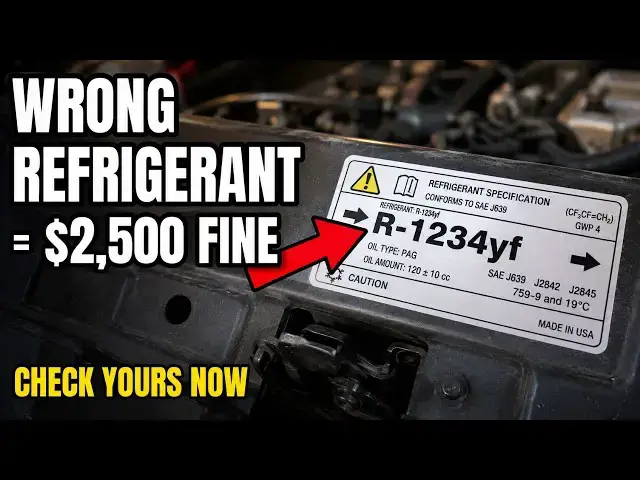
The one thing to check before anything
2:07
else, open your hood and look near the
2:09
front of the engine bay, typically on or
2:11
near the radiator support or the
2:13
underside of the hood itself. There is a
2:15
sticker that names the refrigerant your
2:17
system [music] uses. It will say R134a
2:24
Find that sticker before you do anything
2:26
else. Before you buy [music] a kit,
2:28
before you call a shop, before you spend
2:30
a single dollar. Everything that follows
2:32
depends on which one it says. Here is
2:37
became widespread in newer vehicles as
2:40
the industry transitioned to a more
2:42
environmentally friendly refrigerant,
2:44
>> but the exact type in your car depends
2:46
on your specific vehicle, not just the
2:48
year. The sticker is the only answer you
2:50
can actually rely on. The DIY recharge
2:53
kit problem. DIY AC recharge kits are
2:57
everywhere. They cost $30 to $60 and
3:00
promise to restore cold air in minutes.
3:03
[music] For a certain type of AC problem
3:05
on a certain type of vehicle, they do
3:07
work temporarily. Here is what the
3:08
packaging does not make clear enough.
3:10
Most consumer recharge kits contain
3:15
refrigerant. If your vehicle uses
3:20
which is what the sticker will tell you,
3:21
using an R134a [music] kit is not just
3:24
ineffective. According to MACS
3:26
Worldwide, the EPA, and FJC Inc., using
3:30
any refrigerant other than R1234yf
3:33
[music] to service a system designed for
3:38
is considered tampering with a vehicle
3:40
emissions control device. The civil
3:42
penalty for this violation can reach
3:46
per incident. More immediately, the
3:48
refrigerants are not compatible and
3:50
mixing them damages compressor oil
3:52
chemistry, creates a contaminated system
3:55
that requires specialized equipment to
3:56
clean [music] up and can destroy
3:58
components that would otherwise have
3:59
been fine. This is also why R1234yf
4:03
service ports use different physical
4:08
They were designed that way specifically
4:10
to prevent this from happening
4:11
accidentally. Even on vehicles that use
4:15
a DIY kit cannot tell you whether your
4:18
system has a leak, where that leak is,
4:20
or how quickly you will lose the
4:22
refrigerant you just added. Many
4:24
consumer kits also include a stop leak
4:26
sealant that can clog the ports
4:28
professional service equipment uses
4:29
[music] to connect to your system,
4:31
turning a straightforward service into a
4:33
more complicated job before the real
4:36
repair even begins. [music] The honest
4:38
version, if your vehicle uses R134a,
4:42
has no known leak history, and you are
4:44
topping off as a one-time measure, a
4:46
quality [music] kit used carefully is a
4:48
reasonable temporary step. If your
4:50
vehicle uses R1234yf,
4:53
skip the [music] kit completely. Go
4:55
straight to a shop that has R1234yf
4:59
certified equipment. Now, the part most
5:01
drivers never think about until it is
5:02
too late. Your AC is not just telling
5:05
you the refrigerant is low. It is
5:06
telling you which stage you are at, and
5:08
which stage you are at determines
5:10
whether you still have a cheap fix or
5:12
whether that window has already closed.
5:14
The five stages. Which one are you at?
5:17
Stage one, green. Do not panic yet. Weak
5:20
cooling [music] that improves at highway
5:21
speed, but the AC still blows cold
5:24
eventually. This is your earliest
5:25
warning. This symptom can point to low
5:27
refrigerant, but condenser airflow
5:29
problems and other causes can produce a
5:31
similar pattern, which is why
5:33
professional [music] diagnosis matters
5:35
even at this early stage. What matters
5:37
here is that the compressor is still
5:39
working. Professional leak detection and
5:41
recharge at this stage typically runs
5:47
This is the cheap fix window and it is
5:49
still open. Stage two, yellow. Pay
5:51
attention. AC blows cold for 10 to 15
5:54
minutes, then gradually warms up. This
5:56
pattern points to refrigerant levels too
5:58
low for sustained operation or an
6:00
evaporator that is freezing over where
6:02
moisture on the evaporator surface turns
6:05
to ice and blocks air flow. Both are
6:07
repairable at moderate cost if caught
6:09
before the compressor is stressed
6:11
further. Professional diagnosis at this
6:13
stage, $150 to $400 depending on what is
6:17
found. [music] The window is narrowing.
6:19
Stage three, orange. Stop gambling.
6:21
Clicking, grinding, or screeching from
6:24
the compressor when the AC is switched
6:26
on. This is a serious warning that most
6:28
drivers ignore for too long. Clicking
6:30
usually means the compressor clutch is
6:32
cycling on and off rapidly because
6:34
refrigerant pressure is too low for
6:36
normal operation. Grinding or screeching
6:39
from the compressor itself indicates the
6:41
clutch bearing is failing or the
6:43
compressor internals are already worn.
6:45
Running a compressor in this condition
6:47
can cause it to seize and shed metal
6:49
shavings into the refrigerant lines.
6:52
When that happens, the contamination
6:53
spreads through the entire sealed loop
6:56
and a compressor replacement alone is no
6:58
longer enough. The system requires
7:00
flushing before new components will
7:02
survive. This is where a repair can
7:04
suddenly climb toward $1,500.
7:08
If your AC is making noise, turn it off
7:10
and get it diagnosed before driving on
7:12
it further. Stage four, red. Diagnose
7:15
immediately. AC [music] stopped working
7:17
completely and suddenly with no gradual
7:19
warning. Complete sudden failure usually
7:21
points to either a blown fuse [music] or
7:24
relay, a cheap and fast fix, or a
7:26
compressor that has already failed.
7:27
Check the fuse first because it costs
7:29
almost nothing. If the fuse is fine and
7:31
the compressor is not engaging,
7:33
professional diagnosis before spending
7:35
anything on refrigerant or components is
7:37
the [music] right call. Do not throw
7:39
parts at sudden complete failure. Stage
7:42
five, different problem entirely. Musty
7:45
or mildew smell when the AC runs
7:48
regardless of cooling performance. This
7:50
is not a refrigerant issue. [music] It
7:51
is mold or bacterial growth on the
7:54
evaporator, which collects moisture
7:56
every time the AC runs. That moisture
7:58
has to drain. When the drain is
8:00
partially blocked or the evaporator
8:02
surface accumulates organic material,
8:04
the smell is the result. A professional
8:06
evaporator cleaning typically runs $100
8:10
to $250. [music] An evaporator neglected
8:13
long enough to require replacement runs
8:18
because accessing it requires partially
8:21
disassembling the dashboard. This is one
8:23
of the most preventable expensive AC
8:25
repairs in existence and one of the most
8:28
common. When it does not work, the
8:30
honest limits. Some AC failures are not
8:33
cheap regardless of how quickly you
8:34
catch them. A condenser hit by road
8:36
debris and developed a pinhole leak will
8:39
lose refrigerant no matter how recently
8:41
it was recharged and condenser
8:43
replacement typically runs $700 to
8:49
A compressor that has been running on
8:51
low refrigerant for multiple seasons may
8:53
be internally worn even if it is not
8:56
seized yet and replacement runs $500
9:02
These repairs cost what they cost.
9:04
Catching the symptom early does not
9:06
change the fundamental repair. What it
9:11
condenser repair from becoming a $700
9:13
condenser plus $800 compressor because
9:16
the compressor was run to failure while
9:18
the leak was ignored. [music]
9:20
Here is what to take from this. Find the
9:21
sticker under your hood first. It tells
9:24
you which refrigerant your system uses.
9:26
Everything else depends on that answer.
9:28
Match your symptom to the stage. Weak
9:30
cooling that responds to highway speed,
9:32
stage one, cheap fix window still open.
9:35
AC cold then warm. Stage [music] two,
9:38
pay attention now, compressor noise.
9:40
Stage three, turn it off and get it
9:42
diagnosed. Complete sudden failure,
9:45
stage four, [music] check the fuse
9:46
first. Musty smell, stage five,
9:49
different problem, different fix. And if
9:51
you have already recharged the system
9:53
once and the cold air lasted only a few
9:55
weeks, the refrigerant is not your
9:57
problem. The leak is. Recharging again
9:59
without fixing the leak is borrowing
10:01
time you will pay for at a higher price
10:03
later. A car AC that is slightly
10:06
underperforming in August is giving you
10:08
a warning that has a cheap answer if you
10:10
act on it now. The same system ignored
10:12
for another season can become one of the
10:14
most expensive repairs on the vehicle.
10:16
If this helped you figure out which
10:18
stage your AC problem actually falls
10:20
into, well, that is worth a [music] like
10:22
because knowing that before you walk
10:23
into a shop is worth real money.
10:25
Subscribe to Your Motor Care for this
10:27
kind of breakdown every week. One
10:28
automotive system explained honestly
10:31
with the costs included so you are never
10:33
the least informed person in the
10:35
conversation. Drop a comment with this,
10:37
which stage are you at right now? And
10:39
did you already try a DIY kit? Those two
10:42
answers are exactly how the rest of us
10:44
figure out what actually works before