Up next in 10


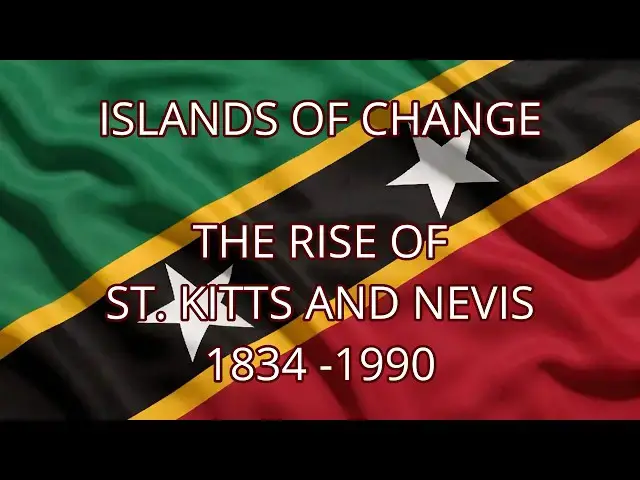
St. Kitts, officially Saint Christopher, has a rich history shaped by colonial rule, economic struggles, labor movements, and the gradual transition to self-governance.
Visit and learn more about St. Kitts and Nevis and the Caribbean: Travel free or at discount.
Work from home as a Travel Agent: https://gr3f.co/c/61445/er6g5
Show More Show Less View Video Transcript
0:00
[music]
0:08
>> Islands of change. The rise of St. Kitts
0:11
and Nevis, 1834 to 1990. St. Kitts,
0:15
officially St. Christopher, has a rich
0:17
history shaped by colonial rule,
0:19
economic struggles, labor movements,
0:20
[music]
0:21
and the gradual transition to
0:22
self-governance.
0:24
From the abolition of slavery in the
0:26
year 1834 to about 1970, [music] the
0:29
island experienced profound
0:31
socio-political and economic
0:32
transformations. Below is an in-depth
0:35
exploration of this period.
0:37
Post-emancipation. [music]
0:39
1834 to 1860s. When slavery was
0:42
abolished in the British Empire in 1834,
0:45
>> [music]
0:45
>> former slaves in St. Kitts and across
0:48
the Caribbean entered a period of
0:49
apprenticeship, [music] which lasted
0:51
until 1838.
0:53
During this time, freed people were
0:55
required to continue working for their
0:57
former enslavers for a set number of
1:00
hours per week [music] in exchange for
1:01
small wages and the right to live on the
1:03
estates.
1:05
By the year [music] 1834, full freedom
1:07
was granted, but economic hardships
1:09
persisted.
1:10
Freed people often remained tied to the
1:12
sugar estates due to lack of alternative
1:14
employment.
1:16
Plantation owners, still in control of
1:18
the land and economy, used their
1:20
influence to suppress [music] wages,
1:22
impose high rents for living on estate
1:24
lands, and limit opportunities for
1:26
social and economic mobility.
1:28
The sugar plantation economy.
1:30
>> [music]
1:30
>> 1840s to 1900s.
1:33
The economy of St. Kitts remained
1:35
heavily dependent on sugar production,
1:37
which had been the backbone of the
1:38
island since the [music] 17th century.
1:41
However, the plantation system struggled
1:43
with fluctuating sugar prices,
1:45
international competition, and declining
1:47
soil fertility. Many former slaves
1:49
became laborers on the plantations,
1:51
working under exploitative conditions.
1:54
With limited land available to them,
1:55
[music] some freed people engaged in
1:57
small-scale farming, growing provisions
1:59
such as yams, sweet potatoes, [music]
2:01
and cassava, often on rented land.
2:05
The division of land remained a major
2:07
issue, as [music] the British planters
2:08
retained ownership of most arable land.
2:11
The British colonial government remained
2:13
in control of the island, ensuring that
2:16
economic power stayed with the white
2:17
planter class.
2:19
However, social discontent was growing,
2:21
laying the foundation for labor unrest.
2:24
Rise of labor movements and political
2:26
awareness, 1900s to 1930s. By the early
2:30
20th century, [music] economic
2:31
conditions for most Kittitians remained
2:33
dire.
2:35
The sugar industry, still dominant,
2:37
provided low wages, poor living
2:38
conditions, and little opportunity for
2:40
workers to improve their status.
2:43
In response to these hardships, labor
2:45
movements began to emerge.
2:47
One of the most significant events was
2:49
the 1935 sugar riots, part of a wave of
2:52
labor uprisings [music] throughout the
2:53
Caribbean.
2:54
Workers protested against poor wages,
2:57
harsh conditions, [music]
2:58
and unfair labor practices.
3:00
The British authorities responded with
3:02
force, leading to violence and deaths.
3:05
The unrest led [music] to some reforms,
3:07
including slight wage increases and the
3:09
establishment of labor unions. [music]
3:11
It also accelerated political
3:13
consciousness among the masses.
3:15
In 1932, [music]
3:16
the St. Kitts Workers League was formed,
3:18
which later evolved into the St.
3:20
Kitts-Nevis-Anguilla Labour Party,
3:22
SKNALP,
3:23
>> [music]
3:23
>> a dominant force in the island's
3:25
politics for decades.
3:27
World War II and post-war political
3:29
changes, 1940s to 1950s. [music]
3:32
During World War II, St. Kitts
3:34
contributed manpower to the British
3:36
[music] war effort. The war created
3:38
economic challenges, but also
3:39
opportunities, as the wartime economy
3:41
brought temporary boosts [music] to
3:42
sugar prices.
3:44
However, at the end of the war, economic
3:46
hardship returned, fueling the demand
3:48
for political [music] change.
3:50
In 1952, universal adult was introduced,
3:54
granting all Kittitians the right to
3:55
vote regardless [music] of race or
3:57
economic status.
3:59
This was a major turning point as it
4:01
allowed for broader political
4:02
participation.
4:03
>> [music]
4:03
>> The SKNALP,
4:05
under the leadership of Robert Llewellyn
4:07
Bradshaw, emerged as the dominant
4:09
political force.
4:10
Bradshaw, a strong advocate for workers'
4:13
rights and independence [music] from
4:14
Britain, was instrumental in advancing
4:16
the labor movement and pushing for
4:18
greater self-governance.
4:20
The West Indies Federation and path to
4:22
Feltham governance,
4:23
>> [music]
4:24
>> 1958 to 1967.
4:27
St. Kitts, along with other British
4:29
Caribbean colonies, became part of the
4:31
West Indies Federation in 1958. [music]
4:34
The Federation was an attempt to unify
4:36
Caribbean islands under a single
4:38
political entity, but it faced
4:39
significant challenges and collapsed in
4:41
1962.
4:43
Following the Federation's failure, St.
4:46
Kitts, Nevis, Anguilla became an
4:48
associated state of Britain [music] in
4:49
1967, giving it full control over
4:52
internal affairs while Britain retained
4:54
authority over [music] foreign affairs
4:56
and defense. Bradshaw became the first
4:58
premier of St. Kitts,
4:59
>> [music]
5:00
>> Nevis, Anguilla, solidifying local
5:02
governance.
5:03
Economic and social conditions, 1950s to
5:06
1970s. [music]
5:08
During this period, St. Kitts remained
5:10
economically dependent on sugar, but
5:12
diversification efforts began.
5:14
The government sought to modernize the
5:16
industry, [music]
5:17
introduce new farming techniques, and
5:19
promote alternative industries,
5:20
including tourism and small
5:22
manufacturing.
5:24
Education and [music] health care
5:25
improved under the labor government with
5:27
increased access to schools and [music]
5:29
medical facilities. Social mobility,
5:32
however, remained limited for many
5:33
working-class [music]
5:34
Kittitians.
5:35
The government also worked to improve
5:37
infrastructure, including roads,
5:39
electricity, [music]
5:40
and water access.
5:42
The Anguilla secession crisis, 1967 to
5:45
1969. [music]
5:47
One of the major political crises of
5:49
this era was the Anguilla secession
5:51
movement. Anguilla, which was part of
5:53
the St. Kitts-Nevis [music] and Anguilla
5:55
state, felt neglected by the central
5:57
government and resented the dominance of
5:59
Bradshaw's administration.
6:01
In 1967, Anguillans [music] staged a
6:04
revolt, expelled the St. Kitts police,
6:06
and declared their intent to secede.
6:08
Despite attempts by Bradshaw [music] to
6:10
regain control, Anguilla sought direct
6:12
governance from Britain.
6:14
In 1969, [music]
6:16
Britain intervened, sending troops to
6:18
Anguilla, effectively ending its
6:19
association with St. Kitts.
6:22
The crisis was a major embarrassment for
6:24
Bradshaw's government, though St. Kitts
6:26
and Nevis continued as a political unit.
6:28
[music]
6:29
By 1970, St. Kitts was on the path to
6:32
full independence. [music]
6:34
The struggle for economic stability and
6:36
political self-determination had defined
6:38
the previous century. The dominance of
6:40
the sugar industry was beginning to
6:42
wane, and leaders like Bradshaw had laid
6:45
the foundation for eventual independence
6:47
in 1983.
6:49
The social fabric of the island had
6:51
evolved from a plantation-dominated
6:53
society [music] to one where labor
6:54
rights and political representation were
6:56
significantly expanded. However,
6:59
challenges such as economic
7:00
diversification, land reform, and
7:02
political unity remained pressing
7:04
issues.
7:06
St. Kitts from 1970 to 1990. [music]
7:09
From 1970 to 1990, St. Kitts underwent
7:12
significant political, [music]
7:14
economic, and social changes. The island
7:17
transitioned from an associated [music]
7:18
state of Britain to full independence,
7:20
navigated economic challenges, and saw
7:23
shifts in governance and leadership.
7:25
The period was marked by continued
7:27
[music] struggles in the sugar industry,
7:29
attempts at economic diversification,
7:31
and political tensions, particularly
7:33
between St. Kitts and Nevis.
7:36
The 1970s, [music]
7:37
economic and political developments.
7:40
By the early 1970s, the sugar industry,
7:43
still the backbone [music] of St. Kitts'
7:44
economy, was in decline.
7:46
Global sugar prices were volatile,
7:48
competition from other producers
7:49
increased, [music] and the cost of
7:51
production remained high. The
7:52
government, still led by Premier Robert
7:55
Bradshaw and the St. Kitts,
7:56
>> [music]
7:56
>> Nevis, Anguilla Labour Party, SKNALP,
8:00
sought to modernize [music] the industry
8:02
and maintain its relevance.
8:04
However, economic diversification
8:06
efforts [music] were slow to take
8:07
effect. Political landscape. Bradshaw
8:10
remained a dominant figure in Kittitian
8:11
[music] politics, continuing to advocate
8:14
for workers' rights and independence.
8:16
However, [music] his administration
8:18
faced increasing opposition,
8:20
particularly from Nevis, where residents
8:22
felt marginalized.
8:24
Calls for greater autonomy for Nevis
8:25
grew louder, foreshadowing future
8:27
political divisions.
8:29
1973. [music]
8:31
Anguilla formally separates following
8:33
the 1967 Anguilla revolt. [music] The
8:35
British government had effectively taken
8:37
control of Anguilla.
8:39
In 1973, [music]
8:41
Anguilla was officially separated from
8:43
the St. Kitts, Nevis, Anguilla state,
8:45
and became a British Overseas Territory,
8:48
a move that Bradshaw opposed, but
8:49
ultimately could not prevent.
8:51
>> [music]
8:52
>> 1978 to 1980.
8:54
Leadership changes and political [music]
8:56
shift. Robert Bradshaw died in 1978,
8:59
marking the end of an era. He was
9:01
succeeded by Paul Southwell, another key
9:03
[music] Labour figure, but Southwell
9:05
himself died unexpectedly in 1979.
9:09
Leadership then passed to Lee Moore, but
9:11
by this time, [music]
9:12
Labour's grip on power was weakening. In
9:14
the 1980 elections, the opposition
9:16
party, the People's Action Movement,
9:18
PAM, led by Kennedy Simmonds, formed a
9:21
coalition government with the
9:22
Nevis-based Nevis Reformation Party,
9:24
NRP.
9:26
This marked a major shift in St. Kitts'
9:28
political landscape, as it ended decades
9:30
of Labour Party dominance.
9:33
1983. [music]
9:34
Independence from Britain on September
9:36
19th, 1983.
9:39
>> [music]
9:39
>> St. Kitts and Nevis achieved full
9:40
independence from Britain with Kennedy
9:42
Simmonds as the first Prime Minister.
9:45
The country became the smallest
9:46
independent [music] nation in the
9:47
Western Hemisphere. However, the move
9:50
toward independence did not resolve
9:52
[music] tensions between St. Kitts and
9:54
Nevis.
9:55
Nevis pushed for secession, 1980s.
9:58
Nevis had long expressed dissatisfaction
10:01
with its relationship with St. Kitts,
10:03
feeling that the smaller island was
10:04
neglected politically [music] and
10:06
economically.
10:07
After independence, the Nevis Island
10:09
Administration, led by the Nevis
10:11
Reformation Party, NRP, [music] pushed
10:13
for greater autonomy and even secession.
10:16
In 1983, the Nevis Island Assembly was
10:19
established, giving Nevis control over
10:21
some of its own affairs. [music]
10:23
However, in 1987,
10:25
a referendum on Nevisian independence
10:27
failed to achieve [music] the 2/3
10:29
majority required for separation.
10:31
Despite this, Nevis continued to demand
10:33
more self-governance, leading to
10:35
constitutional reforms that granted
10:37
[music] it greater control over local
10:39
affairs.
10:40
Economic challenges [music] and
10:42
diversification attempts.
10:44
Throughout the 1980s, the government of
10:46
Kennedy Simmonds sought [music] to
10:47
reduce reliance on sugar and diversify
10:49
the economy. Some key developments
10:52
included tourism expansion. Efforts were
10:55
made to develop St. Kitts as a tourism
10:57
destination [music] with hotels and
10:58
resorts built to attract visitors.
11:01
Manufacturing. The government encouraged
11:03
light manufacturing and industrial
11:05
activity, particularly in electronics
11:07
and textiles.
11:09
Financial services. Offshore banking and
11:11
financial services [music]
11:12
were promoted, positioning St. Kitts as
11:15
an emerging hub in the Caribbean.
11:17
Despite these efforts, the economy
11:19
remained fragile, and sugar continued to
11:21
be a major but declining contributor.
11:23
Hurricane Hugo, [music]
11:25
1989.
11:26
In September 1989, Hurricane Hugo
11:29
devastated [music] St. Kitts and Nevis,
11:31
causing widespread destruction to homes,
11:33
infrastructure, and agriculture.
11:36
The sugar industry was hit hard, and the
11:38
tourism sector suffered setbacks as
11:40
resorts and hotels sustained heavy
11:42
damage.
11:43
The economic impact of the hurricane
11:45
slowed development and required
11:47
significant rebuilding efforts. [music]
11:49
By 1990, St. Kitts and Nevis had made
11:52
significant strides [music] politically,
11:54
having transitioned from a British
11:55
colony to an independent nation.
11:58
However, challenges remained, including
12:00
economic instability, ongoing tensions
12:03
between St. Kitts and Nevis, and [music]
12:05
the need for greater diversification
12:07
beyond sugar.
12:08
The government of Kennedy Simmonds faced
12:10
increasing political opposition, setting
12:13
the stage for further shifts in the
12:14
[music] 1990s. The island was evolving,
12:17
balancing its colonial past with its
12:20
aspirations for a modern economy and
12:22
stable [music] governance.
12:24
The next decade would bring further
12:26
political changes, economic adjustments,
12:28
[music]
12:28
and continued efforts to solidify St.
12:30
Kitts and Nevis's place in the Caribbean
12:33
and global community.
Travel & Transportation