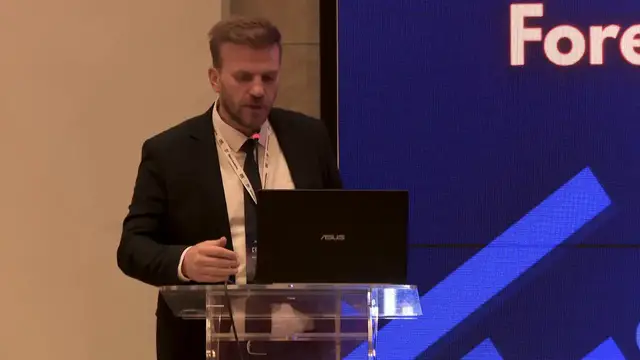

Türkiye: Palestine event in Istanbul highlights Gaza, Jerusalem, global media narratives.
Jun 16, 2026
.ISTANBUL, TÜRKİYE - JUNE 16, 2026: Academics, students and rights advocates discussed Palestine, Gaza, Jerusalem, media narratives and the role of international organizations at a two-day program that began on Tuesday at Bogazici University in Istanbul. The event, titled "Cut To The Chase: Truth Beyond Borders," brought together academics, researchers, human rights defenders and students and was organized by Marmara Anadolu Imam Hatip High School at the university campus. - Palestinian issue 'not only a humanitarian question' Speaking at the program, Sami Al-Arian of Istanbul Sabahattin Zaim University said the Palestinian issue should not be framed solely as a humanitarian question, arguing that the nature of Zionism makes it a regional and global issue. Al-Arian said the conflict should not be seen as one between Islam and Judaism or Muslims and Jews, saying Judaism is recognized in Islam as a revealed religion and Jews as "People of the Book." "This is not a Jew versus Muslim conflict," he said, adding that the issue, in his view, concerns "truth" and "justice" against what he described as aggression and oppression. He argued that Zionism is a political ideology rather than a religious identity and said the Palestinian question has implications for the whole region, including Turks, Arabs, Persians, Pakistanis and Indonesians. Al-Arian said the events since Oct. 7 have exposed what he called the reality of Israel's policies, arguing that the war in Gaza has generated a global movement across universities, media platforms and civil society. He called on young people to understand the "historical moment" they are living in and to organize around issues of sovereignty, justice and independence. - 'It did not start on Oct. 7' Nedaa Al-Abadla, a Palestinian human rights defender from Gaza who is pursuing graduate studies in political science and international relations, said the suffering of Palestinians "did not start on Oct. 7." Sharing personal accounts from Gaza, Al-Abadla spoke about family members killed or lost under Israeli occupation, including her grandfather, uncle and cousin, as well as her childhood memories of Israeli military operations. She recalled being 10 years old in Gaza in 2000 when her school was engulfed in fear and confusion during an Israeli military operation, saying children in Gaza learn early that "childhood is a luxury." She also described a 2003 incident in which Israeli soldiers entered her family's home and turned the building into a military post, forcing 16 family members, including children, into one room overnight. Al-Abadla said the 2014 Israeli offensive on Gaza left lasting trauma, recalling the bombing of nearby homes and the smell of burned bodies after an explosion in her neighborhood. She then spoke about the death of her uncle, who needed urgent medical treatment outside Gaza but was unable to leave because of closed crossings. "He was approved to leave on the day he died," she said, describing his death as caused not by a bomb but by "closed doors." - Jerusalem remains at the core of Palestinian issue Abdallah Marouf Omar of Istanbul 29 Mayıs University focused on Jerusalem and the Al-Aqsa Mosque compound, arguing that the city remains at the core of the Palestinian issue and cannot be separated from the war in Gaza. Marouf said many of the major Palestinian uprisings and confrontations over the past quarter-century were centered on Jerusalem and Al-Aqsa Mosque, including the Second Intifada in 2000, the 2017 protests over Israeli security measures at Al-Aqsa and the 2021 escalation that began in Jerusalem. He said Israel's immediate measures after Oct. 7 included restrictions around Al-Aqsa Mosque, arguing that this showed Jerusalem's centrality in the conflict. He warned that Israeli policies could lead to changes in the status of Al-Aqsa Mosque and compared the situation with the Ibrahimi Mosque in Hebron, where the site was gradually divided after Israel occupied the area in 1967. Marouf said the Ibrahimi Mosque example should serve as a warning, arguing that arrangements initially presented as limited access can eventually turn into changes in sovereignty and administration. - UNRWA 'backbone' of humanitarian system in Gaza Hasan Basri Bulbul of Bogazici University discussed the role of the United Nations and UNRWA, the UN agency for Palestinian refugees. Bulbul said the United Nations played a major role in shaping the Palestinian issue, pointing to the 1947 UN General Assembly Resolution 181, which proposed the partition of Palestine. He said the establishment of UNRWA reflected the international community's approach to Palestinians as a humanitarian issue, while Israel was recognized as a sovereign state. Bulbul argued that UNRWA later became more than a humanitarian agency, saying it helped preserve Pa
Show More Show Less #news