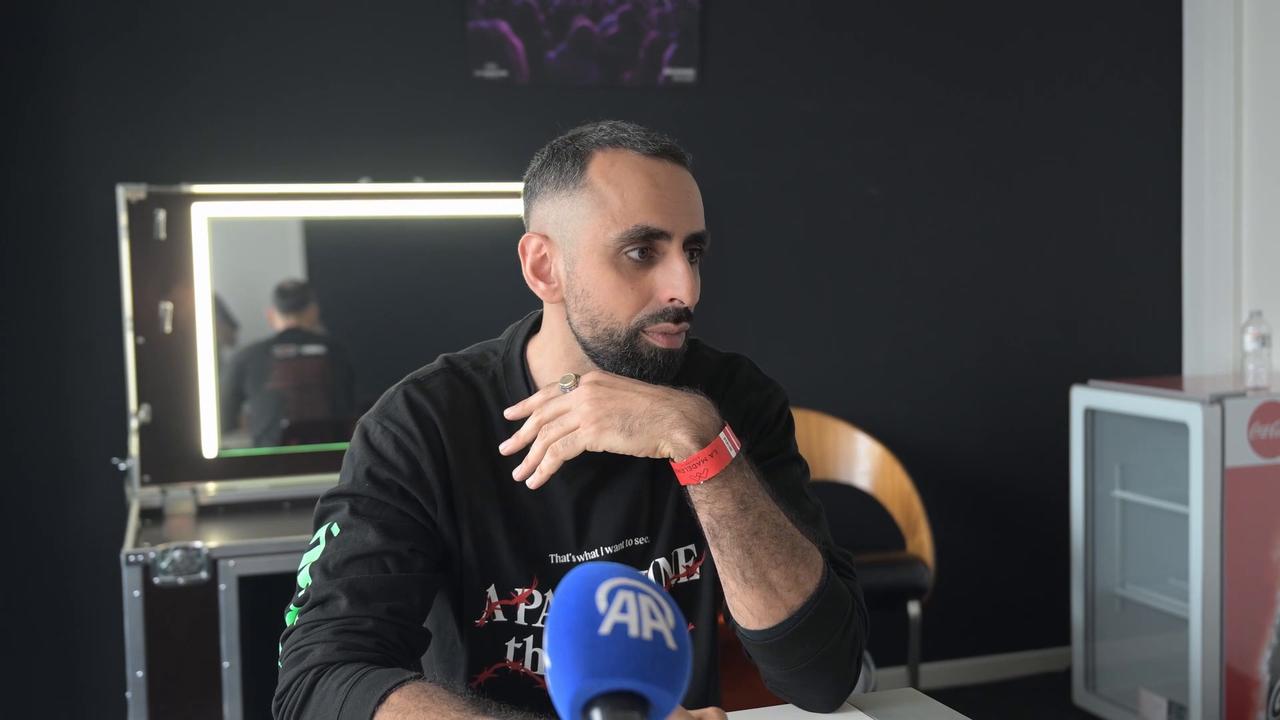

Belgium: Artists slam Eurovision for double standards over Israel participation.
May 13, 2026
SHOTLIST: BRUSSELS, BELGIUM (MAY 13, 2026) 1. PALESTINIAN SINGER BASHAR MURAD SPEAKING TO REPORTER (English) 2. BELGIAN EUROVISION CONTESTANT LAURA TESORO SPEAKING TO REPORTER (English) BRUSSELS, BELGIUM - MAY 13, 2026: As broadcasters boycott Eurovision and criticism mounts over Israel’s participation, artists and former contestants say the competition is facing a growing credibility crisis over what they describe as the European Broadcasting Union’s (EBU’s) inconsistent handling of war and politics. The controversy surrounding this year’s contest has reignited scrutiny of the EBU’s longstanding claim that Eurovision is a non-political cultural event after Russia was banned following the Ukraine war while Israel continues to compete despite the war in Gaza. Palestinian singer Bashar Murad and former Belgian Eurovision contestants Gustaph and Laura Tesoro told Anadolu that the decision has undermined the contest’s image as a platform meant to unite audiences through music. The backlash comes as Eurovision faces one of the biggest crises in its 70-year history. Broadcasters in Iceland, Ireland, the Netherlands, Slovenia and Spain have withdrawn from this year’s contest in protest over Israel’s participation. Eurovision, one of the world’s largest televised music competitions, drew around 166 million viewers last year but is now facing its smallest lineup since 2003, with 35 competing countries. This week, Israel’s contestant secured a place among the 10 finalists competing in Saturday’s grand final. This year’s contest has also been marked by recent protests in Vienna and Brussels, where protesters called Eurovision the “genocide song contest.” A recent New York Times investigation also detailed extensive Israeli government lobbying and promotional efforts linked to Eurovision, including outreach by diplomats to European broadcasters and a major campaign encouraging viewers to vote for Israeli contestants. - ‘Eurovision was always political’ Murad said he was “not surprised” by the EBU’s refusal to respond to boycott calls, accusing Eurovision of becoming a platform used to “artwash and pinkwash” Israel’s actions against Palestinians. “As we have seen time and time again, the main purpose, it seems, of Eurovision now is to protect Israel and to protect its presence in it,” he said. Murad argued that allowing Israel to compete while excluding Russia exposed clear inconsistencies in how Eurovision applies its rules. "I think the risk of keeping Israel in these competitions and allowing it on the international stage is that it's normalizing its crimes against Palestinians,” he said. “It's saying that Israel can do whatever it wants and it gets a free pass to continue and to act as if it's a normal state that fits within the global community.” Rejecting the EBU’s insistence that Eurovision is apolitical, Murad called such claims “ridiculous” and “laughable.” “Eurovision was always political,” he said. “Art and culture are an important political tool whether we like it or not.” He pointed to Ukraine’s victory in 2016 with a song widely interpreted as critical of Russia, as well as Russia’s later exclusion from the contest following the Ukraine war. - Israeli lobbying, voting campaign draw scrutiny Murad also criticized what he described as coordinated Israeli efforts to influence the vote through advertising and political messaging. A recent New York Times investigation found that Israel spent at least $1 million on Eurovision marketing, and that high-level political figures, including Prime Minister Benjamin Netanyahu, posted graphics on social media urging people to vote 20 times – the maximum allowed – for the Israeli contestant last year. After the campaign, Israel’s contestant last year, Yuval Raphael, won the popular vote by a landslide in countries such as Spain and Ireland, which are both highly critical of the Israeli genocide in Gaza and which are now boycotting over Israel’s participation. The report said Israeli officials viewed Eurovision as a key soft-power opportunity amid mounting international criticism over the war in Gaza and detailed intense diplomatic outreach by Israeli officials to European broadcasters amid calls to ban Israel from the competition. "We see how countries like Israel are using the competition for political reasons and trying to pay a crazy amount of money to buy ads to get people to vote, to get people in America, in the diaspora to vote," Murad said. Murad warned the growing controversy risks permanently damaging Eurovision’s credibility. “I think it’s just going to go downhill from here if this continues,” he said. - Artists accuse EBU of inconsistency Gustaph, who represented Belgium in 2023, said he still values Eurovision but has become increasingly critical of the EBU’s leadership. “I’m just not a particularly big fan of
Show More Show Less