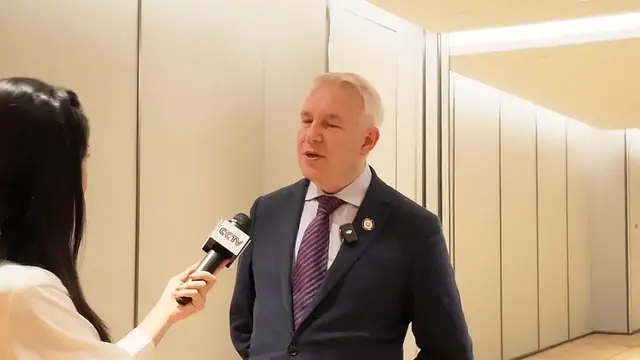

China: More China-U.S. cooperation in AI means greater global benefits: Oxford scholar.
Jul 25, 2026
Shotlist Shanghai, China - Recent 1. Various of cityscape; sign of "WAIC 2026" Shanghai, China - July 17, 2026 2. Sign reading "2026 World AI Conference and High-level Meeting on Global AI Governance" Shanghai, China - July 20, 2026 3. SOUNDBITE (English) Sam Daws, scholar of Oxford University (partially overlaid with shots 4-9): "Actually I think the export controls probably had the opposite consequence that the U.S. was planning. So we're seeing real progress in China developing frontier models. The latest edition of Kimi is closed or even equal to some of the Western frontier models. And even in areas very hard to achieve, China's also been really working hard to develop its own lithography capabilities. So I think, actually that you'll see that the export controls have meant that China has found more innovative ways to explore AI progress. China has been leading the world in what's called embodied AI -- humanoid robots, AI and manufacturing, and is well ahead of the United States in these areas. I think there's a real potential for the data accumulated through the roll out of embodied AI around the world to make models more and more intelligent." SHOTS OVERLAYING SOUNDBITE FILE: China - Exact Location and Date Unknown 4. Desktop, keyboard 5. Various of screens showing AI models FILE: Beijing, China - May 2026 6. Various of webpages showing report on Kimi FILE: China - Exact Location and Date Unknown 7. Animation showing AI 8. Various of robot dogs 9. Various of humanoid robot doing housework SHOTS OVERLAYING SOUNDBITE Shanghai, China - July 2026 10. Various of humanoid robot being trained Shanghai, China - July 20, 2026 11. SOUNDBITE (English) Sam Daws, scholar of Oxford University (partially overlaid with shots 12-13): "I think there are many areas for cooperation. The most urgent is on some of the risks from AI that only the U.S. and China -- has the two major frontier AI countries -- can address. Other areas for cooperation would be the risks from the Nexus of AI and biological systems and chemical systems. And thirdly, I hope there'll be cooperation on scientific discoveries. The more cooperation we can have at the level of scientists, the level of academia, the level of governments and the level of companies, between the two AI superpowers, the more we're likely to benefit from those AI discoveries." SHOTS OVERLAYING SOUNDBITE FILE: China - Exact Location and Date Unknown 12. Various of humanoid robots working Shanghai, China - July 2026 13. Various of China's first AI-powered autonomous laboratory; automated robotics working SHOTS OVERLAYING SOUNDBITE Dongguan City, Guangdong Province, south China - July 2026 14. Various of factory of robotic arms 15. Various of workers at work in factory; robotic arms FILE: Guangdong Province, south China - Date Unknown 16. Various of drones flying Storyline More cooperation between China and the United States in the field of artificial intelligence (AI) will bring greater benefits to the world, an Oxford University scholar said as the 2026 World Artificial Intelligence Conference (WAIC) concluded in Shanghai. The 2026 WAIC and the High-Level Meeting on Global AI Governance came to a close in Shanghai on July 20. Centered around the theme "AI Partnership for a Brighter Future", this four-day global summit brought together officials, industry leaders, and scholars from more than 100 countries to shape the future of AI governance. The event tackled the future of AI through six dynamic tracks: conferences, tech showcases, awards, interactive application experiences, startup incubation, and talent recruitment. While attending the summit, Sam Daws, a political science professor at Oxford University and a senior advisor to the Oxford Martin AI Governance Initiative, shared his opinions on China's development and contributions in AI industry and on the potential of AI cooperation between China and the U.S. -- two major frontier AI countries. Daws spoke highly on China's AI capacity building as well as its open and inclusive ideas in global AI governance, underscoring that the country has been supporting the development of global AI technology and the application of AI in developing countries. He noted that while the U.S. as attempted to place restrictions on China's AI development, including with export controls, these efforts have ultimately backfired, inadvertently driving Chinese innovation in the field. "I think the export controls probably had the opposite consequence that the U.S. was planning. So we're seeing real progress in China developing frontier models. The latest edition of Kimi is closed or even equal to some of the Western frontier models. And even in areas very hard to achieve, China's also been really working hard to develop its own lithography capabilities. So I think, actually that you'll see that the export controls have meant that Ch
Show More Show Less #news