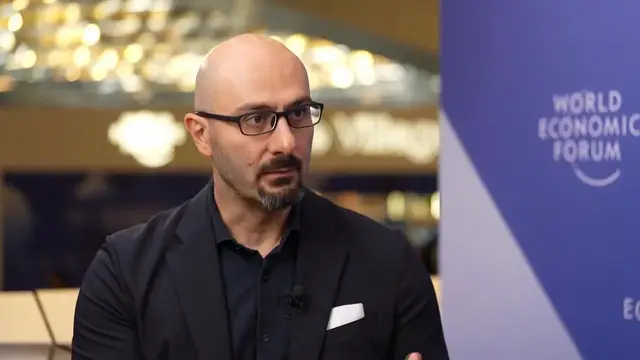

China: AI-5G integration to bridge digital gap, enable physical AI economy: Ericsson VP.
Jun 26, 2026
Liaoning, China - June 26, 2026 Shotlist Dalian City, Liaoning Province, northeast China - Recent (CCTV - No access Chinese mainland) 1. Various of staff members in conference center; participants talking Dalian City, Liaoning Province, northeast China - June 23, 2026 (CGTN - No access Chinese mainland) 2. SOUNDBITE (English) Chafic Nassif, senior vice president, Ericsson: "AI is being used to produce 5G and 5G is a solution that handles AI, and that's what we mean by converging. It makes 5G a lot more efficient. When you have better economies around 5G with regards to energy savings and so on, you have the ability then to make it more affordable, bring it further into emerging countries and communities. And we know that mobile connectivity is one of the primary ways for emerging countries and emerging places to kind of be able to be connected to the rest of the world." Suzhou City, Jiangsu Province, east China - Recent (CGTN - No access Chinese mainland) 3. Various of technicians working, robot carrying box FILE: China - 2026 (CCTV - No access Chinese mainland) 4. Various of humanoid robots working in factory Dalian City, Liaoning Province, northeast China - June 23, 2026 (CGTN - No access Chinese mainland) 5. SOUNDBITE (English) Chafic Nassif, senior vice president, Ericsson (starting with shot 4/partially overlaid with shot 6): "With AI, you have the ability of 5G to bring more content. So things like healthcare capabilities, remote healthcare, things like education, all of these are very, very important for bridging the digital divide. And last but not least, it's very important also to keep in mind that with 5G expanding more and more and bringing AI capabilities in thread, it allows for an AI economy to happen. And that kind of normalizes and standardizes the ability for people to be entrepreneurs, to innovate, to drive things." ++SHOT OVERLAYING SOUNDBITE++ FILE: China - 2026 (CCTV - No access Chinese mainland) 6. Various of humanoid robot working in factory ++SHOT OVERLAYING SOUNDBITE++ Dalian City, Liaoning Province, northeast China - June 23, 2026 (CCTV - No access Chinese mainland) 7. Signs of "Annual Meeting of the New Champions 2026," participants 8. Participants at forum Dalian City, Liaoning Province, northeast China - June 23, 2026 (CGTN - No access Chinese mainland) 9. SOUNDBITE (English) Chafic Nassif, senior vice president, Ericsson (starting with shot 8/ending with shot 10): "Today, the main conversation around AI is very much around data centers, around building the intelligence, which is important, which is very good, and it is something that will continue to happen. However, moving forward, for us to realize prosperity out of AI, to realize maximum value out of it, AI has to become physical. And when AI becomes physical, it means it starts being applied into things like robotics or drones or other things. When that starts happening, it means that the intelligence is starting to move. And when there's motion, there needs to be connectivity. And so the intelligent fabric is not an introduction of a new technology, it is an introduction of an architecture framework where you can drive AI through cloud, connectivity, devices and all the way into applications into the industry." FILE: China - 2026 (CCTV - No access Chinese mainland) 10. Various of humanoid robots in formation; working in factory Dalian City, Liaoning Province, northeast China - June 23, 2026 (CGTN - No access Chinese mainland) 11. SOUNDBITE (English) Chafic Nassif, senior vice president, Ericsson (starting with shot 10/partially overlaid with shot 12): "We have a number of aging populations globally that will require probably robots to help them. We have a number of situations where we need, let's say surveillance over a vast area of farming that requires very continuous ability to kind of be attended to. And with physical AI, we will have a lot of those capabilities and it will be enabled. And the great things is we're not talking like 20-30 years from now, we're talking about something that's starting to happen. And with physical AI starting to happen, with your robotics starting to happen and so on, we think that there will be that whole framework and architectural framework that we talk about in Ericsson that will enable that whole economy to happen." FILE: China - 2026 (CCTV - No access Chinese mainland) ++SHOT OVERLAYING SOUNDBITE++ 12. Various of humanoid robots doing choirs ++SHOT OVERLAYING SOUNDBITE++ 13. Various of humanoid robots operating in different real-life scenarios Storyline The fusion of artificial intelligence (AI) and 5G networks will not only narrow the global digital divide but also lay the foundation for a "physical AI economy," said Chafic Nassif, senior vice president of Swedish telecom equipment maker Ericsson. On the sidelines of the Annual Meeting of the New Champions, or Summer Davos, in northeast Chin
Show More Show Less #news