Up next in 10



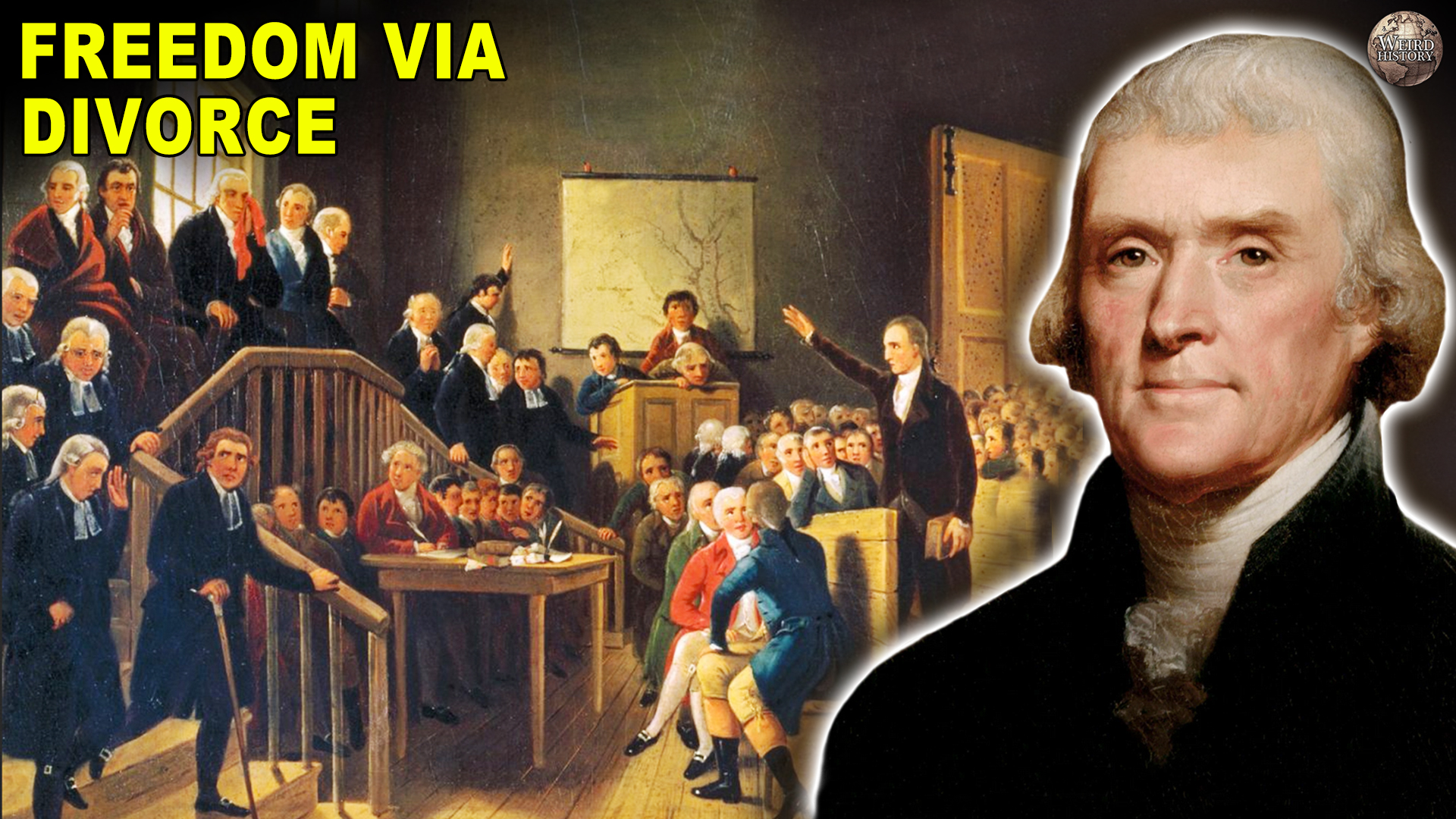
The history of America has been told in many classrooms, but that doesn't mean students hear everything. Consider this: one of the most famous divorces in history shaped America's Declaration of Independence. An affair with a British governor, a rumor of impotency, and a shocking death combined to create a fascinating, and formative, court case. Best of all, one of the prominent Declaration of Independence authors presided over the case, with his notes helping guide the language used in the famous document.
Show More Show Less View Video Transcript
0:00
Not a lot of people know that before Thomas Jefferson was a president or even a founding father
0:05
he was actually a lawyer. And one of his cases, an infamous divorce involving an affair with
0:11
the British governor, rumors of impotency, and a shocking death, directly affected the future
0:18
of America. Today on Weird History, we're looking at how a scandalous divorce case helped shape the
0:24
Declaration of Independence. OK, we the people of the United States should have signed a prenup
0:33
So how did the dissolution of one random couple's marriage help Thomas Jefferson formulate the words of the document
0:40
that would create one of the most powerful nations in history? To answer that, let's start with the marriage itself
0:48
Dr. James Blair was a well-known and respected physician in the Williamsburg area of Virginia
0:53
Catherine Kitty Eustace strolled into town on a visit with her mother, Margaret Eustace
0:59
and immediately hit it off with a doctor, who was rumored to be on the verge of inheriting a
1:04
fortune from his politically and financially powerful father. That might have had something
1:09
to do with Kitty's immediate attraction to Dr. Blair. But hey, maybe he was also really funny
1:15
Within just a few months, Eustace and Blair got engaged. They married in 1771
1:20
only to separate almost immediately. Eustace moved in with her mother, who lived close by
1:26
and filed three different claims against Blair, including one asking for alimony
1:31
It's not a big leap to assume that the marriage between Kitty Eustace and Dr. James Blair
1:36
probably wasn't based on love. In a letter to Ann Blair, her sister-in-law
1:41
Eustace wrote she only married Blair because of how much the Blair family loved her
1:45
which is a weird reason to marry somebody. There might be some truth to that
1:50
though Blair's reputation as a successful physician on the verge of inheriting his ailing father's vast fortune
1:56
might have been more than the proverbial cherry on top. The moment she moved out, Eustace sued for alimony and lost
2:04
She was ordered to move back in with her husband and actually did so for four months
2:08
but nothing about their relationship improved. It's kind of hard to get cuddly with someone
2:13
who just tried to sue you, but they literally had no choice
2:18
There's nothing worse than being unhappy in a relationship and not being able to leave
2:26
And Dr. James Blair and Kitty Eustace really were trapped in every sense of the word
2:31
Divorce was illegal in Virginia, which fell under British rule at the time
2:36
To file for divorce, residents needed to appeal to Parliament, which rarely ended up granting it
2:42
Furthermore, this was well before telephones or email. So getting that appeal to Parliament in the first place
2:47
was a lengthy process. Back in the day, marriages typically didn't happen for love, but rather for financial security
2:54
and creating families, especially in the flourishing colonies in America In 155 years of its existence as a British colony not a single divorce was granted Therefore a lawyer working on a case like that of Eustace and Blair
3:08
would not only have to prove that their specific case warranted divorce, but also that the divorce
3:13
should be legal at all. More on that in a bit. There might have been a reason why Kitty wanted
3:23
to end the relationship so abruptly after their wedding. According to an anonymous letter, Blair was incompetent or unable to perform his husbandly duties
3:33
Ouch. Blair had previously experienced seizures due to a mysterious health condition
3:39
so it's not unthinkable that he was physically diminished somehow, which could have led to
3:43
trouble in the bedroom. Regardless, the rumor spread, adding fuel to the fire of the doomed
3:48
marriage. Another portion of the letter, apparently written by the colonial version of Gossip Girl
3:53
also came to the public's attention. This excerpt claimed that the old lady, Kitty Eustace's mother
4:00
persists her daughter as still a maid, implying that Blair and Eustace were either unable
4:05
or unwilling to consummate their relationship. The story gets even juicier. In September 1771, around four months after Kitty Eustace
4:15
and Dr. James Blair married, the fourth Earl of Dunmore, John Murray, came to Williamsburg
4:21
The Eustices had actually known Murray for a while and had been quite friendly with him
4:25
when he'd been governor of New York. It's good to be friends with a governor
4:30
Eustice began spending time with Murray, even bringing him gifts. This was all done while she was still married to Dr. Blair
4:37
and publicly feuding with him. This stirred up quite the scandal. Rumors spread that Eustice was having an affair with the governor
4:45
to the point where Blair even confronted Murray himself. Bud Murray threatened to remove Blair's brother from his position on the governor's council
4:52
and the doctor dropped the accusations. Kind of sounds like an episode of Jerry Springer
4:57
Someone should throw a chair. So what does any of this have to do with Thomas Jefferson or the Declaration
5:08
Glad you asked, because here's where Jefferson enters the story. In November of 1772, Thomas Jefferson wasn't yet a founding father of America
5:18
He was one of the most prominent lawyers in Virginia, whom Dr. James Blair hired to represent
5:22
him in court. Because no precedent for divorce existed in the colonies, the case was not only
5:28
about advocating for the end of a single marriage, but for the cause of divorce as a whole, which is
5:33
what made this case so special. Here's a quick law history lesson. In the 18th century, a law
5:39
called Partis Sequitur Ventrum stated that whatever a person's mother was classified as
5:45
the child was also. For example, in the 1770 case of Samuel Howell, that law meant that he was an
5:51
indentured servant. Howell's white grandmother was punished for having a black child out of wedlock
5:57
by being ordered into indentured servitude Her child Howell mother remained a servant until she turned 31 but gave birth to Howell before then Because a part of sequitur ventrum Howell too had to be a servant
6:11
It's kind of a bad law. Thomas Jefferson represented Howell, and his defense was built around the argument
6:17
that all men are born free years before the Declaration of Independence was written
6:23
Still, the judge ruled against Howell, who later escaped servitude thanks to a gift of money
6:28
from Jefferson himself. Now, that's a great lawyer. For these radical views, Jefferson
6:33
appeared to be the right man to advocate for the radical act of divorce, which
6:37
is why Blair sought him out. In a lot of ways, Thomas Jefferson
6:41
was a counterculture figure in those days, sort of like a colonial hippie, like a guy
6:46
in a powdered wig running a pirate radio station. His choices to represent Samuel Howell and Dr. James Blair
6:52
reflected his desire for revolutionary change, especially because a success for Blair
6:58
it would offer a big challenge to British rule. Divorce laws in colonial Virginia were dictated by the laws of the British Empire, so fighting
7:06
them was a fight for America's independence. This is one way the case was part of a long process that laid the groundwork for Jefferson's
7:14
later work on the Declaration of Independence. In December of 1772, this historical soap opera experienced another shocking twist
7:27
Dr. James Blair died. This was bad news for Thomas Jefferson, because you can't have a groundbreaking divorce case
7:34
if there's no husband to divorce. But the story was far from over
7:38
As one final posthumous middle finger to Kitty, Blair left nothing to his estranged wife
7:44
His property stayed in limbo, and his wife was granted none of his resources
7:49
Kitty Eustace sued, but was denied access to the doctor's assets anyway
7:53
Undaunted by the court's ruling against her, she turned to the General Court of Virginia for her appeal. Notably, John Murray, the governor
8:01
of Virginia and Eustace's alleged fling, was a co-judge on the case because this really was an
8:06
olden day soap opera come to life. Eustace hired Thomas Jefferson's cousin, John Randolph
8:12
and Patrick Henry. Yep, that Patrick Henry, to represent her. Give me my inheritance or give me death
8:20
Meanwhile, John Blair Jr., Dr. James Blair's brother, hired Edmund Pendleton and James Mercer
8:27
to represent his brother's estate. Jefferson served as consultant on the case
8:31
compiling a ton of notes that later served to aid his work on the Declaration of Independence
8:41
With Dr. James Blair dead, the focus of the case shifted from divorce to inheritance
8:47
and whether Kitty Eustace's spousal claim to Blair's properties was legitimate. So what does that mean
8:53
Basically, the conversation had shifted to whether the relationship had been consummated
8:57
because the law was weirdly obsessed with that at the time, and whether infidelity had occurred on Eustace's end
9:03
That meant the court grew intensely interested in Eustace sex life And as a reminder the man she was rumored to have had an affair with was co on the case
9:13
Yeah, it was messy. If the marriage had been consummated, Eustace was entitled to the estate in accordance with
9:20
Virginia law. The court case then became about whether or not the couple had had sex
9:25
Eustace's side argued that she had, and that even if they hadn't
9:29
that it was Blair's fault because he was impotent. Bit of a weird defense
9:33
It essentially boils down to they definitely had sex, unless they didn't
9:39
Meanwhile, the lawyers representing Blair's estate argued consummation had not occurred. The argument wasn't made public for decency reasons, according to Thomas Jefferson's notes
9:49
but the court ruled in Eustace's favor. So if Kitty Eustace really did marry Dr. James Blair for his money, she got her wish
9:58
After she won the case and she and her mother gained control of all his properties and assets
10:03
they promptly auctioned them off. Eustace remarried in 1777, but turned up alone in Williamsburg in 1787
10:11
and passed away one year later. You could say it was karma, but then again, it was also colonial times
10:17
People died all the time back then. How does all this tie into the Declaration of Independence
10:28
The cases of both Samuel Howell and Dr. James Blair concerned personal liberty in which the governed had no say regarding the laws to which they were
10:36
subject. Laws Thomas Jefferson attempted to overturn using the concept of natural right
10:42
If he could argue the dissolution of indentured servitude using enlightenment concepts of
10:47
self-determination, Jefferson felt he could use the same argument to support the dissolution of
10:52
an unhappy marriage. Basically, Jefferson proposed that a relationship, be it a romantic or political
10:58
one, could be dissolved if one side felt and successfully argued that the relationship was
11:03
no longer beneficial in a material way. That, according to Jefferson, is what true freedom was
11:09
And he incorporated these ideas from his case notes when he drafted the Declaration of Independence
11:14
a few years later. Defending Blair was as much about the case as it was about the future of
11:19
America. Giving the British authority over divorce in the colonies meant that colonists were not free
11:25
to govern themselves. They were reliant on the laws of others. The Declaration of Independence claimed freedom from the British
11:33
casting off that system, including the British prohibition of divorce. But the newly formed states had their own rules about divorce
11:41
The first no-fault divorce laws, meaning divorces that didn't require some proof of wrongdoing on behalf of one or both spouses
11:47
weren't passed until 1970. Before then, you couldn't just split up because the relationship had soured
11:53
You had to prove that your significant other was at fault for ruining the marriage
11:59
And the last state to allow no-fault divorces was New York in 2010
12:04
Progress, like football, is frequently a game of inches. Just ask Hall of Fame coach Tommy Jefferson
Marriage
Troubled Relationships
Family Law