Up next in 10



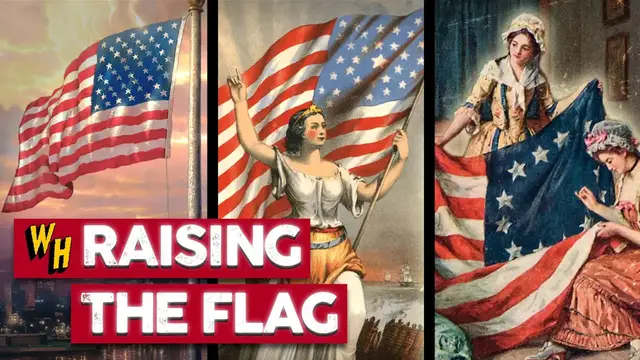
The American flag is one of the most recognized symbols in the United States, and there are strict rules on how to handle it. But what’s the meaning of the American flag - and what’s the meaning behind earlier versions of the flag?
Show More Show Less View Video Transcript
0:00
The American flag is one of the most recognized symbols in the U.S. of A
0:04
The red, white, and blue conjures up images of Uncle Sam, summertime barbecues
0:09
and too many country songs to count. While the stars and stripes have long defined America
0:13
you may be surprised to know that the flag itself wasn't defined for quite a while
0:18
Before, during, and after the Revolutionary War rocked the 1770s, patriots spread all over the country had their own idea of what we should be running up the flagpole
0:27
In other words, the American flag has long been a work in progress, with progress picked
0:32
to go along with it. So today, we're letting our history freak flags fly as we tell you about every version
0:39
of the American flag. For now, let's sing some Yankee Doodle Dandy and Grand Old Flag
0:47
When America was getting its rocky start during the Revolutionary War in 1775, they needed
0:52
a flag to hoist and call their own, separate from the British. The solution was a mixture of the Union flag for the kingdoms of England and Scotland and
1:01
the familiar 13 stripes representing the 13 original United Colonies. George Washington was the first to use the flag for the Continental Army, which boosted
1:09
its popularity and made it the flag to display during that era. The flag had the makings of what its successors would end up looking like
1:16
However, the Union Jack in the corner seemed to imply eventual reconciliation with Great Britain
1:21
So when the Declaration of Independence was signed on July 4, 1776, the Grand Union flag swiftly fell out of fashion
1:28
A year after that first Independence Day, the Flag Act of 1777 attempted to standardize what the American flag should look like
1:36
On June 14, it became official. The 13 stripes in alternating red and white, we love
1:42
In. But instead of the Union Jack, they opted for 13 stars within a blue field, representing a new constellation
1:48
and that's why we celebrate Flag Day every June 14th. In 1751, founding father Benjamin Franklin made a joke
1:59
that the new colony should send England a gift of rattlesnakes and everyone had a good laugh
2:05
If you think that's funny, you should see his Netflix special, though it's mostly about cancel culture
2:10
which is weird because it's like, you're Benjamin Franklin. Nobody's trying to cancel you
2:14
Also, aren't you dead? Anyway, people loved the Association of America and rattlesnakes so much that it inspired South
2:21
Carolina patriot Christopher Gatson to create a flag that represented his view of the new world
2:26
The coiled and ready-to-strike timber rattlesnake on a yellow background with the words
2:30
don't tread on me, underneath, became one of the most popular symbols of the American
2:34
Revolution with its defiant and vigilant stance against those who would do us harm
2:38
Also, snakes are really cool. The flag rose to new heights after being unfurled on the
2:43
mast of the flagship USS Alfred, commanded by Commodore Isik Hopkins. Hopkins was made
2:49
Commander of the Navy and he used the Gadsden flag as his personal flag during the war Today you could still find the Gadsden flag used by history enthusiasts and neighbors you drive by and think ah so that the Libertarian as well as several variations and parody versions for just about any cause you could think of
3:06
That's freedom, baby. The Battle of Bunker Hill was an important part of the early Revolutionary War
3:15
The British had besieged Boston and attempted to take control of the harbor by fortifying
3:19
Bunker and Breeds Hill. When the colonial forces heard about this, they did their best to push back, but ultimately
3:25
retreated against the British. Not all was lost, however. As the British counted their dead from the encounter, they realized just how much of
3:32
a force they were up against now that a ragtag band of rebellion fighters were able to give
3:37
such a significant pushback against the mighty British army. Allegedly, throughout the battle, the Continental troops rallied behind a certain primary
3:45
blue flag with England's St. George Cross in the upper left corner. However, as a way to throw a
3:50
bit of shade, literally and figuratively, the cross is defaced with a pine tree, a symbol of
3:55
New England. This story is a good one. There's no way to actually prove that the flag ever
4:00
appeared on the battlefield. Can a flag commit stolen valor? We assume this flag was created
4:09
between 1776 and 1777, since that's around when Long Island Minuteman Captain John Holbert
4:15
commanded his soldiers. However, historians have since been divided on the authenticity
4:20
of this discovery, claiming the flag dates back to the 19th century, not the 18th
4:25
Debates aside, in 1927, the faded and tattered flag was found on a Long Island property owned
4:30
by Holbert. And the flag is notable because it appears to be the precursor of what would
4:34
eventually become the official American flag. It had the red and white stripes in the blue
4:39
canton complete with 13 stars, though their placement was unique, almost as if someone
4:43
tried to duplicate the crosses of St. George and St. Andrew using only stars
4:51
The legendary Betsy Ross flag is probably the most recognizable flag to fly during the American
4:56
Revolution. The flag features all the best bits from each previous flag attempt, including seven
5:01
red stripes, six white stripes, and a blue canton with a circle of five pointed stars inside
5:07
The story goes that George Washington and financier Robert Morris commissioned upholsterer
5:12
Betsy Ross to make the flag based on a design by Morris. However, some historians dispute the claim
5:18
that Ross had anything to do with the flag's creation, as no paper trail supports the notion
5:22
that she was even in the room when it happened. So write a musical about that, Lynn. Despite the
5:27
uncertainty, the Betsy Ross flag story has stuck through the ages. With its red representing valor, white purity, and blue loyalty
5:34
the Betsy Ross flag was the most popular flag of the original 13 colonies
5:38
and has cemented its place in history as the great, great, great grandfather
5:42
of old glory today, no matter who sewed it together. Before we had a nationally accepted flag in America there was a lot of hubbub around what the flag should represent Many were adamant that the 13 colonies be a prominent feature
5:58
while others wanted to ensure the colors red, white, and blue made it in there
6:02
Then you got the guys who were ticked off about Britain's relative tolerance of French Catholics in Canada and wanted the flag to represent that
6:08
It was like Seinfeld's Festivus. Everyone got a chance to air their grievances
6:11
And the George Rex flag was a fabric forged by grievances with Catholicism, with which the largely Protestant Britain had some major issues
6:20
The Quebec Act of 1774 removed references to Protestant faith in the Oath of Allegiance, allowing the province of Quebec to practice Catholicism freely
6:29
The Protestant colonists in New York and New England didn't like that one bit and made sure their flag reflected that
6:35
In a not-so-subtle diss, the addition of no potpourri flew high in New York neighborhoods
6:41
as a protest to the king's government. Boy, potpourri is a word we just don't use enough
6:46
Try to use it in a casual conversation today. Around 1776 or so, the people of Easton, Pennsylvania, wanted to hoist a flag during
6:57
the public reading of the Declaration of Independence when it came through their town
7:01
So they decided to whip up their own. The 1777 Flag Act was specific on what the American flag should look like, and to Easton's
7:09
credit, they followed every direction. It has red, white, and blue, stars, stripes, the whole nine yards
7:15
They just decided to get a little creative with the placement, effectively reversing
7:19
the location of the stars and the stripes. If you ever find yourself in Easton, check out the Easton Area Public Library, which
7:26
houses the flag to this day. The flag that was supposedly carried into battle at Bennington, Vermont in 1777 is supposed
7:37
because historians aren't so sure the Bennington flag was there at all
7:40
More likely, the flag was designed around the War of 1812, or even in 1826, to mark
7:46
the 50th anniversary of the signing of the Declaration of Independence. The flag is unique in several ways, most obviously by the large 76 in the corner, commemorating
7:54
the year America declared its independence. Other slight changes from designs at the time is the stripe placement, with white replacing red compared to other designs
8:03
There are still 13 stars, but they are seven-pointed instead of the familiar five points
8:08
Despite, or perhaps because of its differences, the flag is a popular variant with flag collectors both inside and outside of Vermont
8:17
The Brandywine Flag. The flag with its own little flag inside. Flagception
8:23
September 1777 saw the massive Battle of Brandywine where more troops fought than any other battle
8:30
in the Revolution. Such a battle required a flag to fly, but since there was still no unified national flag
8:35
the various militias would often carry their own flags into battle. This specific design may have been primarily associated with the 7th Pennsylvania Regiment Company under the command of Captain Robert Wilson The Brandywine flag holds the distinction of being one of the very first colony flags to feature 13 stars and 13 stripes a Pronto version of the flag America uses today
8:59
If his flag's color scheme is any clue, this one comes from the time the United States was stuck
9:04
in a Freddy Krueger nightmare. One, two, King George is coming for you. But for realsies
9:10
During the Revolutionary War, the British had a fort at Vincennes, Indiana, and patriot George Roger Clark wanted it
9:17
So he led a battle to Vincennes to take it, and upon his victory, flew the red and green Clark flag to celebrate
9:23
This is the only early flag concept in America to feature this unique color pairing
9:28
Today, the George Rogers Clark flag may not be flown too much, but you can get Christmas wrapping paper that looks similar enough for a fraction of the cost
9:36
The Serapis flag was an American flag with the standard stars and stripes
9:44
but every third stripe was colored blue instead of the typical alternating red and white
9:48
Benjamin Franklin wrote about this flag to his ambassador to Naples, describing its design in detail
9:53
Excited that the stars on the flag denoted a new constellation, Franklin even had one sewed up and shipped off to his naval officer buddy
10:00
John Paul Jones. Jones happened to be flying the flag when his crew captured the British naval ship
10:05
HMS Serapis in 1779, giving the unchosen flag its official name. Of all the flags during America's childhood, the Bedford flag is by and large the most unique
10:20
The Bedford flag saw others using stars and stripes in their design and said, no thanks. Likely created in the early 1700s as a cavalry militia's banner in Massachusetts
10:29
the Bedford was carried into battle by Minuteman and Massachusetts native Nathaniel Page. The flag
10:35
made no secrets as to what the Minutemen were about, featuring an armored arm, a dagger
10:40
and the Latin phrase, vinka out morira, which translates to conquer or die
10:45
If that doesn't make you want to run away with your red tailcoats between your legs, we're not sure what will
10:53
Let's face it, before the American loyalists bested the British at the Battle of Cowpens
10:57
South Carolina, the Revolutionary War was not going well for the Thirteen Colonies
11:02
and supposedly the battle that paved the way for America's victory featured a specific flag flying
11:08
William Batchelor, the 3rd Maryland Regiment, carried a flag in a battle that featured 13 white and red stripes
11:13
and 13 white stars on a blue background. However, the placement of the eight-pointed stars was unique
11:19
Instead of 13 in a circle like the Betsy Ross variant, 12 stars form a circle around the 13th
11:26
However, some historians take issue with this origin story as Batchelor's regiment was not part of the battle
11:31
making this thing more likely a 19th century design, rather than one flown during the Revolutionary War
11:38
Sorry, Bachelor, we cannot give you a rose