Up next in 10



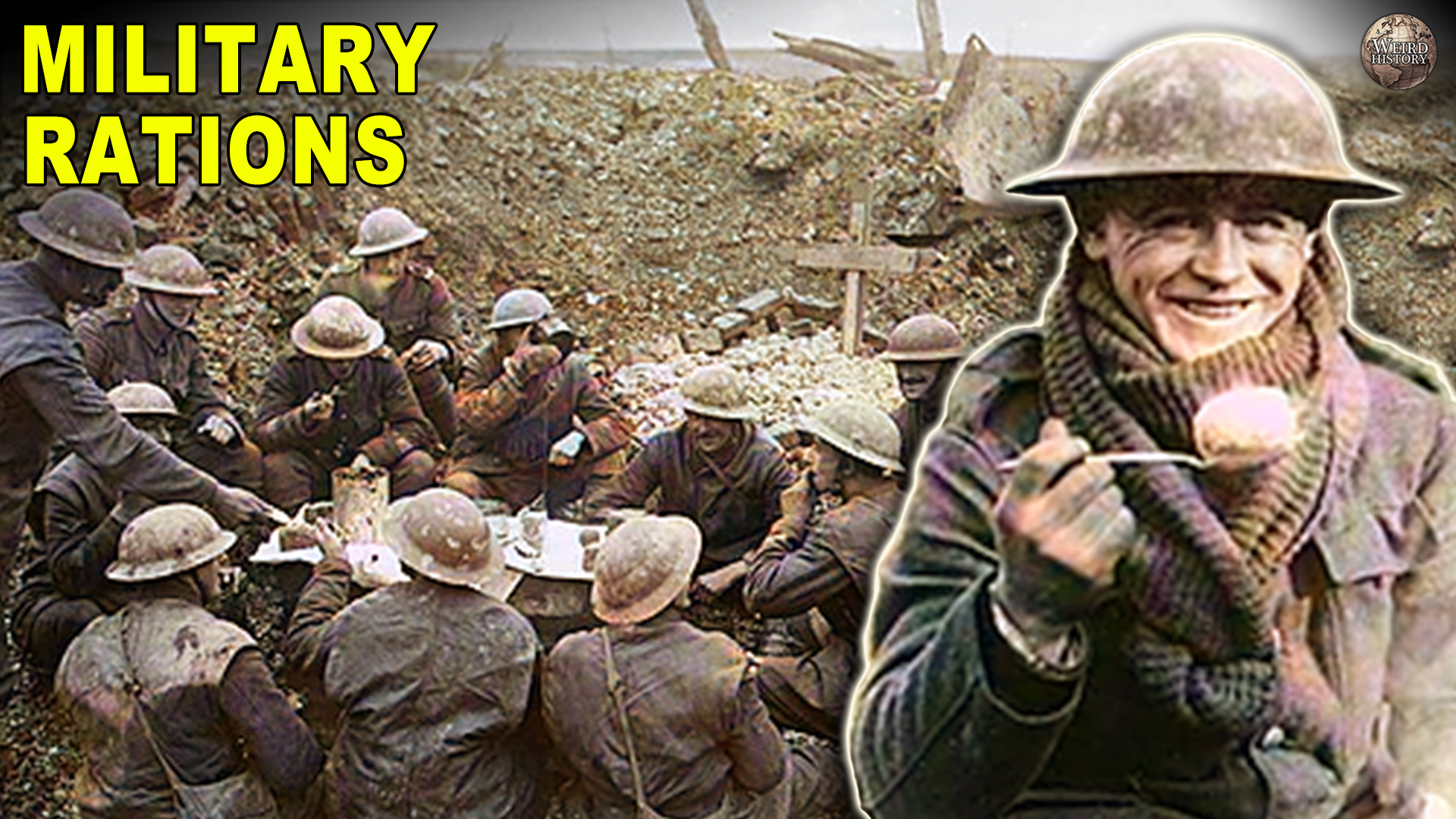
For centuries, troops have marched off to fight, risking their lives in combat. But what did soldiers eat in different eras? And which conflict offered the tastiest military foods? From blood soup to fermented horse milk, soldiers' rations throughout history have contained some unappetizing options. There have even been military provisions so disgusting that they actually took the lives of soldiers. Some armies would have been happy to get any food.
Show More Show Less View Video Transcript
0:00
Keeping your army sufficiently supplied
0:02
is one of the biggest challenges of military strategy. Convincing a few thousand people to attack your enemy
0:08
is tricky enough, but you also have to arm, clothe, and feed them for weeks, months, even years
0:15
Figuring out what to give your troops for breakfast, lunch, and dinner, and maybe even the occasional mid-morning snack
0:20
is a surprisingly complicated art that has gone through some major changes
0:24
across centuries of conflicts. So today on Weird History, we're exploring the evolution of military rations throughout history
0:32
Okay, time to lay siege to some nachos. They serve nachos at war, right
0:42
Let's jump back to Sparta, the ancient Greek city-state that's basically identified with
0:46
warfare thanks to the 2006 film 300, a movie that is as badass as it is historically inaccurate
0:53
But the movie does contain some truth. The Spartans really did have an entire culture built and shaped around combat, with young
1:01
boys leaving home to begin training in military barracks as early as age seven
1:06
As historian Plutarch explained, the training was designed not only to make Spartan men
1:10
strong and capable fighters, but was calculated to make them obey commands well, endure hardships
1:16
and conquer. Even today, the word Spartan in English means marked by strict self-discipline or self-denial
1:23
so their cuisine did not exactly tend toward the rich and flavorful
1:27
These soldiers would have primarily drunk a black broth made from blood, boiled pig's legs, and vinegar
1:33
Yeah, you know what? I think I'll just have the salad. Allegedly, the taste was so foul that the soldiers would often remark
1:39
that they'd rather be struck down in battle than have to return to camp for supper
1:44
which might have been an effective combat strategy, but probably didn't do wonders for the cook's self-esteem
1:49
The ancient Romans were just about as infamously warlike as the Spartans
1:53
but their soldiers would often enjoy tastier provisions. So tasty that we did a whole episode
1:59
about it. Though more simple and easy to prepare foods, like wheat and barley, were the staples of
2:04
their diet, Romans tended to eat more luxurious foods like bacon, cheese, and wine, even when on
2:09
the move. It's believed that the average Roman soldier consumed about a pound of meat each day
2:14
That could not have made marching any easier. The last thing you want to do on a belly full of hot
2:19
dogs is exercise. To keep up with demand, a traveling army would bring its own livestock
2:24
along, sometimes butchering up to 120 sheep per day, depending on the size of the garrison
2:29
As the Roman army conquered more and more of Europe, Africa, and the Near East, they'd taste
2:34
and enjoy the foods native to the lands in which they were arriving, and begin integrating them
2:39
into their diet. Many historians believe this high-calorie diet was among the secrets to Roman
2:44
military success in the empire's massive subsequent expansion. The Romans may have been infamous conquerors but no commander on earth amassed a larger land empire than Mongol leader Genghis Khan whose army spread across much of Eurasia in
3:02
the late 12th and early 13th centuries, from modern-day Poland in the west to Gaza in the
3:07
south, and encompassing most of Central Asia and China. It's a territory of roughly the same size as the entire African continent
3:15
That is a lot of real estate. All of this conquering was powered by, you guessed it, fermented horse milk
3:22
No, seriously, Mongol warriors were nomads, not farmers, so they had to rely on food they could bring with them across long distances
3:29
As with the Romans, this meant traveling with large herds of livestock, which provided meat and dairy
3:35
And since fresh milk wouldn't last particularly long on the road, fermented horse milk, often served as dried milk curd, was where it was at
3:44
Sometimes Mongol warriors would keep a bag of meat, onions, and some rice under their saddle during the day's ride
3:50
allowing the friction and heat of their own bottoms to cook the food, turning it into what some historians call saddle stew
3:57
Ironically, the name also applies to the stuff that comes out of your body after you eat saddle
4:01
stew. In his famous writings, Italian author and adventurer Marco Polo also recorded another
4:07
Mongol nutritional practice. He claimed that the warriors made small punctures in the necks of
4:12
their horses, and sometimes drank a bit of their blood during long rides for sustenance
4:17
During the First Crusade of the Middle Ages, which began in 1095 CE, hundreds of thousands
4:23
of Europeans left their homes and marched to Jerusalem in an effort to retake the city
4:28
for Christendom. These soldiers would have brought their own food from home with them, which typically consisted
4:33
of relatively cheap and easy-to-transport dried meat and porridge. Keeping the cost of the trip low was essential for most of these soldiers, as they were paying
4:42
their own way to the Middle East, rather than relying on patrons or support from the church
4:46
Many would have sold their most valued possessions or mortgaged their land to pay for the journey
4:51
Some wealthier crusaders might have also brought along fruit and cheese, if they could afford it
4:56
Due to the peculiar nature of medieval siege combat, by the way, sometimes battles would
5:00
actually be paused partway through for mealtimes. During the 1189 to 1191 Siege of Acre, a key
5:07
Third Crusade victory by Guy of Jerusalem against Saladin, Crusaders reportedly halted the battle
5:13
twice in order to enjoy a proper meal, invoking the storied tradition of calling a time out
5:19
Now, pass that butt soup in the spoiled horse milk. In 1683, the Ottoman Empire laid siege to the Austrian city of Vienna and brought bountiful
5:32
and generous military rations along with them. This included not just lamb and mutton
5:37
along with delicacies like honey and coffee, but also fresh-baked bread. Biscuits were also
5:43
shipped all the way from home in Istanbul where 105 dedicated ovens prepared food exclusively for troops at the front That an army you want to join It like marching into battle for Panera Bread
5:55
The iconic French general Napoleon is quoted as saying, an army marches on its stomach
6:01
While the quote is probably apocryphal, he clearly believed in the sentiment
6:05
as his troops were famous for bringing bread along with them to the front. What kind of bread
6:10
Did you even need to ask? French troops carried fresh baguettes with them
6:14
taking advantage of their convenient shape by stuffing them down their pant legs
6:18
Typical rations for French soldiers during this era also included meat and wine
6:23
A lack of ready resupplies of these kinds of provisions contributed to the colossal failure of Napoleon's 1812
6:29
infiltration of Russia and the ultimate undoing of his military schemes. The guerrilla revolutionaries who fought
6:36
for America's independence from Britain often didn't have to travel as far as the Ottomans
6:40
to get to the battlefront, but they didn't exactly arrive as well stocked with rations
6:44
The Continental Army struggled with nonstop supply problems. The American colonies lacked
6:50
the infrastructure that European fields of battle had developed for centuries, and Congress also lacked the authority to levy taxes against the population and spend them on
6:58
supplies. This meant that soldiers had to make do with whatever they got. Congress had authorized
7:04
a pound of beef and a pound of flour per soldier per day, along with steady rations of peas, beans
7:09
milk, rice, beer, cider, and molasses. But they were not always able to make good on this promise
7:14
and troops would often go a full day or longer without any rations at all. Congress suggested
7:19
to General George Washington that he simply seize food from local farmers wherever the army traveled
7:25
on behalf of his men. But Washington was hesitant to do so for fear of antagonizing the very
7:30
colonial population on whose behalf the men were fighting. By the American Civil War, molasses
7:38
a viscous and sugary syrup that would be mixed into dishes to add flavor
7:43
remained a key ingredient to the soldier's regular menu. Union troops also regularly consumed meat, flour, and some dehydrated vegetables and dried fruits
7:52
This included a combination of salt pork or beef, ham or bacon, bread, potatoes
7:57
a hard bland bread known as hard tack, onions, beans, peas, rice, dried apples and peaches
8:03
coffee, tea, sugar, vinegar, salt, and pepper. Basically, your rations were all the stuff you can buy while you're waiting to get seated at Cracker Barrel
8:11
Feeding their troops in the field was a considerably larger problem for the Confederate Army
8:15
and helped contribute to their eventual loss of the war. According to General Robert E. Lee, a lack of fresh supplies not only impacted the soldiers' ability to fight
8:24
but led to mass desertions that threatened the entirety of the war effort. The lack of available rations forced Confederate soldiers to forage for food while on the march
8:33
One soldier journal from 1864 reports the men eating an all vegetable diet consisting of potato tops vines and a combination of weeds In other words sh pull up from the side of the highway not exactly the menu for a healthy fighting force
8:49
The advent of canning processes to keep food fresh for longer periods provided a major upgrade to
8:54
wartime rationing and allowed soldiers in the field to enjoy a wider variety of prepackaged foods
9:00
However, during the Spanish-American War, these canning procedures were still in their infancy
9:04
and lacked the consistency and reliability of modern technology. Many soldiers got food poisoning after eating poorly canned and preserved food that had spoiled
9:13
Poet Carl Sandburg, a veteran of the conflict, described the process for testing out a tin of canned beef, known as Red Horse
9:20
The tin would be carefully sniffed and inspected by a series of soldiers prior to consumption
9:24
and would be thrown overboard if it didn't make the grade. By the end of the conflict, most historians believe foodborne illnesses such as botulism
9:32
claimed more American lives than the actual fighting. Only about 280 Americans perished in combat
9:38
but more than 2,600 expired from other causes. Canned meats, and particularly canned milk
9:44
also traveled to the front during World War I. The milk would sometimes be heated up
9:49
as a way of preparing hot meals. Still, World War I rations were not particularly popular
9:54
and mostly consisted of cans of meat and veggies, hardtack crackers, colloquially known as dog biscuits
10:00
tobacco, and sometimes candy. Guessing the dog biscuits were not the most popular item on that list
10:07
By World War II, rations received something of an upgrade and were also split into three groups, C rations, D rations, and K rations
10:16
A D ration was literally just a chocolate bar. C and K rations consisted of more of a variety
10:22
including tinned beef and potatoes, biscuits, toffee, and instant coffee. As a treat, soldiers were also sometimes given cigarettes and chewing gum
10:30
along with toilet paper, when available. By the Vietnam conflict, the government introduced what were known as MCIs
10:37
or Meal Combat Individual Rations. This included canned meat, which soldiers heated up using C4
10:45
Yeah, give me that cooking show, Food Network. They also received cans of crackers, cookies, applesauce, and cake
10:52
This meant that food could even be taken along on patrol by packing the cans in socks or tying them to backpacks
10:59
MCI rations also came with malaria tablets, salt pills, and tablets known as Lomodal that
11:05
soldiers were instructed to take four times a day to prevent diarrhea, which definitely
11:10
makes it harder to fight battles. Today, the US Army provides rations known as MREs, or meals ready to eat
11:18
Rather than cans, these come in vacuum-sealed pouches, and in order to prevent too much
11:23
fatigue from eating the same meals over and over again, they're available in 24 varieties
11:28
There's even an MRE pizza which can stay fresh for up to three years
11:33
though the pizza is probably best if enjoyed after no more than two and a half