Up next in 10



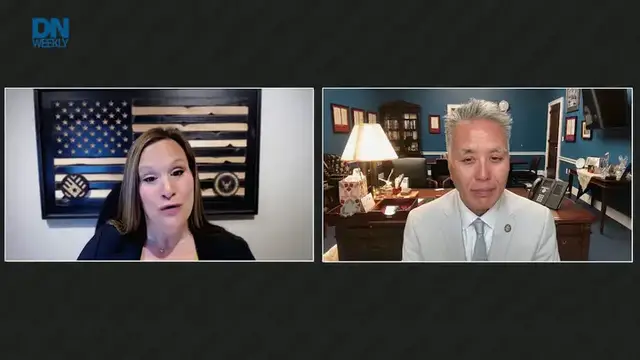
Rep. Mark Takano, ranking member of the House Committee on Veterans’ Affairs, weighs in on new legislation to change the face of some veteran benefits.
Show More Show Less View Video Transcript
0:00
My name is Natalie Oliveira
0:01
I am a freelance journalist with Military Times, and I wrote an article about our VSOs who are clashing over the Taking Care of America's Veterans Act
0:13
And I'm grateful to have ranking member Representative Mark Takano with us today
0:19
Thank you so much, sir, for being here with us. You're welcome. You're welcome
0:23
Glad to be here. So tell me, what is it about the Taking Care of America's Veterans Act that you specifically oppose
0:33
Well, specifically, I call the Taking Care of America's Veterans Act the taking benefits away from America's veterans
0:43
And, you know, basically it's about the largest cut to veterans' benefits in history, $57 billion that it cuts in order to pay for the things, the other bills that are in the bill
1:06
That is my biggest objection, that 1.5 million veterans will lose $57 billion in benefits
1:17
And if using projected savings from the pending VA rule is off the table, what alternative funding mechanism would you support to see the taking care of the VA
1:31
So there's plenty of alternatives. There's $100 billion in unspent Department of Defense funds that could be used instead
1:46
I am in particular, I think what I believe about this bill, the so-called Taking Care
1:57
of America Veterans Act is that it is an elaborate Trojan horse to avoid the momentum behind the Major Richard Starr Act which is just four signatures away from being voted on the floor that would cost about billion
2:17
And so what has the Republican majority done? They have built this elaborate Trojan horse
2:24
where they take the Richard Starr Act, combine it with a bunch of other priorities, some of which I agree with, some of which I don't
2:38
and have decided that they're going to cut $57 billion out of existing veterans' benefits
2:47
specifically benefits for disabled veterans, to pay for these priorities, that is simply wrong
2:54
So I mentioned that one way to pay for some of this legislation is to tap into the $100 billion that are unspent
3:06
We could delay the implementation of a benefit for multimillionaires and billionaires on the inheritance tax
3:20
We don't have to implement that right away. and we could, you know, pay for it in that manner
3:29
But here's the thing. We shouldn't be asking, we shouldn't be asking
3:35
putting one group of veterans against another group. And that's what this bill does, is it's kind of a hunger games
3:42
that the majority has created. You know, some veterans are more worthy than others
3:50
Some veterans of disability benefits are more worthy than others. No, all veterans have sacrificed
3:56
We shouldn't be asking one group of veterans to sacrifice for the other
4:01
If Congress cannot reach an agreement on the funding mechanism, what do you believe happens next
4:08
Do lawmakers rewrite the bill identify another offset pursue these provisions individually or risk losing them altogether I think we can pursue each of these provisions individually I believe the Major Richard Starr Act would pass in a
4:28
heartbeat. The House of Representatives, and I believe it would pass with great momentum to the
4:33
Senate, and we would find a pay-for. We don't need to know the pay-for at the outset. That could be
4:40
subject to negotiations, I want to remind you that I was the primary author of the Honoring
4:44
our PACT Act, which was projected to cost a lot of money in the hundreds of billions of dollars
4:52
We passed it out of the House without initially having a pay-for. There was intense negotiations
4:58
once both the House and Senate agreed that this was a priority, that we owed veterans
5:04
this compensation and medical care for toxic exposure like burn pits
5:14
That was hundreds of millions of dollars, by the way. We're not talking about the $57 million that this legislation, the CBO says, would cost
5:25
or that's what would result from the change in disability, the claims in disability
5:36
What we're talking about here is allowing Congress to work its will
5:43
allowing Congress to do the right thing for veterans, and we'll figure out how to pay for it
5:49
But look, a red line for me, a red line for me is we're not going to take away from one
5:56
group of veterans to pay for another. We're not going to ask one group of veterans to sacrifice for another group of veterans
6:03
They've all sacrificed. And again, I'll repeat what I just said. Congress should not be asking them to do that
6:11
We need to do our job and we'll find a way. but we
6:17
it's our job as members of Congress to honor the pact that we made
6:21
with veterans you know that that our job major veterans organizations that have traditionally worked hand in hand aligned together are now publicly divided over TCAVA
6:36
What does that tell you about this legislation and what concerns you most about that divide
6:41
It tells me, look, I have a huge respect for all the veteran service organizations that are there, the ones that are chartered
6:51
They are made up of people who seek to advocate for veterans and, frankly, whose voices stand above politics
7:03
And they should not be the subject of manipulations by congressional leadership
7:12
members, you know, people, member of Congress, Congress should not be pitting VSOs against each
7:22
other. But, you know, unfortunately, VSOs are being made to participate in a kind of hunger
7:32
games. Like this is an all or nothing bill. And this is the way it's got to be. No, it's not the
7:37
way it's got to be. There are certainly priorities that Major Richard Starr, other priorities that I
7:47
would agree with, could move forward. And we don't have to do this in a way that divides VSOs
7:53
So what that tells me is not bad VSOs. I would say it's bad leadership in Congress that forces
8:01
the VSOs to have to take sides in ways that they wouldn't really choose to do
8:10
Look, I know that the Veterans of Foreign Wars strongly supports Major Richard Starr
8:15
but they don't support Major Richard Starr being passed in a dishonorable way
8:23
That's as far as I want to go here. I really regret that veterans service organizations have been made to take sides when we could be working on these priorities in a much more unified way
#news