Up next in 10



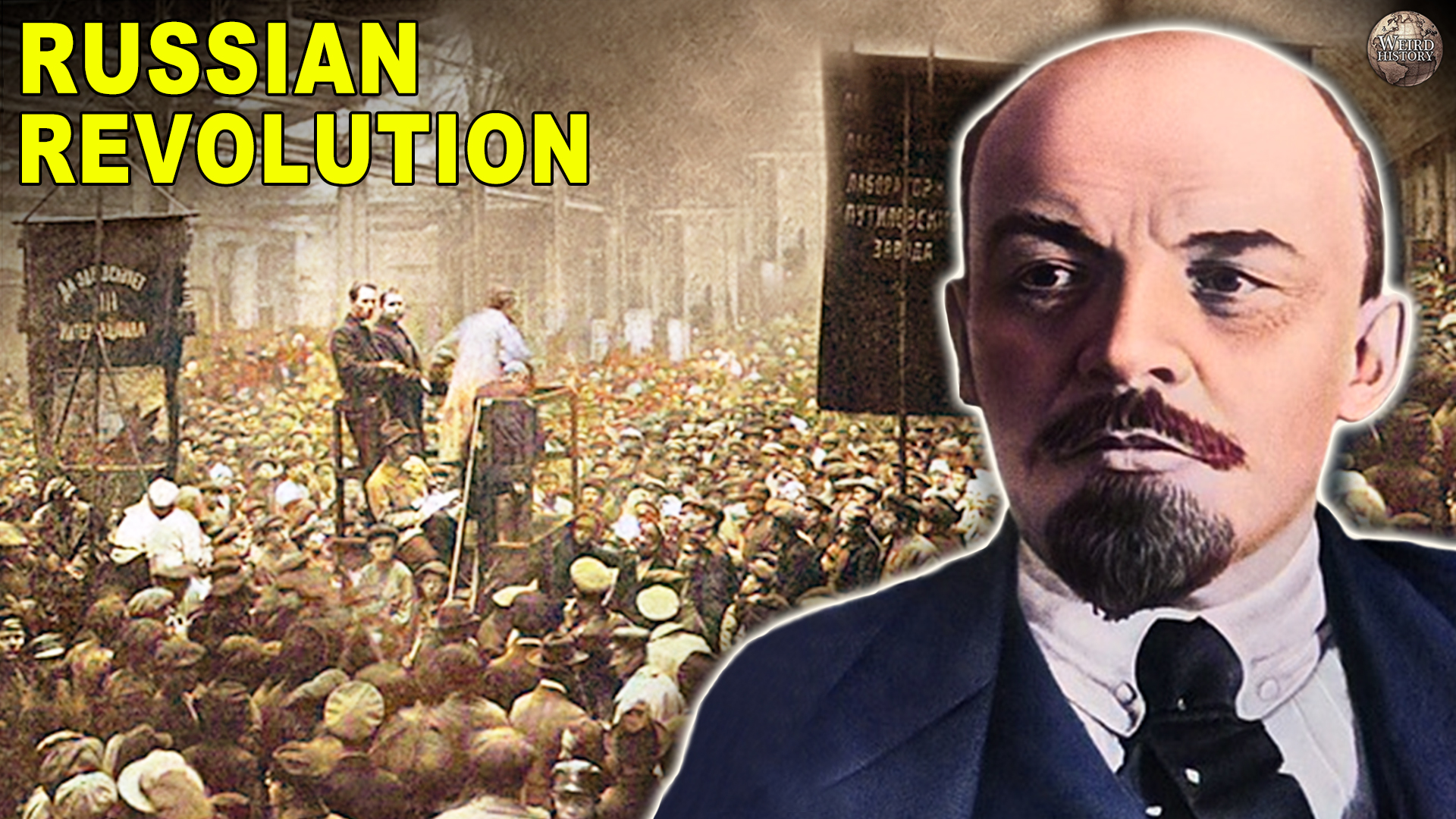
The Russian Revolution resulted in the establishment of the first Communist state in history and was the work of Vladimir Lenin and Joseph Stalin - that's the general story told to history students in textbooks, an incredibly simplified version of the events that took place between 1905 and 1925 in Russia.
Show More Show Less View Video Transcript
0:00
The Russian Revolution resulted in the establishment
0:02
of the first communist state in history and was the work of Vladimir Lenin and Joseph Stalin
0:08
Or at least, that's the story you've read in textbooks. But in truth, that's an incredibly simplified version
0:14
of the events that took place between 1905 and 1925 in Russia
0:18
So today, we're going to take a look at some fascinating little-known facts
0:22
about the Russian Revolution. OK, you say you want a revolution. Well, here we go
0:30
Technically, the Russian Revolution was actually three events. There was an uprising in 1905 that set the stage for the two uprisings that occurred in 1917
0:42
The Revolution of 1905, also called the First Russian Revolution, was the result of widespread discontent among the peasantry and workers in Russia
0:52
Directed against the Tsarist government of Nicholas II, the 1905 revolution included notable events like the Bloody Sunday Massacre
0:59
which, for the record, is not the same Bloody Sunday as the U2 song
1:03
Apparently, Sunday is just a popular day for state violence. On this Bloody Sunday, hundreds of people were left injured and slain
1:11
after Russian troops crushed a demonstration by factory workers in St. Petersburg
1:15
In response to the revolution, Tsar Nicholas II issued the October Manifesto
1:20
which reformed the government, established representative bodies called Duma, and saw to the development of a constitution
1:27
But the Dumas failed to get any cohesive reforms passed, and the additional strain of World War I
1:33
led to even more upheaval in the country. By February of 1917, a revolution broke out in Petrograd
1:40
with thousands of demonstrators protesting and rioting. As a result, Tsar Nicholas abdicated
1:45
and took his son out of the line of succession, leaving his brother, Michael, as the next ruler
1:51
Michael ultimately refused to take the throne. Probably a smart move. and the Russian Provisional Government was established
1:58
But this governing body only lasted a few months. Never able to stabilize or wield any effective power
2:03
the Russian Provisional Government kept Russia in World War I and was fairly hands-off, which led to continued shortages and violence
2:11
It was against this government that Vladimir Lenin launched a coup d'etat in October
2:15
and established a communist Russia. Or it might have been November, depending on your calendar
2:20
Yeah, about that. The events of 1917 and how they shaped Russian history
2:30
are a bit muddied by the fact that the Soviet Union didn't adopt the Gregorian calendar until 1918
2:36
The calendar, named after Pope Gregory XIII, was slightly shorter than the Julian calendar
2:42
In 1917, Russia still used the Julian calendar, even though it had been long since abandoned
2:47
by much of the Western world. According to the Julian calendar the uprisings in Russia took place on February 23 3 October 24th and October 25th of 1917 But on the Gregorian calendar those dates
3:01
were March 17th, November 6th, and November 7th. When Russia finally switched to the Gregorian calendar in 1918
3:08
it eliminated 13 days from its calendar, which now makes it pretty confusing
3:12
to identify the dates of those historical events. And you thought daylight savings time was a pain in the ass
3:20
During the Russian Civil War, the United States sent roughly 5,000 troops to North Russia to
3:28
fight at the request of British and French troops in the region. The group landed in
3:32
Arhangelsk, Russia, in late 1918, just as World War I was coming to an end. Largely comprising
3:38
men from Michigan and Wisconsin, shout out to the Midwest, the Army Expedition Force was tasked
3:43
with keeping weapons out of German and Bolshevik hands, as well as assisting a group of Czechoslovakian
3:49
forces stranded in Russia. Through the winter of 1918 and 1919, the polar bears, as they became known
3:55
focused their efforts on six specific locations throughout the province as temperatures reached below
4:00
negative 50 degrees Fahrenheit. Amid the cold, American forces found that their weapons
4:05
froze to the point of being unusable. According to Harry J. Costello, one of the men who served
4:11
the problem was eventually solved by an American machine gunner who suggested putting hot water
4:15
in the jacket, wrapping the gun in several heavy blankets, and changing the water frequently when freezing was near
4:21
This method didn't work everywhere, however. On fronts where it was next to impossible to build a fire
4:26
the water-cooled machine guns were useless. It's a shame there weren't any hollowed-out taunt-toms nearby
4:37
Born in what is now Ukraine, Asip Bernstein studied law in Germany
4:41
and went on to become a finance lawyer. During the Bolshevik Revolution, he was arrested by the Cheka
4:47
or Bolshevik secret police. for counter-revolutionary crimes. After being taken into custody, Bernstein
4:53
received a death sentence for working with banks in pre-Bolshevik Russia. On his execution day, he was lined up
4:59
in front of a firing squad when one of the commanders asked what his name was
5:03
Upon hearing the man's name, the commander realized Bernstein wasn't just some lawyer
5:07
but he was also one of the most talented chess players in Russia. It sounds like a twist from a Hollywood movie
5:13
but the commanding officer challenged him to a chess match. If Bernstein won, he would be allowed to live
5:20
If he lost, well, you know. Bernstein accepted the challenge and won
5:24
He was spared freed and later settled in France, where he presumably told everyone his name all of the time
5:35
By late 1917, the provisional government of Russia was failing. The Winter Palace in Petrograd was the seat of government
5:43
which made it a prime target of militant Bolsheviks The head of the Russian provisional government Alexander Kerensky naturally ordered its defense Reportedly 137 members of the Women Battalion of Death which kind of sounds like an e
5:56
team, stood alongside Cossack and Russian troops to resist the Bolsheviks. But it didn't go well
6:03
According to David Soskis' first-hand account of the event, the palace was pillaged and
6:07
devastated from top to bottom by the Bolshevik armed mob, as though by a horde of barbarians
6:12
Among the palace's target areas was an extensive wine cellar. When bottles were smashed and crates of wine were thrown into holes in the river ice
6:20
crazed people dove in after and drowned. Reports also surfaced that officials tried to pump wine out into the streets
6:27
but crowds gathered to drink it from the gutter. Hey, it was a good vintage
6:31
Still another reporter recalled thinking she heard gunfire, but it was actually the pop of corks by soldiers who lay on the white snow
6:38
not dead, but merely drunk. It was not common for revolutionaries to change their names
6:48
but both Vladimir Lenin and Joseph Stalin gave their personal monikers a bit of a punch-up
6:53
They were nothing if not PR-minded. In 1901, Vladimir Ilyich Alianov adopted the surname Lenin while in exile
7:01
The pseudonym was to protect his true identity, but why did he choose the name Lenin
7:05
After all, Beatlemania was still a good 60 years in the future. Observers, including Lenin's own niece, Ulga Olejnova
7:13
theorize it may have been in reference to the Lena River. Other possibilities include being an homage to a character in Leo Tolstoy's novel
7:21
Kazaki, or it may have belonged to a dead man whose name Lenin simply usurped
7:25
sort of like 50 Cent. The man the world knows as Joseph Stalin was born Josef Iskironovich Jugosvili
7:33
In 1912, however, he changed his name to a Russian word that essentially means
7:37
Man of Steel. This was 26 years before Action Comics number one, which makes Stalin the original
7:43
Man of Steel. Historian Wilhelm Pockiblem believes Stalin's name change was driven by the fact that
7:49
the surname was simple, devoid of all artistic pretense, understood by any worker, and most
7:54
importantly, looked like a real last name. Also, Stalin sounds cool. You cannot underestimate the
8:00
importance of a cool-sounding name. Speaking of names, when communists took over in 1917
8:05
the practice of Octobering was established to unite the populace through rituals and ceremonies
8:11
One way this manifested was to give babies names inspired by the changing culture
8:15
Names like electrificatza, meaning electrification, carm, meaning Red Army, and ninel, which is Lenin spelled backwards, became popular
8:25
Other October names include Melor, an anagram derived from the words Marx-Engels-Lenin-October Revolution, and Comitern, a portmanteau of communist international
8:35
At least Khaleesi didn't make the list. More Game of Thrones references
8:39
Will it ever die And it wasn just personal names that were affected St Petersburg was named Petrograd in 1914 because it sounded too German though it was then changed to Leningrad in 1924 shortly after Lenin passing
8:52
However, in 1991, a referendum was passed changing the name of the city back to St. Petersburg
9:02
The war between Vladimir Lenin's Bolshevik Red Army was composed of members of the Red Guard, elite troops
9:08
in Imperial Russia and personnel from the Imperial Army. The Red Army seemed to be at a disadvantage
9:13
with support sent to Russia by the US, Japan, the UK, and other countries around the world
9:19
However, conscription recruitment and mass mobilization allowed the Bolsheviks to grow the Red Army's ranks
9:24
to overwhelming numbers. Too overwhelming, it turns out, even for Lenin. Desertion, a lack of supplies, and poor training
9:31
resulted in Lenin issuing a December 1919 memo that suggested, it is 1,000 times more expedient
9:37
to have no more than a million Red Army men in all, but well-fed, clothed, and shod ones
9:42
rather than three million half-starved, half-naked, half-shod ones. And while we understand his point
9:47
a Bolshevik army of shirtless soldiers hopping around in one boot would have been no less historic
9:57
After Tsar Nicholas II abdicated in March of 1917, he, his wife Alexandra, and their five children
10:04
were kept in confinement at Yekaterinburg in the Ural Mountains. In July of 1918, when it looked like there might be an effort to rescue the Romanovs
10:12
the whole family was whacked. In addition to Nicholas and his children, numerous members of the extended Romanov family were done away with
10:19
According to Time magazine, all these people were taken to an abandoned mine and thrown down a shaft
10:25
Hand grenades were then dropped in after them to eliminate any uncertainty. Damn, how would you even categorize that
10:31
Execution by action movie? Lenin was exiled in 1895 and lived in Siberia for three years
10:43
Once that period ended, he went to London, where he published a pamphlet about making
10:47
Russia a socialist country entitled, What is to be Done? He would not be the last person to write the equivalent of an indignant blog post after
10:54
being thrown out of a place. Lenin returned to Russia in 1905
10:57
By that time, the Russian order was restored, and the promises made by Tsar Nicholas II's
11:02
October Manifesto had come to fruition. Russia had a constitution, and there was a national parliament
11:08
And so Lenin was once again exiled in 1907. In April of 1917, Lenin headed back to Russia
11:14
with dozens of other exiles, riding a train from Zurich through Germany, then up to the Baltic Sea
11:19
From there, the group took a ferry and boarded another train to Sweden. The landscape proved to be challenging for Lenin
11:25
and his fellow revolutionaries. They had to use horse-drawn sleds to cross a frozen river
11:29
into Finland, but they made it. And Lenin took a train to Petrograd soon after
11:33
Keeping Lenin out of Russia was apparently like trying to ban Garfield from the Olive Garden
11:38
They do have similar whiskers