Up next in 10



The yakuza of Japan are often compared to other underground organizations like the Mafia or a Mexican drug cartel. With numerous organizations, syndicates, and participants, the yakuza are much more than that, with a history that goes back for centuries and extends throughout Japanese cultural, political, and economic foundations. Many of the details are relatively unknown to the Western world.
Show More Show Less View Video Transcript
0:00
The Yakuza are much more than just an underground criminal
0:03
organization like the mafia or a radical video game franchise. Their history goes back centuries
0:09
And while their influence has ebbed and flowed, one thing that has remained constant
0:12
is the Yakuza's enduring adaptability. So today, we're going to take a look
0:17
at the surprising history of the Yakuza or the Yakuza, whichever one you like
0:23
OK, time to count all your fingers and strap in for a quick tour of the Japanese criminal underworld
0:29
The origins of the Yakuza name tell the story of the foundations of the group itself
0:40
Comprising of three separate parts, ya, ku, and za, Yakuza translates to good for nothing
0:46
or born to lose. The name is basically a Springsteen song. When you split it up, however
0:51
it becomes 893, the name of a losing hand in a popular card game called Hanafuda
0:57
which is comparable to blackjack. The Yakuza grew out of a gambling and peddling culture in Japan
1:02
tracing back to the 18th century, but they see themselves as based in a much older tradition
1:07
Yakuza members consider themselves to be part of a ninkyo dantai, or chivalrous organization
1:13
with links to the earliest days of the Muromachi and Edo periods. The Muromachi period, which lasted
1:18
from 1138 to 1573 CE, and the Edo, or Tokugawa period, which lasted from 1603 to 1867 CE
1:27
was home to ronin, wandering samurai without lords. Ronin, like Ishikawa Goemon, were outsiders who stole from the rich, gave back to the
1:36
poor, and avenged wrongdoing in Japan. And while that certainly sounds like something to aspire to, in reality, the only thing the
1:44
Yakuza really gives back to the community is racketeering and extortion. And there's no gift receipt, so good luck returning it
1:51
Still, the image is appealing to plenty of people. At its peak in 1963, the Yakuza had roughly 183,000 members
1:59
Because data about crime syndicates in Japan wasn't available before 1958, the numbers prior to this peak
2:05
are unknown. known. The Yakuza was at the height of its power
2:15
in the mid 20th century, thanks in part to the CIA and its relationship with Yoshio Kodama
2:21
Kodama was a political revolutionary prior to World War II and operated in China
2:25
as a Japanese spy throughout the conflict. Along with collecting information for Japan
2:30
Kodama accumulated wealth through a network of back channel operations, violent acts, and connections
2:36
with the Japanese underworld. It was like sending Tony Soprano to infiltrate an enemy nation
2:40
According to a CIA report, Kodama was blood brother to a number of the Yakuza
2:46
But that didn't stop the agency from enlisting him to serve as a contact in Asia during the late 1940s
2:51
The CIA also funded the Liberal Democratic Party in Japan, a political group within which Kodama exhibited
2:57
immense power and influence. With the CIA and the Yakuza on his side
3:01
he became an extremely influential undercover man in conservative and financial circles by the 1960s
3:07
As an intermediary between the Japanese underworld and legitimate authorities, Kodama developed a reputation
3:13
akin to a mafia godfather. During the mid-1970s, however, a scandal involving Lockheed
3:18
Aircraft Corporation, Kodama, and the Japanese government brought the Yakuza powerhouse under scrutiny He was indicted for tax evasion and violating international exchange laws But he died in 1984 before any verdict was issued That one way to beat a rap
3:33
That man was a master strategist. The Yakuza is a patriarchal organization
3:45
that mirrors Japanese society as a whole. In it, the Oyabun is the boss as well as a parental figure
3:51
Under the oyabun are the kobun, apprentices who are essentially seen as children
3:57
The oyabun-kobun relationships binds all yakuza members and includes specific responsibilities. However, unlike most parent-child relationships, these responsibilities are less doing the dishes
4:08
and more destroying your father's enemies. The oyabun mentors his kobun to kill others or even kill themselves for the sake of the oyabun
4:16
which is slightly more extreme than what fathers tell their kids when the neighbors return the
4:20
lawnmower with an empty gas tank, but only slightly. According to one former Yakuza Kobun, when you're a Yakuza
4:27
people are always watching you. Think of yourself as being on stage all the time
4:31
It's a performance. If you're bad at playing the role of a Yakuza, then you're a bad Yakuza
4:36
This performance has strict rules. One of the most important rules for members
4:41
is to keep their tattoos private, like a college freshman coming home for winter break
4:46
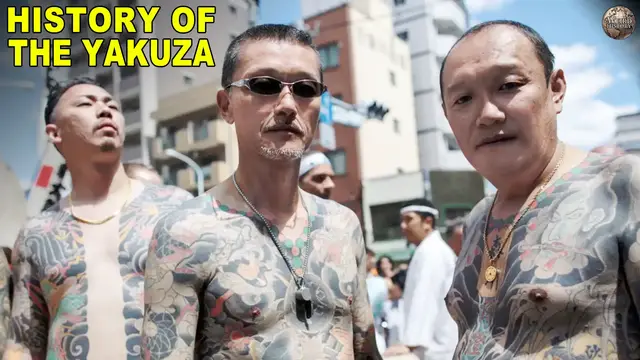
This is done mostly out of respect, because Japanese culture generally frowns on tattooing
4:51
Members of the Yakuza get tattoos to demonstrate their loyalty as well as their ability to withstand pain
4:57
Once associated with punishment, the tattoos attest to a tradition dating to the 3rd century
5:02
that holds men, both great and small, tattoo their faces and work designs upon their bodies
5:08
Yakuza tattoos take years to complete, cost thousands of dollars, and are
5:13
on areas of the body that one wouldn't expose to the public. Mm-hmm
5:16
even those places. Another act of body modification practiced by Yakuza members is called purling
5:23
which involves inserting small beads or pearls under the skin of your genitalia, with each bead
5:29
or pearl representing a year in prison. Yeah, that's cool, guys, but I think I'll try to stay
5:34
out of prison. One of the most notorious and cringe-inducing practices associated with Yakuza
5:39
is yubitsume, or finger shortening. It began as a punishment used by Japanese gamblers known as Bakuto
5:46
Yubitsume was performed when a serious offense had taken place, but not quite serious enough for banishment or execution
5:54
It was designed to weaken one's hand, essentially making the offender more dependent upon his boss
5:59
Yubitsume commonly involves the self-amputation of the top joint on one's pinky finger
6:04
It's intended to be an apology in lieu of words, because nothing says I'm sorry like chopping off your own pinky
6:10
Most Yakuza members are too proud to outright apologize or beg for forgiveness
6:14
to the point that yubitsume is the preferred option. Evidence suggests that the practice of yubitsume
6:20
is not as common as it once was. But in 1993, data indicated 45% of Yakuza members
6:27
had lost at least one finger. Out of those, 15% undertook the ritual two times or more
6:33
At that point, I'm guessing the problem is you, not the yubitsume. And because sometimes yubitsume just isn't enough
6:40
there's also shuniyubi, which entails the loss of an entire finger to preempt more severe punishment
6:45
For six years, French photographer Chloe Jaffe documented the lives of women married to members of the Yakuza However before she could start she had to get permission from a Yakuza boss That step alone might have scared off most people Going straight to an underworld kingpin
7:00
and asking him if you can photograph his operation might end with you at the bottom of a reservoir
7:04
and a whole bunch of people saying, I told you so. But the boss was impressed by Jaffe's determination
7:10
and slowly opened his doors to her. Jaffe soon discovered that while women can't officially
7:15
become Yakuza themselves, a woman who has married a member of the Yakuza is absolutely part of the group. She explains that Yakuza wives
7:23
live like most housewives in Japan, but their specific attachments to their husband's connections
7:28
depend on his status in the organization. For instance, leaders' wives serve as consultants
7:33
and manage finances, although usually through an intermediary. Women also get tattoos comparable to
7:39
Yakuza members, but according to Jaffe, they are more like armors, omamori in Japanese. They are
7:46
protections. The women are also bound by similar rules. They keep their tattoos hidden, and once
7:51
they are connected with the organization, they find it very difficult to leave. Michael Corleone
7:56
had it right. Just when I thought I was out, they pull me back in. Shoko Tendo, the daughter of Yakuza
8:03
member, admitted that while she hated the way my father behaved, I became just like him. Violence
8:09
drugs, and turmoil defined her early life, but looking back, she would later say she wouldn't
8:14
have lived any other way. The largest Yakuza subset is the Yamaguchi Gumi. In 2015, roughly
8:25
100 years after it was established, the Yamaguchi Gumi organization fractured into two separate
8:30
groups. The offshoot, Kobe Yamaguchi Gumi, formed its own organization, although it later split into
8:36
three smaller groups. The main outcome of this initial split was a violent civil war that has
8:41
lasted more than five years. Authorities in Japan established an entire agency to try to quell the
8:47
violence that erupted during the Yamaguchi-gumi war, similar to how the FBI was established to
8:53
deal with the growing organized crime problem in the US. Officers patrolled near schools
8:58
arrested members of both groups en masse, and monitored the rebellion faction's headquarters
9:02
in Kobe, but were unable to prevent assassinations and violence. Despite years of fighting
9:08
members of the two groups appeared to make amends in 2021, signaling what may be the end of the war
9:13
Fingers crossed. Except for, you know, those who have done Yubitsume. The Saki Ritual is a ceremonial exchange between kobun and their oyobun. A full sake ceremony
9:27
includes a mix of fish, salt, and sake, along with a kobun, oyobun, and intermediaries called
9:32
azukarinin. With the kobun and oyobun facing each other while sitting at a Shinto shrine
9:37
they exchange sake cups and recite their duties to each other in a formal pledge
9:42
The sake symbolizes blood and establishes lifelong bonds. But from the perspective of
9:47
Satoru Takagaki, a former Yamaguchi-gumi boss, the civil war within the organization
9:53
has fundamentally changed the Yakuza. According to him, when the Yamaguchi-gumi split apart
9:58
the Yakuza world had to reassess the meaning and importance of the bonds cemented by ritual
10:03
sake drinking. Takagaki felt that when you ignore the precepts and rationale of the Yakuza world
10:09
you call into question the entire structure of the society. This is why no respectable Yakuza organization bonded
10:16
with Kobe Yamaguchi Gumi. He believed that if one drank the sake and later became disenchanted with that oath of loyalty then he should just leave the group and go straight To put it another way if you don have the stomach to honor the pledge then don drink the sake Oh boy that wouldn be the first
10:31
time we shouldn't have drunk the sake. The Yakuza have taken steps over the years to try and soften
10:40
their public image. As early as the 1960s, Yamaguchi Gumi leadership tasked the organization
10:45
with combating amphetamine use. In 2014, Yamaguchi Gumi launched a website to help purify the nation as part of its ongoing
10:53
Drug Expulsion of Land Purification Alliance initiative. The website put forward anti-drug messaging
10:59
alongside a theme song that included the lyrics, With nothing but my courage and this body
11:04
I trust myself to the life of a Yakuza and follow this path I've decided on
11:10
In Nagoya, the Yamaguchi Gumi emblem is our life, dedicated to chivalry
11:15
That's the spirit of a man. We're not kidding. They really wrote a song
11:19
This toe-tapping jam was intended to emphasize masculinity and self-discipline, while downplaying
11:24
the many crimes in which Yakuza members have been involved. According to journalist and Yakuza expert Jake Adelstein, the point of the website is
11:31
to demonstrate that the Yamaguchi Gumi is actually a humanitarian organization. The Yakuza also publishes its own magazines
11:39
When it debuted in 2013, Yamaguchi Gumi Shinpo was a magazine with only eight pages
11:45
proving that literally every organization on Earth has a newsletter. It was printed for the roughly 27,000 members of the Yamaguchi Gumi group within the Yakuza
11:54
intended to communicate goals and policies from the top down. The publication included poetry and games, an essay by Yamaguchi Gumi boss Kiyoshi Takayama
12:04
and a story about fishing. It's like a highlights magazine for tattooed gangsters with missing fingers
12:09
According to Adelstein, the magazine is the Yamaguchi Gumi's attempt to show the public
12:13
that it's an old organization that upholds traditional Japanese values, that its members
12:18
are not a bunch of violent thugs. This was not the first publication of this type issued by the Yakuza
12:24
From 1965 to 1975, Yamaguchi Gumi Jiho was in print, similarly distributed among thousands
12:30
of its namesake's members. Yakuza membership has been on a decline since the early 2000s
12:41
Japan's National Police Agency estimated roughly 26,000 full-time and associate members at the
12:46
end of 2019. That's just 14% of the numbers the Yakuza had in its ranks during its mid-20th century peak
12:53
The world has not seen a steeper membership drop since the Kirk Cameron fan club
12:56
And in 2020, the group saw lower numbers for the 16th year in a row
13:01
However, as Adelstein noted in 2017, they aren't just vanishing. they're transforming
13:06
One former Yakuza boss explained, the Yakuza are a franchise. You pay your association dues to borrow the power
13:13
and menace of the group. Fear makes people pay you. But if you can't use the name or the symbol, why even stay
13:18
It's like running a McDonald's without being able to use the golden arches. Better to cut expenses than leave
13:23
We're not vanishing. We're restructuring. That sounds like a quote from the CEO of MoviePass
13:28
And while there's something appealing about a fearsome criminal organization adopting the corporate jargon of an imploding tech startup
13:33
Unfortunately for the Yakuza, their restructuring has been negatively impacted by the COVID-19 pandemic
13:40
with numerous businesses no longer to pay mikajimerio, or protection money. They're presumably placing a temporary hold on all leg
13:47
breakings until these business owners can get back on their feet