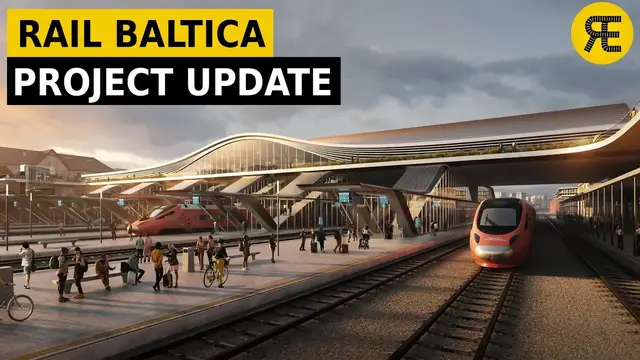

Is Rail Baltica Still Worth It After Costs Quadrupled?
Jun 28, 2026


In this episode of Railways Explained, we return to the Rail Baltica project, one of the most ambitious railway infrastructure investments in Europe, connecting Estonia, Latvia, and Lithuania with Poland and the wider European standard-gauge railway network. When we covered Rail Baltica more than three years ago, the project was presented as a fully electrified, double-track, mixed-traffic railway designed for passenger speeds of up to 230 km/h, freight trains of up to 1,050 meters, ERTMS Level 2 signalling, and full integration of the Baltic States into the European rail system. But since then, the project has changed dramatically. The original cost estimate of around €5.8 billion has increased several times over, with current estimates reaching approximately €23.8 billion. At the same time, the project has shifted toward a phased implementation strategy, with Phase 1 focused on delivering a reduced single-track configuration by 2030, while many parts of the original vision — including full double-tracking, wider freight terminal development, and deeper integration of major urban hubs — are being pushed into an undefined second phase. In this video, we explore: Why Rail Baltica is strategically important for the Baltic States and the EU How the project connects Estonia, Latvia, Lithuania, Poland, and the wider European rail network Why costs have increased from €5.8 billion to nearly €24 billion What Phase 1 will actually include by 2030 Why the project is shifting toward a single-track high-speed railway concept How operational plans have changed for passenger and freight services The role of Riga Airport, Kaunas, Vilnius, Tallinn, Pärnu, and Salaspils The challenge of 1435 mm standard gauge vs. 1520 mm broad gauge Why variable-gauge rolling stock and adaptive bogies may be needed Whether Rail Baltica still justifies such a massive investment Rail Baltica remains a project of major geopolitical, economic, and transport importance. It supports regional integration, military mobility, and the long-term shift toward sustainable transport. But with rising costs, reduced scope, uncertain funding, and major operational compromises, the question is now unavoidable: Is Rail Baltica still the same project that was originally promised? Let us know your thoughts in the comments. Railways Explained E-Book Our e-book featuring the first 100 Railways Explained stories is available now. If you enjoy deep dives into railway projects, infrastructure, and transport history, check it out through the link in the description. https://payhip.com/b/mTDPX Support Railways Explained Become a Patreon supporter, join our YouTube Membership, or subscribe to the channel to help us keep producing detailed railway analysis from around the world. Become a member on Patreon for exclusive content, behind-the-scenes access, and more: https://www.patreon.com/railways_explained Join our YouTube membership to support the channel and get special perks: https://www.youtube.com/channel/UCGq3OyOoLPYj4Oyk1DWnKxQ/join Donate via PayPal: PayPal.Me/railwaysexplained Check out our official merch and show your love for all things railway: https://railways-explained.creator-spring.com Subscribe for more in-depth railway stories and analyses from around the world. Big thanks to our Patrons: Walid, Mind K, An Oni Moose, Julian Baumann, Hendrik Hinrichs, Robert P. Walsh, Xosé F. Estrada, Mårten Hammarstrand, Lucas Richter, Korawich Kavee, Alex Zaslavsky, Ben M, Nathan Walls, Bill, Tim McKeoun, August Bigelow, Brendan McKeon, Linda Vainomae-Hoffmann, Linda Vainomae-Hoffmann, Reinforcedconcrete, Alex McDonald, Martin Pelles, Alice Conalbi, Declan Crowley, Martin Hinge, William Rohe Follow us on Social Networks: Facebook: https://www.facebook.com/RailwaysExplained/ Instagram: https://www.instagram.com/railways_explained/ Linkedin: https://www.linkedin.com/company/70132922/admin/feed/posts/ #railway #megaprojects #highspeedtrain
Show More Show Less