
Inside Portugal’s Railway System: History, Performance, and Challenges
Dec 25, 2025


Get Our E-Book!
We’re thrilled to announce the upcoming release of our first-ever e-book: a curated compilation of 100 Railways Explained scripts, filled with insights, facts, and rail stories from across the globe. If you love our videos, you’ll definitely enjoy reading it. https://payhip.com/b/mTDPX
Support Us & Get Exclusive Benefits:
Become a member on Patreon for exclusive content, behind-the-scenes access, and more: https://www.patreon.com/railways_explained
Join our YouTube membership to support the channel and get special perks: https://www.youtube.com/channel/UCGq3OyOoLPYj4Oyk1DWnKxQ/join
Donate via PayPal: PayPal.Me/railwaysexplained
Check out our official merch and show your love for all things railway: https://railways-explained.creator-spring.com
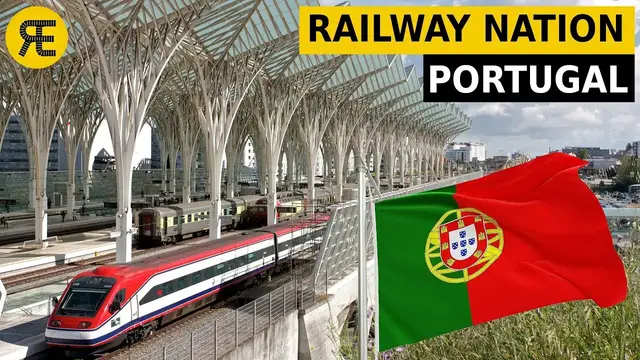
Portugal’s railways are often overlooked in European railway discussions — yet they tell a fascinating story shaped by geography, politics, and late modernization.
In this video, we take a deep dive into Portugal’s railway system, explaining how its unique geography influenced the structure of the network, why three main corridors became its backbone, and how historical choices still shape rail transport today. We explore the rise of the Northern, Southern, and Eastern Lines, the long period of stagnation after World War II, and the dramatic turnaround that began after Portugal joined the European Union in 1986.
You’ll also learn why rail freight plays only a minor role in Portugal, while passenger rail has experienced record-breaking growth, especially after the introduction of ultra-cheap national rail passes. We break down where passengers actually travel, why Lisbon dominates rail demand, and how services like Alfa Pendular became the prestige segment of the network.
Finally, we look at the institutional evolution of Portuguese railways, from a private 19th-century monopoly to today’s structure with Infraestruturas de Portugal, and explain why Portugal remains one of the least liberalized railway markets in Europe.
This video sets the stage for our next episode, where we’ll focus entirely on Portugal’s high-speed rail ambitions and what they could mean for the country’s future.
Subscribe for more in-depth railway stories and analyses from around the world.
Big thanks to our Patrons:
Walid, Mind K, An Oni Moose, Julian Baumann, Hendrik Hinrichs, Robert P. Walsh, Xosé F. Estrada, Mårten Hammarstrand, Lucas Richter, Korawich Kavee, Alex Zaslavsky, Ben M, Nathan Walls, Bill, Tim McKeoun, August Bigelow, Brendan McKeon, Linda Vainomae-Hoffmann, Linda Vainomae-Hoffmann, Reinforcedconcrete, Alex McDonald, Martin Pelles, Alice Conalbi, Declan Crowley, Martin Hinge, William Rohe
Show More Show Less #education