0:00
In 1977, moviegoers were lined up to see Star Wars for the very first time
0:05
a movie full of spaceships, droids, and laser swords. That same year, France was still using the guillotine
0:11
Yes, the same device associated with powdered wigs in the French Revolution
0:15
was still in use when Star Wars A New Hope hit theaters
0:19
A galaxy far, far away, and an execution device from the 1700s
0:24
sharing the same calendar year. Hi, I'm Cara, and welcome back to Mental Floss Video
0:28
We tend to imagine history as a neat timeline where one era ends before the next one begins
0:33
Medieval things stay medieval, industrial history is over here, and the modern era is somewhere way, way later
0:40
But history doesn't actually work like that. It's chock full of moments that feel like they happened centuries apart, but happened at the exact same time
0:48
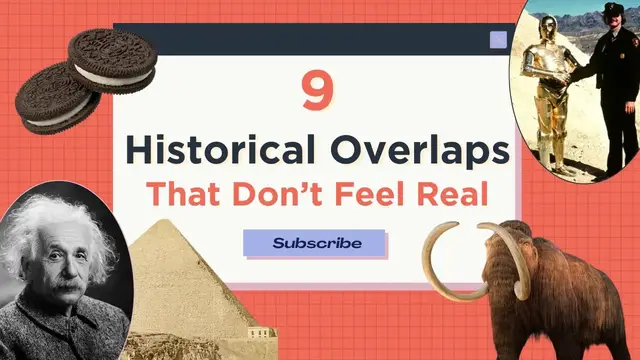
Today, we're looking at nine historical overlaps that don't feel real, but somehow are
0:58
Star Wars A New Hope premiered in May 1977 and instantly became a cultural phenomenon
1:06
It introduced a new era of blockbuster filmmaking, special effects, and sci-fi storytelling
1:12
Kids were begging for action figures. Adults were debating the force. And theaters were packed
1:18
Meanwhile, in France, the guillotine, a machine designed in the 1700s, was still being used
1:24
for capital punishment. The final execution took place in September 1977, the same year Luke Skywalker first ignited
1:32
a lightsaber on screen. This overlap is especially jarring. The guillotine feels like it belongs to a different world
1:38
A world of powdered wigs, revolutionary tribunals, and 18th century justice. But in reality, it lasted well into the era of disco, early computers, and space fantasy blockbusters
1:50
The Apple II computer was already on the market. Voyager 1 was preparing to launch
1:55
And France was still using a device designed during the Reign of Terror
1:59
We tend to imagine woolly mammoths as ice age creatures that disappeared long before civilization But a small population survived on Wrangel Island a remote island off the coast of Siberia until about 1650 BCE Meanwhile Egyptians built the Great Pyramid between 2667 and 2648 BCE
2:19
That means mammoths lived more than a thousand years after the Great Pyramid was completed
2:24
Picture this. While Egyptians were quarrying limestone blocks, organizing massive labor forces
2:30
and developing early writing systems, a few shaggy Ice Age giants were still roaming an Arctic
2:36
island. The world contained both one of humanity's most iconic architectural achievements
2:41
and the remnants of a prehistoric species. Even stranger, by the time those mammoths had finally
2:47
died out, Egypt had already gone through multiple dynasties, developed complex religious systems
2:52
and built temples that still stand today. Oxford University is old, but it's hard to grasp how old
2:59
until you compare it to the Aztec Empire. Teaching began at Oxford around 1096
3:04
during the High Middle Ages. This was a world of feudalism, illuminated manuscripts
3:09
and early scholastic philosophy. Oxford scholars were debating theology, astronomy, and the origin of the universe
3:16
for centuries before the Renaissance. The Aztec Empire, meanwhile, wasn't encountered by Europeans until 1428, when the Triple Alliance formed
3:26
and the empire began to rise in power. That's a 332 year age gap
3:31
So Oxford predates the rise of Tenochtitlan, the capital city with its floating gardens, aqueducts
3:37
and monumental temples. It predates the Aztec calendar stone, the empire's military expansion
3:43
and the height of its cultural achievements. When Oxford was already a well-established center
3:48
learning, the Aztec Empire didn't even exist yet. The London Underground opened in 1863, becoming the
3:55
world's first underground railway. It was a marvel of Victorian engineering. Steam-powered trains
4:01
running beneath the city connecting neighborhoods in a way that had never before been possible Just five years later in 1868 the UK held its final public hanging Thousands of spectators gathered to watch the execution
4:15
of Michael Barrett outside Newgate Prison. And here's the part that feels surreal
4:19
Those spectators could have taken the tube to Aldersgate station, now Barbican
4:24
just a short walk from the execution site. So the world's first subway system
4:28
and the centuries-old tradition of public hangings overlapped. One represented the future of urban transportation
4:34
The other was a relic of medieval punishment. And for five years, they coexisted in the same city
4:40
Albert Einstein died in 1955, the same year that the first McDonald's fast food restaurant opened
4:46
Einstein lived through the rise of early fast food. He lived through the invention of the hamburger bun
4:52
the popularity of drive-ins, and the beginning of the American obsession with quick, affordable meals
4:58
It's strange because, at least to me, it feels like Einstein belongs to a different era
5:03
An era of chalkboards and pipe smoke and black and white photographs
5:07
Whereas McDonald's feels like a symbol of post-war consumer culture. But their timelines overlap perfectly
5:13
Albert Einstein could have walked past a McDonald's. He could have seen the golden arches
5:19
He could have ordered a burger. The Titanic sank in April 1912
5:23
And just one month before, Nabisco introduced the Oreo cookie. So while newspapers were reporting on one of the most tragic maritime disasters in history
5:32
Americans were discovering the cookie that would one day become the best-selling cookie in the
5:38
entire world. The Titanic is a symbol of the Edwardian era. Opulence, engineering ambition
5:44
and tragic hubris. And Oreos are a symbol of modern snack culture, but they enter the world
5:50
almost simultaneously. Imagine someone in 1912 reading about the Titanic in their morning paper
5:56
while dunking an Oreo in milk. Saigo Takamori, often called the last true samurai, died in
6:03
1877 after leading the Satsuma Rebellion, a final stand against the rapid modernization
6:09
of Japan during the Maiji Restoration And just one year earlier in 1876 Alexander Graham Bell made the first telephone call Takamori was fighting to preserve a centuries warrior tradition
6:21
rooted in honor, loyalty, and swordsmanship, while Bell was ushering in a new age of global communication
6:28
Two worlds, samurai culture and modern technology and communication overlapped by a single year
6:34
The last samurai lived in a world where phones already existed. In 1843, Scottish inventor Alexander Ban invented the electric printing telegraph
6:44
the earliest ancestor of the modern fax machine, a concept that feels shockingly modern for the mid-19th century
6:50
That same year, thousands of Americans began the first major migration along the Oregon Trail
6:56
They were traveling in covered wagons, walking beside oxen, and facing dangers like disease, starvation, and harsh weather
7:04
So in 1843, the world contained people transmitting images via wires, people dying of dysentery on the frontier, and people crossing the continent at walking speed
7:13
The timeline of technological progress is confusing. Construction on the Brooklyn Bridge
7:18
began in 1869 and continued through the 1870s. It was one of the most ambitious engineering
7:25
projects of its time, a suspension bridge using steel cables, massive stone towers
7:31
and innovative construction techniques. Meanwhile, the Battle of Little Bighorn, where Lakota
7:36
Northern Cheyenne, and Arapaho warriors defeated General Custer, took place in 1876. Engineers in
7:43
New York were designing suspension cables, testing steel, and redefining what a modern city could
7:49
look like. At the same time, the American West was in the midst of violent conflict between the U.S
7:55
military and indigenous nations. Two visions of America, industrial modernity and frontier warfare
8:02
coexisted in the same moment. History is not a straight line, and it never has been. It's a
8:07
tangle of overlapping stories all happening at once. And the more you zoom in, the more you realize
8:13
eras you thought were separate were actually neighbors. Thanks for watching Mental Floss
8:17
and we'll see you next time