Up next in 10



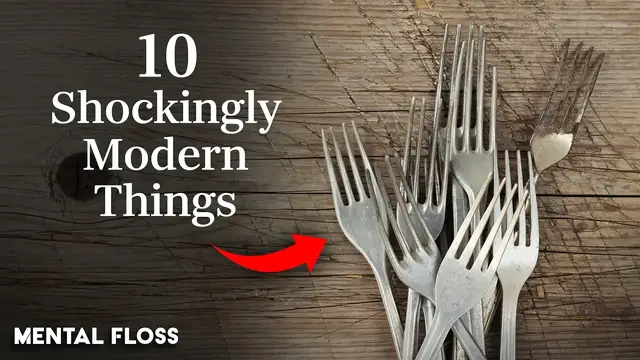
We assume things like weekends, childhood, surnames, forks, and even the color blue have always existed. They haven't. In this episode of Mental Floss, Cara reveals the surprisingly recent origins of everyday parts of human life and how modern culture shaped the way we see the world today.
#mentalfloss #surprisingoriginstories #originstories
Don't miss a video! Subscribe NOW: https://www.youtube.com/@MentalFloss?sub_confirmation=1
About Mental Floss:
Mental Floss is where curious people come for trivia-tastic information. Mental Floss produces lists of fun facts, debunks common misconceptions, and tells untold stories from history, science, culture and more.
Follow Mental Floss:
Website: http://www.mentalfloss.com
Twitter: http://www.twitter.com/mental_floss
Facebook: https://facebook.com/mentalflossmagazine
Discord: https://discord.io/mentalfloss
Copyright Notice: This video and YouTube channel contain dialog, music, and images that are property of Mental Floss. You are authorized to share the video link and channel, and embed this video in your website or others as long as a link back to this YouTube Channel is provided.
2026 Mental Floss
Things You Think Are Ancient But Are Actually Modern | Mental Floss
https://www.youtube.com/@MentalFloss
Show More Show Less View Video Transcript
0:00
You know the color blue. The sky, the ocean, the default color of half the world's stuff
0:06
But here's the twist. For most of human history, people didn't really have blue
0:11
Not the color, not the category. There just wasn't a word for it. Ancient Greek? No blue
0:16
Early Chinese? No blue. Hebrew? Nope. Homer looked at the Mediterranean and called it
0:23
wine dark, which honestly sounds like he needed glasses or maybe a vacation. But this isn't a
0:28
story about eyesight. It's a story about how a bunch of things we assume are ancient are
0:33
actually pretty new. Hi, I'm Kara, and this is Mental Floss. Today, we're looking at things that
0:38
feel timeless, the stuff we assume humans have always had. But in reality, a lot of these ideas
0:44
showed up shockingly late. Some are younger than the light bulb, some are younger than the microwave
0:49
and one is younger than your grandparents' first apartment. Roll the intro. The two-day weekend is not ancient. It's not medieval or even Victorian. The U.S. didn't
1:03
standardize the Saturday-Sunday weekend until 1940, when the Fair Labor Standards Act capped
1:09
the workweek at 40 hours. Before that, most people got one day off. And depending on where
1:14
you lived, that day wasn't always Sunday. Jewish workers pushed for Saturday. Factory owners pushed
1:20
for staggered days so that the machines never stopped. And some industries experimented with
1:24
rotating schedules to keep production running. And here's the deeper twist. The idea of a weekend only became possible once industrialization created a clear divide
1:34
between personal time and work time. Agrarian societies didn't have that clear divide
1:39
If it was Tuesday, the cows needed milking. If it was Sunday, the cows needed milking
1:44
The weekend we know today is younger than the first McDonald's. And it only exists because the modern work week exists
1:51
Children have always existed, right? But childhood, the protected stage of life, is pretty new
1:57
Before the 1800s, most kids worked. They were basically treated as small adults
2:02
If you were seven and could hold a broom that was your resume Once compulsory schooling laws arrived everything changed Kids finally got a stage of life that wasn just tiny worker The invention
2:13
of childhood also required the invention of children's literature, child-sized furniture, playgrounds, and even the idea that kids have birthdays that are worth celebrating. None of
2:24
that really appeared until the late 1800s and early 1900s. The childhood you probably picture
2:30
with toys, playgrounds, and birthday parties, is newer than the light bulb. Blue pigments existed
2:35
in ancient Egypt, but the concept of blue came much later. Many ancient languages had no word
2:41
for blue, not because people were colorblind, but because blue dyes could be rare and expensive
2:47
Cultures name colors in the order that they become useful. Egyptians were the first to create a
2:52
synthetic blue pigment, but it didn't spread widely. Greek, Chinese, and Hebrew texts all
2:58
skip blue entirely. Even in early Japanese, the word for blue and green was the same. Traffic
3:03
lights in Japan still use the term blue today. When researchers show color swatches to cultures
3:09
from around the world without a color for blue, they can obviously see the color, but they don't
3:14
group it the same way that we do. Language shapes perception, and the world hasn't always been
3:19
labeled the way that we label it now. Surnames definitely feel ancient, at least to me. But
3:24
But hereditary last names spread very slowly. In Europe, they became common from the 1300s to the 1800s. Roughly
3:32
In Scotland, many families didn't adopt fixed surnames until the 1700s or 1800s
3:37
In Iceland, they still aren't really universal. In parts of East Asia, surnames were standardized for census records and tax purposes, not tradition
3:47
Some families even changed surnames multiple times depending on political shifts. And it gets even more interesting, because many surnames actually started as descriptions
3:56
Your job, your location, your father's name, or something you once did that stuck forever
4:02
Taylor, Hill, Johnson, Armstrong. A lot of us are walking around with medieval nicknames
4:09
Your last name as a permanent family marker That is newer than the piano Forks did exist in ancient times but the table fork the one you eat with didn catch on until the 1700s When forks first appeared in medieval
4:22
Italy, clergy called them excessive delicacy. People thought they were pretentious. Even in
4:28
the 1600s, English travelers mocked Italians for using them. One writer said they were effeminate
4:33
for avoiding touching their food. It took another century for forks to become common across Europe
4:39
and North America. The fork only really became popular once plates, table manors, and dining
4:44
furniture evolved. Because you need a flat plate and a stable table to make a fork useful. Medieval
4:49
trenchers, basically edible plates, didn't exactly pair well with forks. Your silverware drawer is
4:56
more modern than the United States. Ancient cultures didn't see nature as something separate
5:01
from humans. That idea, nature as a pristine, untouched realm, emerged in the 18th and 19th
5:08
century with Romanticism. National parks came even later. Yellowstone, the first one, was created in
5:14
1872. Before that, the idea of preserving land for its beauty didn't really exist. And the modern
5:21
idea of wilderness required removing the people who already lived there. Many early national parks
5:27
displaced indigenous communities. So the idea of untouched nature was created by touching it
5:34
Nature as a place you go to is younger than the telephone. Running water, indoor plumbing
5:40
toilets that flush reliably. These are very recent. In the U.S., fully plumbed bathrooms
5:46
didn't become standardized until the 1920s to 1950s. And it really depended on region and income
5:53
Before that, outhouses and shared facilities were common, even in cities. And the bathroom isn't
5:59
just a room, it's really an entire infrastructure. So it didn't become possible until cities built
6:05
sewer systems, water treatment plants, and municipal plumbing codes. The idea of a private
6:11
bathroom inside your own home is probably younger than your oldest living relatives. The word
6:17
teenager didn exist in the modern sense until around the 1940s That when advertisers realized they could market directly to 13 to 19 year olds Before that you were a child and then you were an adult No in No youth culture
6:32
teen fashion, teen movies. And the invention of the teenager also created teen rebellion
6:38
teen music, and teen identity. Once companies realized teenagers had spending power
6:44
it all changed. The concept of teen life is younger than the microwave. Wealth differences
6:50
are definitely ancient. They have existed since humans did. But the modern middle class
6:56
defined by income, consumption, and lifestyle, is not. It emerged in the late 19th and early 20th
7:03
century with industrialization. The idea that most people should have stable jobs
7:08
consumer goods, and leisure time is a 20th century phenomenon. The middle class only really
7:14
exist when wages, housing, and consumer goods line up in a specific way. So maybe it's not a
7:20
permanent feature of society, maybe it's just a moment. A lot of things we think of as ancient
7:26
traditions were formalized in the 19th century. Tartan clan patterns were standardized in the
7:32
1800s for textile production. Christmas trees became popular in the mid-1800s thanks to Queen
7:38
Victoria. Bagpipes as a symbol of Scotland were codified in the 18th and 19th centuries
7:44
Historian Eric Hobsbawm called these invented traditions, practices that feel ancient but were
7:50
created to build national identity. In short, a lot of so-called ancient traditions were created
7:56
because they felt ancient. People wanted continuity and roots, so they created them
8:01
Your family's ancient holiday tradition of arguing about side dishes might actually be one of the
8:07
oldest here. The next time something feels timeless to you, whether it's weekends, forks, childhood
8:13
surnames, or even the color blue, remember this. A lot of what we think of as ancient human life
8:19
is actually pretty new. Human culture has always been a series of reinventions
8:24
and many of the things we treat as eternal are barely older than your grandparents
8:29
I'm Cara, thanks for watching Mental Floss, I'll see you next time
education