Up next in 10


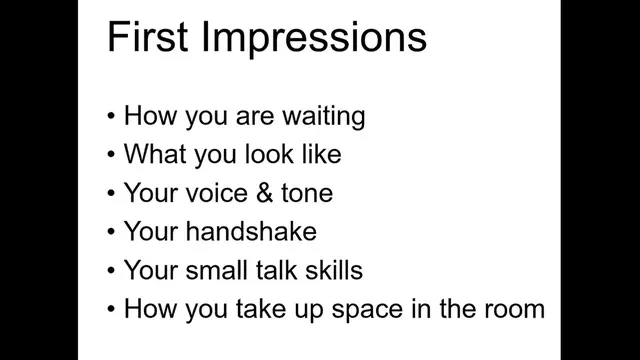
The first impression at a job interview matters. There are six components to make a positive first impression:
//Creative Commons Attribution Licence video (Reuse allowed)
Show More Show Less View Video Transcript
0:00
Hey there, wanted to talk a little bit about first impressions and body language because
0:06
absolutely interview prep is mostly about how you answer those questions and what
0:13
questions that they might ask and having a strategy with what you say, but we all know
0:18
we see the stats about how you show up and how you say things and what your body is doing
0:24
can give off a whole lot more than just words. So in terms of first depression, I would say, well, I have, you know, the first thing I have
0:34
here is like how you were waiting. And that matters, but even how you arrive matters. So that
0:40
means that the interview actually starts when you're in the vicinity of where you're being interviewed
0:45
Because you don't know, you know, the guy that you cut off, if you're in a car or the somebody
0:50
who's your route to on the bus. You don't know what role they might play in the interview. So you just
0:56
want to be on your best, you know, kind of behavior as soon as you're in the area of where you're
1:01
going to be interviewed. And then usually you walk to a building and then you're either, you know
1:07
greeted by the person, if it's like a startup kind of place or if it's a bigger organization
1:13
you're probably greeted by a receptionist. I used to be a receptionist at a radio station
1:20
And when they were interviewing people, the HR person would give me a little piece of paper and
1:25
say, can you let me know what time this person arrived, how they treated you, and how they waited
1:34
So they wanted notes on all of that, because all of that they took into consideration when they were
1:40
hiring somebody. And not every organization does that, but how you wait and how you treat that person
1:47
can make a difference. For us at the radio station, the feeling, the feeling, the feeling
1:55
was that if they were going to be rude to a receptionist and show impatience while they waited for an
2:02
interview, then that would show a lot about how they might treat other people and how they would represent the organization
2:11
So when you're waiting, you know, for an interview really important to not just like be scrolling on your phone
2:17
You want to be, you know, really aware of the space so that when the person who's going to interview comes out, you can look at them, you can make eye contact, you can
2:25
smile, you can stand up and you can shake their hand instead of feeling like, oh, you have
2:30
to gather all your things or turn off your phone or they have to wait because that first impression of you being ready to go can just speak volumes The second is you know what you look like and that really matters You know appearance and
2:45
grooming really matter. So as much as you can figure out what the culture is when you're going
2:51
for the interview. Usually the general rule is to dress one kind of notch up than the job that you're
2:59
applying for. So if you're applying for, you know, a manager role, then maybe you would dress like a
3:04
director. If you're applying for, you know, receptionist role, then maybe you would dress like a coordinator
3:09
So kind of just one step up. I guess the only, um, the only exception would be if you're applying
3:17
for like a CEO job, I wouldn't dress up in like formal wear. I would just go, you know, I would just wear
3:22
I would wear regular executive kind of clothes. But also, so that it, there's that plus, take a
3:29
to consideration the culture of the place that you are going to. So I'm somebody who I worked in
3:36
nonprofits for a long time. I would always dress up in business wear when I applied for a job
3:41
even at a nonprofit center. And I know that at times I was totally overdressed and better
3:48
dressed than the people who were interviewing me. But from the start, what it gave was it helped
3:54
them to see. I know that I took myself serious as a professional. And that first impression
3:59
lasted the whole time, their impression of the value and the level that I was at
4:05
But for some place, if you know everybody wears jeans and you're being interviewed by someone
4:10
you know and you feel uncomfortable, then strategize that with what feels right
4:15
I would also say in terms of clothing, like really important that the clothing that you wear
4:21
feels good on you, right? So if I am more comfortable in a dress and a cardigan sweater with a cool
4:28
necklace, that is going to look and feel way better. I'm going to make it a better impression than if I'm
4:34
wearing a blazer. So also pay attention to your preferences, to your preferences too. So there. So you're
4:43
waiting really nice. You've got the look. You've like, you know, got your haircut. You've groomed
4:48
You have clean fingernails, you know, clean shoes. And then the next thing is about your voice and your
4:55
tone. And so you can control a lot when you're first meeting someone. And it's kind of speaking
5:02
like with the voice of positivity goes really well. And I'm not saying that you have to be as like
5:09
perky and excited as I always seem to be But being aware of your voice so that you know if you get if you meet someone and they go you know how is the ride in and you like oh it was okay And you not
5:24
you're not kind of, you know, lifting, lifting your head so that the words will reach the other
5:31
person, but kind of more, you know, slumping your neck down and crunching your chin towards your
5:38
chest and making it really hard and clear or unclear for them to understand what you're saying
5:46
And so think about how you could phrase some things, still being honest, but in a more positive way
5:51
and that you're speaking really clearly. And often, I don't know about you, but often when I get nervous, I talk really fast
6:01
And so watching that speed too, right? But when you first meet someone, it's great to like stand up and say, hey
6:08
Really nice to meet you. Shake their hand, smile. That is awesome. So that handshake is really important. That
6:15
handshake, what you're really looking for is to show confidence, like you've got this, like you are meant to meet that person
6:23
And you might want to practice on a couple people and just go, how's my handshake? And what impression doesn't give you
6:29
Because you really want to find that balance between being a crusher, somebody who crushes the hands, which is really painful
6:38
if you wear rings and somebody crushes you, you know, or some people go too light and too light
6:44
creeps me way out, way, way more than if I got a crusher. So finding that middle ground. The ideal
6:52
place really being where the skin between your thumb and your pointer finger, where that hits that
6:59
little bit and there hits the other person's, you know, that part. If, you know, you come from a culture
7:05
where handshaking doesn't work, then it's okay, you know, think of a gesture that
7:10
and you probably know better than me, but think of a gesture that some no, you don't shake hands
7:14
but make sure that something else in your body language is inviting, right? That is, that's a smile
7:20
or great eye contact. The last little bit is that is about your small talk skills
7:29
So they did a study where, and I don't have the study in front of me, but they did a study where
7:34
they tracked people who made small talk on the way to the interview versus people who just
7:42
quietly walked with them and they found that people who made small talk with the person who going to interview them on the way to the interview room had a better chance of landing the job and left a better impression So you might want to think as just part of your prep about
8:01
something that you might say on the way there. I will usually use like, I'll just look around
8:08
and think about something that I can comment on, you know, or just, yeah, find a, find something
8:15
that you can do what's like an easy one is to compliment the person's dress um you know i have i remember
8:23
once i was waiting for an interview and i was waiting maybe five minutes um longer than i expected but i
8:31
heard this board meeting going on and everyone was just like laughing their head off in this board meeting
8:37
so when the person interviewed me came out she's like oh i'm sorry i'm late and i said no it's okay i really
8:43
enjoyed it. I loved hearing laughter and that helped me to know this is a really awesome place to work
8:49
And she's like, oh yeah, hey. And then that just kind of broke the ice. And we started to walk and
8:54
we went to the interview and I got that job. So, you know, making comments about, you know
9:01
cool decor or how you got there or the office location, all of that is great icebreaker stuff
9:09
And then the last bit is that once you, you know, are in that interview
9:13
room of being aware of the space that you take up. So an ideal space to kind of take up in an interview
9:20
room is, you know, sitting up, not slouching, right? Like so sitting up straight, spine, tall
9:27
shoulders bring them up, bring them back, right? Hands on your lap, not, or if you're a fidgetter
9:35
then you then tuck them under your legs. But finding, and I often like will put my feet flat just
9:41
to ground myself. And that is a really positive open space to take. If you get into the interview
9:50
room and then you kind of like cross your legs and cross your arms and make yourself really small
9:55
that's not a super inviting pose for somebody who wants to have a conversation with you
10:00
So try as much as you can to have really open body language. So that's a little bit of the tips on
10:07
making a really awesome first impression. It's really, you know, smile. shaking hands, being really present to wear, and then owning your awesome, just owning how great
10:19
and awesome you are. And of course they called you for an interview because you're incredible
10:23
and not forgetting that. Okay, thank you. Bye
Jobs & Education
Training & Certification
Career Resources & Planning