0:01
hello and welcome to another filter
0:03
grade tutorial my name is Leighton and
0:05
in this quick video I'll be showing you
0:06
how to use layer masks in Adobe
0:07
Photoshop masking is a non-destructive
0:09
way to eliminate certain aspects or
0:11
section of a layer to be able to easily
0:13
undo or fix your actions layer masks
0:16
work great if you want to remove
0:17
backgrounds or add an adjustment or
0:18
effect to a select area of the layer so
0:20
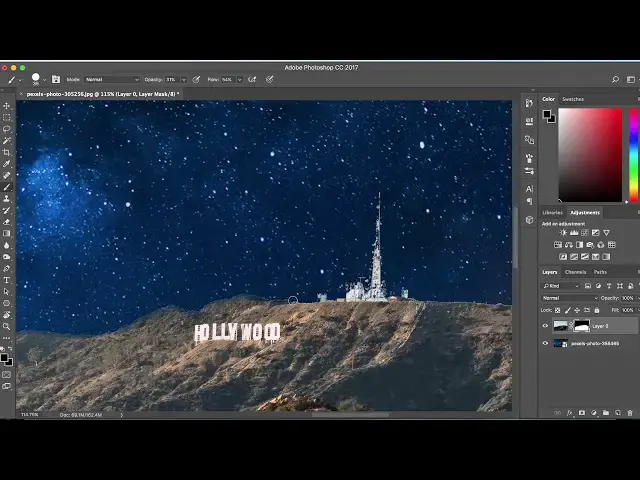
here I am in Photoshop I've got a nice
0:23
photo of the Hollywood Hills in
0:24
Hollywood sign and what I want to do is
0:26
actually place the sky in this photo
0:28
with this sky of a night scene so we can
0:31
do this fairly easily with layer masks
0:33
there's a couple ways you can go about
0:35
doing this the easiest and quickest way
0:37
to eliminate your background or sky is
0:40
when you go over here to the toolbar on
0:41
the left hand side and click the magic
0:43
wand tool you can actually just click on
0:45
the sky hold shift and just keep adding
0:47
points until your entire background is
0:50
highlighted as you can see there's a
0:51
little dotted line here going across the
0:53
sky so once this is highlighted all you
0:55
have to do is go down to the bottom of
0:56
screen and click this layer mask button
0:58
here just a circle inside the rectangle
1:00
click that and automatically has gotten
1:02
rid of the foreground and left the sky
1:04
which is the opposite of what we want
1:05
but in order to switch that around all
1:07
you have to do is double click on this
1:08
mask that you've created and that's
1:10
gonna bring up your options and right at
1:12
the bottom this button invert that's
1:14
just gonna invert the layer mask so
1:16
right away you see you've replaced the
1:18
now--how layer masks work is whatever is
1:20
white is gonna be showing and whenever
1:23
it's black is gonna be eliminated so as
1:26
you can see here on this mask the sky is
1:27
black meaning that we've gotten rid of
1:29
it completely in the foreground is white
1:31
if you're still kind of struggling with
1:32
this concept think about putting a white
1:34
sheet of paper up to a light source like
1:36
a light bulb you're still gonna be able
1:37
to see light coming through that sheet
1:39
of paper however if you hold a solid
1:41
black piece of paper up to the light
1:43
that solid paper is gonna block any
1:45
light coming through so it's the same
1:47
concept with layer masks you can
1:49
actually paint a layer mask by clicking
1:50
the brush tool and making sure the color
1:53
selected is black you can actually
1:55
remove the layer just by painting on it
1:58
we undo that and change the color to
2:00
white it's gonna bring back your
2:02
original photo as you can see if I paint
2:04
this we're back here now if you don't
2:06
want to have as harsh of a brush you can
2:08
actually select a shade of grey so I'm
2:11
gonna select that one right there
2:12
this is useful if you want to have a
2:14
nice fade or gradients transition from
2:16
the foreground to the background it
2:18
doesn't look as good I would recommend
2:20
sticking with white or black and then
2:22
changing your actual brush settings
2:23
maybe bring the opacity down as well as
2:25
a flow so you can just fix the edge here
2:27
because you still see a little bit of
2:28
the blue from this guy before and you
2:30
can just kind of go along brushing over
2:32
the edge just to make it less obvious
2:34
that you've cut this out somes gonna
2:36
quickly go over the edge just to make
2:37
sure it looks a little bit more natural
2:40
you spend as long as you want doing edge
2:42
maintenance on this mask you might even
2:44
go to the blur tool here and just do a
2:46
quick run-through of this edge just to
2:50
kind of blur it into the background a
2:51
bit more make it look more natural I'm
2:52
gonna leave that and move on to a bigger
2:54
issue which is the fact that this
2:55
foreground is looking very bright and
2:58
well lit and does not really blend well
2:59
with this background so I'm actually
3:01
gonna create a curves layer and I'm
3:03
gonna right click so that can turn it
3:05
into a clipping mask so what that does
3:08
it just only affects this layer here and
3:10
it will not affect the bottom background
3:12
layer which is this guy it's only gonna
3:14
adjust the foreground so using the
3:15
curves adjustment I'm gonna just the
3:17
exposure so it looks much more real
3:19
because the Hollywood Hills are not this
3:23
I surround the highlights alright so it
3:25
looks good it's got a bit of a red kind
3:26
of hue to this foreground and you can
3:28
really see this on the white of the
3:30
Hollywood sign so I'm gonna use this
3:32
layer mask which is already here I'm
3:33
gonna paint black gonna change my pass
3:36
it all the way up flow all the way up
3:38
and I might add a bit of a feather to
3:39
the edge of my brush okay so now I'm
3:41
just gonna paint black over the
3:43
Hollywood letters and as you can see if
3:44
I paint on this foreground it's gonna
3:46
return back to its original state before
3:48
I made the curves adjustment it's meant
3:50
undo that basically just exaggerate the
3:53
letters a little bit more and correct
3:55
that red hue that the curves layer made
3:57
so again just a subtle adjustment but
3:59
that's really gonna make a difference we
4:00
zoom out mind adjust that even more so
4:02
there you go I've used two different
4:03
masks here using the magic wand tool I
4:05
got rid of the sky and created a mask
4:08
then I created a curves adjustment layer
4:09
to make the scene more realistic and
4:11
darken the overall look then create
4:13
another mask to accentuate and
4:15
exaggerate the Hollywood sign making it
4:17
more bright so it sticks out a lot so
4:18
there you go that's a quick and easy way
4:20
of how to create masks in Photoshop I
4:22
would highly recommend using masks over
4:23
actually erasing use the eraser tool
4:26
then continue making adjustments
4:27
you won't be able to hit undo if you go
4:29
too deep and adjustments there's no way
4:31
of really getting it back however if you
4:33
use the layer mask and just paint on the
4:35
scene in a pinch you can always just
4:37
switch the foreground and background
4:38
color paint with white and you can bring
4:41
back your foreground now if you like to
4:43
speed up your workflow in Photoshop and
4:45
create effects that would take you a
4:46
long time or things you just don't know
4:47
how to do check out filter grade comm
4:49
for all the best Photoshop actions such
4:51
as light leaks some lens flares color
4:53
wash film effects and many more in
4:56
addition to the Photoshop actions
4:57
check out filter grid for all the best
4:58
Lightroom presets capture one styles and