
Python libraries and frameworks | parsing HTML and XML documents | Frameworks
Oct 5, 2023
Python libraries and frameworks are collections of pre-written code that can be used to perform common tasks. Libraries are typically smaller and more focused on a specific task, while frameworks are larger and provide a more complete solution for developing a particular type of application.
Here are some of the most popular Python libraries and frameworks:
Libraries:
NumPy: For scientific computing and data analysis.
Pandas: For data manipulation and analysis.
Matplotlib: For data visualization.
Scikit-learn: For machine learning.
TensorFlow: For deep learning.
Requests: For making HTTP requests.
Beautiful Soup: For parsing HTML and XML documents.
Frameworks:
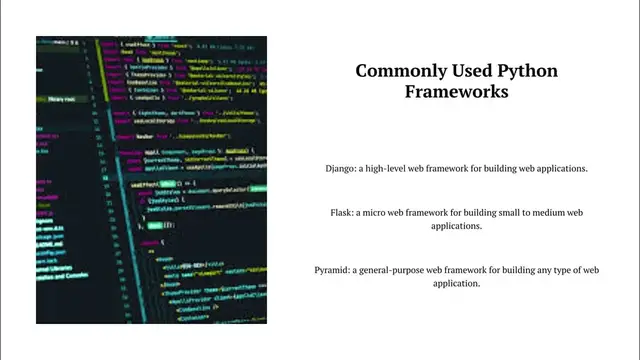
Django: For developing web applications.
Flask: For developing micro-web applications.
Pyramid: For developing web applications.
TurboGears: For developing web applications.
CherryPy: For developing web applications.
SQLAlchemy: For object-relational mapping (ORM).
WTForms: For form validation and processing.
Python libraries and frameworks can be used to develop a wide variety of applications, including:
Web applications
Desktop applications
Mobile applications
Machine learning applications
Data science applications
Scripting applications
Automation applications
Python libraries and frameworks make it easy to develop powerful and complex applications quickly and easily.
Here are some examples of how Python libraries and frameworks can be used:
NumPy: NumPy can be used to perform complex mathematical operations on large arrays of data. For example, you could use NumPy to calculate the average of a list of numbers or to find the correlation between two variables.
Pandas: Pandas can be used to manipulate and analyze data in a tabular format. For example, you could use Pandas to filter data, sort data, and perform calculations on data.
Matplotlib: Matplotlib can be used to create a wide variety of data visualizations, including charts, graphs, and histograms. For example, you could use Matplotlib to create a line chart to show the trend of sales over time or a bar chart to show the distribution of customer ages.
Scikit-learn: Scikit-learn can be used to build and train machine learning models. For example, you could use Scikit-learn to build a classification model to predict whether a customer is likely to churn or a regression model to predict customer lifetime value.
TensorFlow: TensorFlow can be used to build and train deep learning models. For example, you could use TensorFlow to build a deep learning model to recognize objects in images or to translate text from one language to another.
Django: Django can be used to develop full-stack web applications. Django provides a variety of features that make it easy to develop web applications, including a built-in ORM, a template system, and a user authentication system.
Flask: Flask is a micro-web framework that is lightweight and easy to use. Flask is a good choice for developing small and simple web applications.
Python libraries and frameworks are powerful tools that can be used to develop a wide variety of applications.
Show More Show Less