Up next in 10



Roller coasters have been human's favorite thrilling experience for hundreds of years. But why are we so obsessed with the feeling of... almost dying? And where did the coaster obsession begin? From Six Flags to Cedar Point to Russian Mountains in Paris in the 19th century, we're going to be taking a look at the full history of the roller coaster. We even get to chat with a roller coaster expert and thrill engineer to give a little insight on the future of thrill rides. Join host Justin Dodd (@juddtoday) as he (literally) rides the history of the roller coaster. Special thanks to Professor Brendan Walker for chatting with us! Check out all the cool stuff Studio Go Go is working on here: https://studiogogo.ltd/ Don't miss a video! Subscribe NOW: https://www.youtube.com/@MentalFloss?sub_confirmation=1 About Mental Floss: Mental Floss is where curious people come for trivia-tastic information. Mental Floss produces lists of fun facts, debunks common misconceptions, and tells untold stories from history, science, culture and more. Website: http://www.mentalfloss.com Twitter: http://www.twitter.com/mental_floss Facebook: https://facebook.com/mentalflossmagazine Copyright Notice: This video and YouTube channel contain dialog, music, and images that are property of Mental Floss. You are authorized to share the video link and channel, and embed this video in your website or others as long as a link back to this YouTube Channel is provided. 2025 Mental Floss The Roller Coaster's Thrilling History | Mental Floss https://www.youtube.com/@MentalFloss
Show More Show Less View Video Transcript
0:00
This is the Shell Razor, a roller coaster built entirely inside the American Dream Mall in New Jersey
0:07
It features the steepest drop in the world. It has a max vertical angle of 121.5 degrees, which is 31.5 degrees more than straight down, if you can imagine that
0:19
Oh boy, it features seven inversions, max speed of over 60 miles per hour in less than two seconds
0:25
You know what, I gotta go, we're about to drop... Hi, I'm Justin Dodd and this is the History of Fun, an exploration of the origins of humans
0:34
having a good time. Today we're looking at roller coasters, the engineering marvels that
0:40
have thrilled and terrified people for hundreds of years. I'll be trying to figure out, with a
0:44
little help from my buddy professor Brendan Walker, thrill ride engineer and coaster expert
0:49
exactly why humans are so obsessed with the feeling of almost dying, upside down
0:55
while going many miles per hour. Let's get started. The first rides to really resemble roller coasters in any way originated in the mountains of Russia
1:09
Or that's at least what a popular name suggests. Russian mountains are the name given to a specific
1:14
mountain-free amusement ride that started to pop up in the country in the 15th century
1:19
and they were essentially really intense sled rides. Riders would trek up a bunch of stairs
1:24
get into either a cut tree trunk or an ice block fitted with the straw seat and ride that sucker
1:29
down an ice-covered hill reaching speeds of 50 miles per hour. These guys were hauling
1:34
In 1784, Russian mountains got a pretty serious upgrade. A ride in St. Petersburg used carriages
1:40
for passengers to ride in, as well as a grooved track that could go down and up some nice hills
1:46
Who ordered the construction of what is arguably the first actual roller coaster? Well, that would
1:50
would be Catherine the Great. These new and improved Russian mountains started spreading
1:55
throughout Europe. In 1804, a ride called Les Montagne-Russe opened in France, which featured
2:00
drumroll please, wheels. Mind blown. Now the rides were faster, smoother, and horrifically dangerous
2:08
But people didn't seem to mind. In fact, according to coaster historian Robert Cartmel
2:14
the first recorded instance of injuries to passengers, rather than decreasing the popularity
2:18
of the ride, actually increased the attendance. They came in droves to fly down a Russian mountain
2:25
in Paris. In the following years, new pseudo-coasters opened with some much-needed safety
2:30
measures, including locking wheels, continuous tracks, and powered cables that would hoist the
2:35
carts back to the top of the hill. Europe kept killing it with new and improved designs throughout
2:40
the 19th century. One of the most iconic roller coaster features today first popped up around
2:45
this time. Its inspiration came from an unlikely source, a children's toy popular in England and
2:50
France called the Loop de Loop. Essentially, it was a marble track that used centripetal force to
2:55
loop a ball after going down a hill. So, some wild but brilliant person thought, instead of a marble
3:02
what if that gravity-defying object was a person? The first Loop de Loop coaster opened in the 1840s
3:07
in Paris. They were, reportedly, pretty jarring and uncomfortable. The Loop was relatively small
3:13
about 13 feet high, and it basically traced a perfect circle. Which was a problem
3:18
More on that later. During the latter half of the 19th century, many of the influential roller coasters that
3:23
resemble the ones we ride today were being made not in Europe, but in America
3:27
We could thank a dude named LaMarcus Thompson for starting the thrilling trend
3:32
Thompson was an inventor who, over his life, accumulated several patents for various roller
3:36
coaster technologies. He's known as the father of the gravity ride and, arguably way cooler, the father of
3:43
the American roller coaster. He's most famous for creating Coney Island, New York's Switchback
3:48
Railway, which debuted in 1884 and is considered the first modern American roller coaster
3:53
The Switchback Railway blew people's minds back in the 19th century. This thing was sick. Get this
3:59
It moved a whopping six miles per hour. And what were the coaster cars like? They were basically
4:04
benches that moved slowly. People went wild for this thing. It cost a nickel to ride
4:09
and the money started pouring in. Thompson made a few other notable impacts on the rollercoaster
4:14
world. He eventually introduced tunnels and painted scenery so passengers could feel immersed
4:18
in the experience. Think, it's a small world, but slower. Incredible. All joking aside, Thompson
4:25
really did change the amusement park game. Soon, competitors started popping up all across the
4:30
country, trying to outdo each other, leading to some of the coaster staples we know today
4:35
The world of thrill-seekers undoubtedly owes a debt to the father of the American rollercoaster
4:47
But here's where it gets a little bit dicey. Turns out there might be more than one person in the running for daddy of the American rollercoaster
4:57
One contender is John G. Taylor of Baltimore. He received his patent for improvement in inclined railways in 1872, well over a decade
5:05
before Thompson's switchback railway opened. And while the title might sound like the most boring amusement park ride in history, or
5:12
worse yet, simply an improvement of an even duller ride, it actually appears to be a novel
5:17
concept for what is clearly a primitive roller coaster. The ride would mostly be powered via its own momentum, going up and down hills on parallel tracks
5:26
However, roller coaster researcher Victor Canfield notes that, a mechanism for stopping the car at the end of run is not shown or described. Whoops. So maybe
5:36
it makes sense that Taylor's ride wasn't as much of a hot ticket idea as Thompson's. But while for
5:41
years it was believed that Taylor's coaster was simply an idea on paper, it turns out he may have
5:45
actually built the thing. In 1872, the Providence Evening Press reported on new attractions at the
5:51
local Rocky Point, including a machine for corking soda expressly for the educated Bear Katie
5:58
Which, I mean, so many questions. Is the soda for the bear? Is the bear corking the soda
6:03
Who named the bear? Katie. But anyway, later on they describe a machine that is clearly related to Taylor's patent
6:09
and say, One of these railways was run at Holly Grove in Baltimore last summer by Mr. J.G. Taylor
6:15
the patentee, and over 100,000 people rode on it. And that a company bought the rights to bring it to Rhode Island
6:22
So it was built 100 people rode on it and it was so successful he started licensing All over a decade before that Coney Island nonsense Case closed
6:35
Or it would be if, while researching this video, we hadn't uncovered a really annoying line
6:40
in a June 1870 Baltimore Sun about the opening of that very Holly Grove even earlier. Among
6:46
the new amusements for the multitude is an inclined railway patented by Mr. Eastman
6:51
and then a description of a seemingly identical ride to Taylor's. This thing even had check rooms under the ride
6:57
reminiscent of modern-day lockers at theme parks in case the thrills made you lose your pocket watch and monocle, I'm assuming
7:04
So far, we've been unable to positively identify Mr. Eastman. We have a guest, but none of our guests' patents seem to match the ride
7:11
But then it gets more interesting. The very next year, the Baltimore Sun's report of Holly Grove's opening
7:17
comments that people were particularly interested by the considerably improved inclined railway of J.G. Taylor
7:25
Taylor definitely built something, but how much it built on this mysterious Mr. Eastman
7:30
is a possibly open question for future research. But this still definitely, firmly predates Thompson
7:37
And now, with an asterisk, it's surely case closed. But wait, what about the Maush Chunk switchback railway in Pennsylvania
7:46
Mining entrepreneur Josiah White built the track in 1827 as a method to haul coal from
7:52
Summit Hill to the Lehigh River Landing. It was a roughly 9-mile speedy downhill track
7:58
Transporting coal was a pretty lucrative business, but why let the coal car sit idle in the late
8:03
afternoon after the miners go home? For 50 cents a ride, passengers could hop on the cars and fly down the mountain, living
8:09
out every kid's fantasy of being a piece of freshly mined coal
8:13
The attraction became so popular that White continued to improve upon its design for better
8:18
and safer rides. Well, actually better coal transportation, but it had the same effect
8:22
He even introduced a ratchet rail system that prevented the cars from rolling backward
8:26
which not only added a much-needed safety measure, but arguably more importantly, added
8:31
the clanking sound that would forever be associated with an ascending roller coaster
8:36
The Maus Chung switchback railway may not technically be a roller coaster by modern definitions
8:42
but it definitely introduced many people to the concept of a thrilling track-based ride
8:47
It hurled people down that mountain until its closure in 1933. So, in conclusion, I don't really know
8:55
It's kind of just up to your own interpretation. Is a rideable mine cart a roller coaster
9:00
Kinda. Does having the first patent for a pseudo-coaster make you the true heir to the roller coaster throne
9:06
Maybe. Does being the guy with the longest Wikipedia page of the lot make you the one people will
9:11
point to through history? Probably. Roller coasters really started to take off at the turn of the century
9:17
The first great North American coaster, featuring a loop, was built at Sea Lion Park in Coney
9:22
Island near the start of the 20th century. Designer Lena Beecher called it the Flip Flap Railway
9:29
Probably could have workshopped that one a bit. Before humans were allowed on, it was supposedly tested first with sandbags and then with monkeys
9:36
A natural progression. it was determined the G-forces weren't going to blow people's brains out of their ears
9:42
human riders got to hop on board. But similar to its European counterparts, it was uncomfortable and super dangerous
9:49
A circle loop just doesn't work that well in large-scale designs. The rapid upward climb creates too much centripetal force, and the G-forces were dangerously high
9:58
Then at the top, the coaster would slow down too much and people could fall out
10:03
Not ideal. That's why people eventually preferred Edwin Prescott's Loop the Loop, which opened in Coney Island in 1901
10:10
Its design featured a softer, oval-shaped design, like the ones you usually see today
10:15
The teardrop shape allows the G-forces to be spread out, as well as allowing the designers to control the speed a bit better
10:21
The Loop the Loop was very popular, although it only stayed open for a few years
10:25
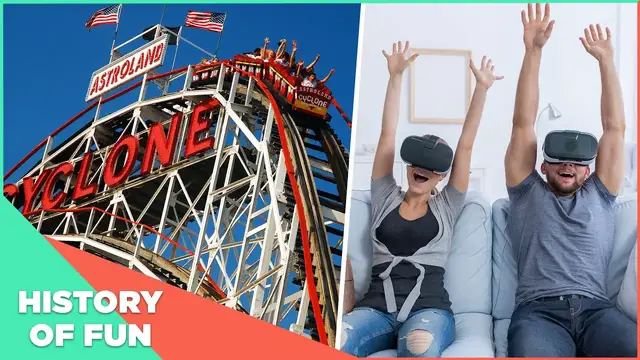
One of the most famous roller coasters in history opened in 1927, the Cyclone, Coney Island's most successful coaster to date
10:33
Its influence and fame spread far and wide for being a thrilling, elaborate, and most of all, fun ride
10:40
Some fun facts about the cyclone. According to Coney Island legend, aviator Charles Lindbergh rode in it in 1929
10:47
He said it was greater than flying an airplane at top speed. Another notable rider who screamed their way down the cyclone
10:54
Emilio Franco, a West Virginia coal miner who had lost the ability to speak several years earlier
11:00
So, let me reiterate. Emilio Franco, who had been reportedly unable to vocalize sound for six years
11:06
screamed while going down the first drop of the cyclone. In 1975, a man named Michael Boodley set a record by riding the cyclone
11:13
1,001 times over a 45-hour period. I can't even fathom what would inspire someone to do such a thing
11:20
But 19-year-old Richard Rodriguez might. He broke the record by riding the cyclone consecutively for 104 hours
11:27
stopping only for bathroom breaks, reportedly. Another record holder is Howie Lipstein
11:32
who in 2009 was honored at Luna Park for having ridden the Cyclone at least once a year for 50
11:38
consecutive years. But it wasn't all smooth sailing from the Cyclone to Millennium Force
11:43
or the Lightning Rod. In the 40 years after the Cyclone was built, the coaster fad started to
11:48
decline. More than 2,000 amusement parks went out of business, and hardly anyone was making
11:53
new roller coasters. Even with diminished demand, the low coaster supply caused issues
11:58
There are reports of the few remaining coasters having consistent wait times of up to five hours
12:04
People got upset and unruly, and fights would often break out in line. There were even a couple
12:09
murders. I mean, waiting in line for a ride is not my ideal way to spend an afternoon, but yikes
12:14
guys. Think of all the lives FastPass could have saved. All the mayhem led to, predictably
12:19
bad publicity. More rides and parks closed. But eventually, things started to turn around
12:25
Disneyland opened the Matterhorn in 1959. It is usually cited as the first tubular steel coaster
12:32
though modern researchers have pointed to some potential European predecessors, but I can't get back on the Thompson-Taylor-Eastman tear. Anyone who's ridden a wooden roller coaster
12:41
knows that, while usually pretty fun, they can be a bit jarring in the butt area. Steel coasters
12:47
Coasters that use tubular steel rails and nylon wheels are dramatically smoother
12:52
Steel coasters reignited people passion for new inventive rides The first Six Flags opened soon after in Texas but coasters had a watershed moment in 1972 when Kings Island opened in Ohio
13:04
Historians point this out as the beginning of a specific phenomenon—coaster fanatics
13:08
who would travel to many different roller coasters and theme parks in a concentrated
13:12
time, seeking consistent thrills. Now, riding roller coasters could become a regular hobby
13:18
not just a once-a-year treat. Wrored all the rides at Kings Island? Just head over
13:23
Cedar Point ride the Maverick. Coasters became bigger, faster, and more thrilling. The 70s and
13:28
80s gave us the modern suspended roller coaster—you know, where the cars hang below the track—and the
13:34
first standing coaster, you know, where you…stand. The Moonsault Scramble opened in Japan in 1983
13:40
and was the first to top 200 feet. Coasters broke 100 miles per hour in 1997 with the Tower of Terror
13:46
in Australia's Dreamworld. Cut to today. We now have rides like Kingda Ka, which is the tallest
13:51
coaster in the world at 456 feet high. It exceeds 120 miles per hour in under 4 seconds from launch
13:58
The car utilizes a hydraulic launch to reach these speeds, a technology in a completely
14:03
different universe from rides of 100 years ago. This takes thrill-seeking to a whole new level
14:08
I mean, you're basically hurtling toward heaven for 50 terrifying, amazing seconds
14:14
So, for nearly 600 years, humans have been trying their darndest to go higher and faster to experience
14:20
a very specific kind of fun, thrill. I'm Professor Brendan Walker. I'm known as the world's only thrill engineer
14:29
but I hope there are going to be many more to come
14:33
I worked for military aircraft. I then retrained in industrial design and then interaction design
14:39
And people just kept on asking me to make bigger and bigger installations
14:42
for museums and things. And I was going, hang on, I think people can ride these things
14:47
I was also looking at it from a psychology perspective as well
14:52
The sort of objective side of engineering, the very sort of subjective side of thrill
14:58
and all that delight and euphoria and arousal and excitement and all those kinds of things
15:06
Why do you think that so many humans are attracted to experiencing thrill or fear in sort of a controlled setting
15:14
The relationship between sort of thrill, fun and pleasure and survival are really closely linked
15:22
So whether it's chasing prey, whether it's looking for sex for reproduction or whether it's evading getting eaten
15:31
all these things are rewarded with high levels of adrenaline and dopamine, which give us that really terrific rush
15:38
Fast forward now, you know, like 50,000 years to where we are today
15:44
you know, the industrial revolution and where we started becoming much more urban dwellers and less
15:52
you know, less risky environments. We became de-risked as a kind of species. And so we never
15:59
felt truly alive again because we were no longer facing these kind of dangers or really having to
16:04
strive for food. And so we've naturally sort of recreated that sensation of fun and pleasure and
16:10
thrill through riding the kind of machines which are constantly being evolved in our industrial
16:16
world. The thrill in itself isn't an emotion, but thrill is the movement between different emotions
16:22
So if you're taking someone from a very low place to a very high place, that, and if you do it quickly
16:28
you'll get a real rush. Brendan is right. Thrill can be interpreted as your brain's attempt to
16:34
regulate your emotions in the face of risk. Being on a roller coaster is, indeed, a risk
16:40
or at least that's how our bodies and brains perceive it, so the brain floods our veins with
16:44
some helpful chemicals. Other high-stress thrill-seeking leads to even more dramatic results
16:49
Skydiving, bungee jumping, swimming with sharks, holding your friend's newborn baby for the first
16:53
time, knowing that you have a tendency to drop things. Here's what's going on in that old
16:58
noggin of yours when you're doing something thrilling. First, risk is perceived. Oh no
17:03
I'm securely attached to a metal death trap that is about to fling me around and may potentially fly off its tracks, like in Roller Coaster Tycoon
17:10
Egad! The amygdala reacts by releasing a combination of adrenaline, dopamine, and endorphins
17:15
These neurotransmitters help the body deal with stress and are also generally mood-boosting
17:20
But they also function to make your mind and senses hyper-focused on the situation
17:25
Dopamine also serves a unique function in stressful situations. It basically tells the brain there's a potential reward in store if the perceived danger is overcome
17:34
You can imagine why this might be a beneficial signal. If you're a bee, unsure if it's worth venturing out for a prime pollen source, for example
17:42
and I pray that you are, or a human sizing up a large source of potential dinner and or violent death
17:47
this kind of reward system would incentivize you to face a scary situation with a high upside
17:52
Depending on how thrilling the situation is, it might be time to release the testosterone hounds throughout the body
17:58
This might give you a better chance of success if the risk at hand was, say, fighting a mountain lion with your bare hands
18:05
Doesn't really apply to riding a roller coaster, but thanks for trying anyway, brain. Okay, now at this point, adrenaline is shooting through your body
18:12
One of its functions is to increase your heart rate, get your blood pumping, and open up your airway so more oxygen can get in
18:18
The oxygen is directed to your brain to keep you alive in this thrilling situation
18:23
Now, seeing as how most roller coasters last less than two minutes, you're probably arriving back at the platform any second now
18:30
Congratulations, you survived. That reward that the dopamine promised you earlier, it's back
18:35
Your brain continues to release these good-time neurotransmitters. You may experience a small wave of euphoria
18:41
That's why when you get off a roller coaster, you often feel pretty amazing
18:46
like you're walking on a cloud, even when you're assuredly walking on ground that a kid has at one point puked on
18:51
But another interesting thing happens when you're riding a roller coaster. Your levels of cortisol, the stress hormone, increase
18:59
So why are roller coasters still fun if they actively stress us out
19:03
The crushing weight of existence already does that. Why would I pay money to do it
19:08
Well, it turns out there can be good stress. What has been deemed eustress is a kind of positive feeling of stress
19:15
Eu from Greek meaning good, like euphoria. Eustress might counteract the usual symptoms of anxiety and lead to a different perception of reality So our bodies experience eustress shoot a bunch of fun neurotransmitters through our body we experience intense feelings and then we ride that high for a while Got it
19:33
But I wonder, which part of the coaster experience is the most thrilling
19:37
Even it starts way early on when you see something advertised and go
19:42
you imagine yourself going, I want to do that. Then you buy the ticket, you're going
19:46
I'm really going to go and do that. So all these little moments can be designed
19:51
and then you get to the queue line and you can see people so a lot of shoe lines are really well
19:56
designed so you got the ride hurtling past you with you know several tons of people screaming
20:01
you going oh my god and then when you get on the ride and you actually get locked in
20:05
what our studies showed because we were using physiological monitoring so looking at people's
20:12
heart rate and sweat levels and looking at pupil dilation and other traits we found that um the
20:18
actual worst bits, I said the worst bits as in probably the best design bits of the ride after
20:22
that, only reached about 80% of the levels of arousal of that. The culmination really was being
20:29
locked in. Let's say you were talking to like an amateur thrill engineer who was interested in what
20:35
you do. What is like the smallest piece of advice you could offer them? I usually start out with
20:41
playground ride equipments. We start basic. You know, they all want to do something really crazy
20:46
The piece of advice I say to them, I'm saying, who's sat next to them
20:52
Who's watching them? You can go on the best roller coaster ever, but if you're riding it by yourself and not with your friends
20:58
it becomes a really flat experience. You know, these kind of emotions, fun and play, we need to do with other people
21:07
You know, we are animals. It's all about communicating and interacting with other people
21:12
So the best thing to say is to improve any ride experience, consider who you're performing to and who you're performing with
21:21
Riding roller coasters and doing exciting, scary things are more fun when you do it with other people
21:26
Heck, that's part of the reason that we have those on-ride cameras that snap a photo of you and your friends as you fly along the track
21:33
Those cameras, by the way, were first introduced on Log Flume rides in the 80s
21:37
A study done by researchers at the University of South Carolina explored the concept of group mentality when it came to something as thrilling and scary as skydiving
21:46
Here's what they found. For many skydiving initiates, interpersonal influence had its greatest effect in group situations
21:52
as several respondents first jumped with friends or with a college skydiving club
21:56
Some of these divers would not have jumped without the support of others sharing the experience
22:01
This suggests group polarization, a phenomenon in which there is a change
22:05
from a modestly positive attitude to a very positive one in the presence of peers
22:10
So that's why you ended up on Steel Vengeance with all your friends last summer
22:14
even though you had no intention of riding that monster. It's a shared experience, one that afterward you can all high-five and exclaim
22:21
we did it, and really mean it. It's just human. Do you remember your first memory of having fun
22:27
We used to live in an old quarry. I mean, it was in a valley and it very often used to get flooded
22:36
My sense of fun as a kid was either getting stranded, you know
22:43
as in isolated for days on end in the snow or flooded
22:49
You can't get to the shops, you can't interact with people, but you might have your brothers and sisters there and you can play with them
22:55
And it's the same with the water as well, you know, with it going over your wellies and flowing. I mean, it probably was quite dangerous
23:00
you know, you can always get, you know, dragged away in the flow. But at the time, you know
23:06
making boats and doing all sorts of stuff in that moment. So I think it was like sort of
23:10
it was edgy, it was dangerous, but also you could play in it as well and sort of imagine
23:15
There it is again, an element of danger and fun. There's something innately awesome and exciting
23:21
about being in vaguely dangerous situations. Kids recognize it, and so do old men like me
23:27
If you're pretty positive you're not actually gonna die, then a thrilling, dangerous
23:31
experience is mostly just fun. Our brains try to rationalize this scary yet exciting moment, and we feel adrenaline and
23:38
euphoria and fear, and it's awesome. But with new technologies like virtual reality, is there a world where we can replicate that
23:45
feeling of thrill without the actual, you know, close-to-deathness? I want to pick Brendan's brain one last time about the future of Thrill Rides before we
23:53
wrap up. sort of reach the limits of where roller coasters can go there's so many nice effects you know we're
24:00
still getting the highest the fastest the most drops you know but they're all starting to become
24:05
more marketing tools rather than genuine advancements really in the in the world of fun
24:13
and thrill so now I'm thinking well theater and virtual reality and visual illusion um I think
24:20
they're the areas where we're going to continue to have fun and to continue to push the boundaries of
24:28
exploring, if it's not what our body can sustain it's where you know what are the limits of what
24:34
our mind can support. I think it's these kind of sort of slight subtle changes so I'm not
24:41
reinventing the swing, I'm not reinventing the the carnival ride but just by feeding people
24:48
different visual information we can really help them to to take their worlds to completely different
24:53
places and so it becomes a storytelling tool and that's for me i think um where i'm starting to
25:00
you know it unlock you know those three minutes that we have somebody's attention it isn't just
25:06
because i want to throw them around and uh you know make them feel like they've had a beautiful
25:10
physical experience but we can also it's a great time to immerse them in new worlds and feed them
25:16
of their information and ideas and make it a much richer theatrical production. And so that's kind
25:22
of what's exciting me at Studio Gogo. So here we are. Humans recognized their need for speed 600
25:29
years ago and never stopped chasing. We started with sled rides down icy mountains, moved to
25:34
monkeys doing loop-de-loops, and ended up in virtual reality. I don't know about you, but I'm
25:39
pretty excited to see what other completely absurd and amazing things humans cook up next. I'll make
25:45
sure to be first in line. Don't forget to give your sunglasses to your mom to hold on to, check
25:49
the secureness of your lap bar, and put both hands way above your head for that first drop
education