Up next in 10



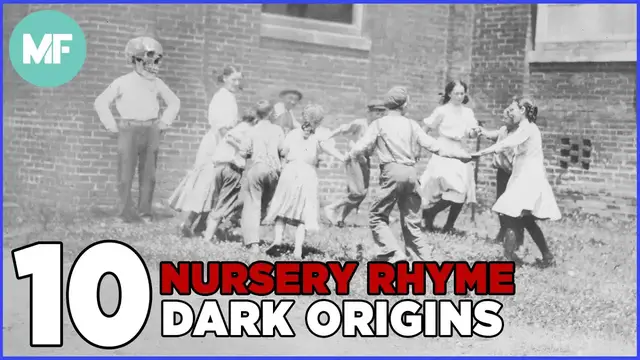
Nursery rhymes like "London Bridge Is Falling Down" and "Ring Around the Rosie" are commonly sung by children on the playground, but what were those songs originally about?
What do alcohol taxes have to do with "Jack and Jill?" Is "Here We Go Round the Mulberry Bush" originally about prison inmates?
In this episode of The List Show, Erin shares the surprisingly dark origins of 10 seemingly innocent nursery rhymes.
In case you forgot, The List Show is a trivia-tastic, fact-filled show for curious people. Subscribe here for new Mental Floss episodes every Wednesday: https://www.youtube.com/channel/UCpZ5...
Don't miss a video! Subscribe NOW: https://www.youtube.com/@MentalFloss?sub_confirmation=1
About Mental Floss:
Mental Floss is where curious people come for trivia-tastic information. Mental Floss produces lists of fun facts, debunks common misconceptions, and tells untold stories from history, science, culture and more.
Website: http://www.mentalfloss.com
Twitter: http://www.twitter.com/mental_floss
Facebook: https://facebook.com/mentalflossmagazine
Copyright Notice: This video and YouTube channel contain dialog, music, and images that are property of Mental Floss. You are authorized to share the video link and channel, and embed this video in your website or others as long as a link back to this YouTube Channel is provided.
2025 Mental Floss
10 Dark Origins of Nursery Rhymes | Mental Floss
https://www.youtube.com/@MentalFloss
Show More Show Less View Video Transcript
0:00
When you think of London Bridge as falling down, two things probably come to mind. Fergie's
0:04
iconic, but risque, homage released in 2006, and the original banger you recited on the
0:09
playground during childhood. That nursery rhyme appears in the written record almost
0:13
300 years ago, but many believe it dates back much further, to the year 1014. Some believe
0:18
it has origins in things even less appropriate for children's years than whatever the heck
0:22
Fergie was alluding to. Less PG materials like a bloody war replete with plundering Vikings
0:27
I'm Erin McCarthy, and this is The List Show. Nursery rhymes are some of the first songs that children learn
0:32
But it turns out that even the most inconspicuous and quaint-sounding children's rhymes have
0:36
some potentially dark and horrifying origins, from songs that came out of prison to lines
0:41
meant to accompany animal cruelty. Let's get started. London Bridge is falling down, on the surface, tells of a crumbling bridge and the pleas
0:54
to an anonymous fair lady to build it back up with iron, silver, and gold. Some historians
0:59
believe, however, that it may be in reference to a 1014 Viking attack on the British Isles
1:04
There's a Norse story about a raid on London that was led by Olaf II of Norway that involved
1:09
the destruction of the London Bridge. Some experts actually doubt that this event ever
1:13
even happened, but the story has spread far and wide. Some point to London Bridge's international
1:18
dissemination as evidence of its Viking origin. Presumably, the song could have spread during
1:22
itinerant group's travels. When this theory was being developed in the 19th century, one of the
1:27
strongest pieces of evidence was this line in the 13th century Icelandic collection Heimskringla
1:32
which was supposedly recited after victory in London. London Bridge is broken down
1:37
gold is won and bright renown, shields resounding, war hearts sounding, Hildur shouting in the din
1:44
I don't know. That's pretty convincing, especially when you consider that the line
1:48
is London Bridge is broken down in some of the earliest versions of the nursery rhyme
1:53
As the writer Frances Arnold Froster asked in 1899, is it possible that the rhyme Still
1:58
Sung is a far-off echo of the song of Olaf's Norwegian Bard? Today, the answer to that
2:02
question in many corners of the internet is a resounding yes. It would be a shame, then, if that whole story was built on a shakier foundation than London
2:10
Bridge itself. Which, spoiler alert. The rhyme I just read comes from a 19th century translation
2:15
by someone named Samuel Lange. A few decades later, that translation was described as
2:20
more vigorous than accurate, which, incidentally, also describes my attempts at Old Norse translation
2:26
A more modern and accepted translation renders the line as such. Further, you broke bridges, Battlesnake's user, daring in EGR's storm of London
2:35
Lands you have turned out to win. Which is 100 what I going to get my godkids to start singing on the playground The best guess is that Lang was adapting the complicated skaldic poetry of Haim Schringle into something more familiar to his audience and intentionally mimicked the already known London Bridge as falling down Later
2:53
writers saw the translation, assumed it was completely faithful, and made a connection
2:57
the wrong way around. So what does that mean for the Viking origin story? Nothing good
3:02
There are a few other explanations out there, including that it was really about an old bridge
3:06
falling down, but there was a whole trend during that era of trying to tie then-modern things to a
3:11
dim and distant past, often on scant evidence. So keep in mind that while the following stories
3:17
are popular and sometimes widely accepted, they may not always be ironclad historical fact
3:23
We'll do our best to reflect how certain each origin story is. Mary Mary Quite Contrary is seemingly a song about gardening. Mary, the contrarian
3:31
is being solicited for advice on how to grow as lovely a garden as hers. But who is Mary
3:36
and what the heck are silver bells and cockle shells? One popular interpretation of this rhyme
3:41
identifies the titular gardener as Queen Mary I of England, otherwise known as Bloody Mary
3:46
She reigned from 1553 to 1558 and is mostly remembered for her attempt to reverse the English
3:51
Reformation. Sort of a contrary endeavor. During her short reign as Queen of England in Ireland
3:56
she ordered the executions of hundreds of Protestants. This has led some to conclude
4:00
that the garden is actually more of a graveyard. The silver bells mentioned in the song? Thumbscrews
4:06
a horribly painful, old-timey torture tool. Cockle shells? Even worse. Torture instruments
4:12
usually attach to male genitals. Some experts are dubious, noting that the rhyme doesn't appear for
4:17
a few hundred years after Queen Mary, but there doesn't seem to be a more persuasive explanation
4:22
out there. Mary Mary, Quite Contrary, is not the only nursery rhyme with possible ties to Bloody
4:27
Mary. We all remember three blind mice, if only from their iconic appearance in Shrek. It's a
4:32
children's song about some blind rodents running after the farmer's wife. The original lyrics do
4:36
involve their tails getting chopped off with a knife, which is already pretty grisly. But according
4:40
to some, the song is another nod to Bloody Mary's Protestant executions. The three mice in question
4:45
are believed to be a group of bishops—Hugh Latimer, who had actually resigned his bishopric
4:49
years earlier, Nicholas Ridley, and most notably the Archbishop of Canterbury, Thomas Cranmer
4:55
They were burned at the stake for their heresy, their blindness, and apparent reference to their
4:59
religious beliefs. Goosey Goosey Gander has such a fun and alliterative name that it couldn't
5:04
possibly be violent, right? Right? Guess what? When it was written down in 1784, its lyrics were
5:11
pretty tame. Goosa-goosa-gander, where shall I wander? Upstairs, downstairs, in my lady's chamber
5:17
There you'll find a cup of sack and a race of ginger. Doesn't sound too bad, just a wandering
5:21
goose getting some snacks from his lady's house. But later versions have some additional lines at
5:25
the end There I met an old man who wouldn say his prayers so I took him by his left leg and threw him down the stairs These lines were likely tacked on some years later according to noted English folklorists Iona and Peter Opie who said that
5:38
It is very probable that they had a separate origin. They are much the same as the lines which
5:43
schoolchildren address to the crane fly, Daddy Longlegs, sometimes pulling off its legs as they
5:48
repeat, Old Father Longlegs can't say his prayers, take him by the left leg and throw him downstairs
5:54
That means more than one silly little rhyme might be hiding some random animal cruelty
6:00
Jack and Jill has all the elements of classic storytelling. A boy and a girl and a pail of
6:06
water. There's also a broken crown and I think Adam Sandler is somehow involved. Overall
6:11
a fairly harmless song and an objectively incredible Al Pacino musical number
6:15
What's my name? Donkacino! I'll dunk-a-dunk-a-dunk-a-dunk-a-dunk-a-dunk-a-chino! Yeah, banger! A common theory for the Diddy's origin says that the titular characters are actually Louis XVI
6:26
King of France, and his wife Marie Antoinette. You know, the let-them-eat-cake lady, which she
6:31
probably didn't actually say, by the way. Check out our episode on misconceptions about the French
6:35
Revolution for more on that. But back to Jack and Jill. Some people believed the nursery rhyme was
6:40
a loose reference to Louis and Marie's beheading. The first written recording of Jack and Jill comes
6:44
a good three decades before those events, though, so that origin seems apocryphal. The more likely
6:50
story attributes the rhyme to the 17th century king of England, Charles I. Apparently, he attempted
6:55
to increase taxes on alcohol, which were generally measured in units known as jacks and jills. After
7:00
that failed, he instead reduced the respective volumes of a jack, about an eighth of a pint
7:05
and in turn the jill, which was twice the size of a jack. So the jill's increased price came
7:10
tumbling after. Charles was eventually beheaded himself, but it seems the poem may have just been
7:14
a relatively wholesome invective against alcohol taxation. Ba-Ba Black Sheep is another classic nursery rhyme with some tax-based origins. Most scholars
7:23
agree that the song is in reference to the Great Custom, which was a tax on wool that was introduced
7:27
in 1275. In recent years, the fact that the sheep is black and the word master appears in the song
7:32
have led some to wonder about potentially racist connotations. As the Great Custom origin suggests
7:37
though, it doesn't seem likely that those readings reflect how the poem was originally
7:41
intended to be understood. Eeny, Meeny, Miney, Moe is another seemingly innocent playground song
7:46
that has been reexamined in the last century. While modern kids use the nursery rhyme to pick
7:50
who's it for tag, the late 19th, early 20th century version was explicitly racist
7:55
with a racial slur in place of the tiger kids catch today. That's not to say the original
8:00
song was written that way. Different variations of it pop up all around the world, making it tough
8:04
to point to any one definitive version. But we can say that at least one iteration, here in the U.S.
8:10
was repellent Rockabye Baby was recorded circa 1765 in Mother Goose Melody It been It been the go song to quietly sing to a fussy baby who you desperately want to fall asleep for centuries A popular interpretation
8:22
of this song involves the son of King James II of England and Mary of Modena. It was widely rumored
8:28
at the time that the child was not their son at all and was merely being passed off as their own
8:32
He was supposedly brought into the birthing room as a way to ensure a Roman Catholic heir
8:36
to the throne. Quite a serious allegation at the time. In a related explanation, the song
8:41
is seen as an elaborate metaphor, with the child representing England being figuratively blown
8:46
between Protestants and Catholics. Honestly, it's a bit out there, even as these theories go
8:51
There's another explanation about wanting the child to die, presumably in some kind of
8:55
cradle-rocking accident, but that seems equally tenuous. Then you get explanations involving
9:01
colonists in the United States. Suffice it to say, we don't really know anything for sure
9:06
Here We Go Round the Mulberry Bush is often sung as part of a children's game that involves holding
9:10
holding hands and running around in a circle. Cute! The actual history of the song is slightly
9:15
less cute. A speculative origin was offered by the historian R.S. Duncan, who served as the governor of
9:20
England's Wakefield Prison in the 1990s. According to him, the song originates with
9:25
the centuries-old institution, back when it was a house of correction, and the female
9:28
prisoner supposedly ran around a mulberry tree in the prison yard for exercise. Sort
9:32
of makes the sight of children gleefully running around in circles a bit less adorable
9:37
Let's end today with the contentious origin story of the classic nursery rhyme, Ring Around
9:42
the Rosie. On the surface, this is one of the few nursery rhymes that seems like it has obvious, dark origins
9:47
Ashes, ashes, we all fall down? That sounds like the ending of a super-sad post-apocalyptic fairy tale
9:53
Some sort of nuclear fallout Shakespearean tragedy. Many have pointed to the actual historical apocalypse of the Great Plague of London in
9:59
1665 as a possible inspiration. Nearly a sixth of the population was thought to have died from the disease
10:05
The Rosie in question? red rash that covered the bodies of the infected. A pocket full of posies is apparently an attempt
10:11
to cover up the putrid smell. This theory has been spread pretty far and wide, and is
10:15
probably one of the more well-known dark nursery rhyme origins. But it turns out that this reading
10:20
is most likely false. Snopes shot it down and quoted folklorist Philip Hiscock's more credible
10:24
suggestion, which resembles something more like a Kevin Bacon movie than an apocalyptic nightmare
10:29
Hiscock points to Protestant bans on dancing in the 19th century, which were prevalent in Britain
10:34
as well as North America, saying, Adolescents found a way around the dancing band with what was called, in the United States
10:40
the Play Party. Play parties consisted of ring games, which differed from square dances only
10:45
in their name and the lack of musical accompaniment. They were hugely popular
10:49
and younger children got into the act too. Finally, a children's song whose origins are about
10:53
children singing songs. I can rest a little better tonight. That'll do it for today's slightly disturbing episode of The List Show
11:00
Thanks for watching, and we'll see you next time
#education