Up next in 10



The uncracked codes in this episode of The List Show include the famous (or infamous?) Voynich Manuscript, the slightly lesser-known Beale Ciphers, and some unsolved potential codes with real implications for criminal justice. Voynich Manuscript-obsessive Erin McCarthy shares those moments from the history of cryptography and more. You'll learn how famous cryptanalysts feel about some of the most vexing uncracked codes in history and why Kevin James may be a secret cryptography enthusiast. In case you forgot, The List Show is a trivia-tastic, fact-filled show for curious people. Subscribe here for new Mental Floss episodes every Wednesday: https://www.youtube.com/channel/UCpZ5qUqpW4hW4zdfuBxMSJA?sub_confirmation=1 The Smithsonian piece we mentioned regarding Tamám Shud: https://www.smithsonianmag.com/history/the-body-on-somerton-beach-50795611/ Don't miss a video! Subscribe NOW: https://www.youtube.com/@MentalFloss?sub_confirmation=1 About Mental Floss: Mental Floss is where curious people come for trivia-tastic information. Mental Floss produces lists of fun facts, debunks common misconceptions, and tells untold stories from history, science, culture and more. Website: http://www.mentalfloss.com Twitter: http://www.twitter.com/mental_floss Facebook: https://facebook.com/mentalflossmagazine Copyright Notice: This video and YouTube channel contain dialog, music, and images that are property of Mental Floss. You are authorized to share the video link and channel, and embed this video in your website or others as long as a link back to this YouTube Channel is provided. 2025 Mental Floss 8 Mysterious Uncracked Codes | Mental Floss https://www.youtube.com/@MentalFloss
Show More Show Less View Video Transcript
0:00
In the early 1860s, raiders attacked the island of Rapa Nui, now known as Easter Island, and
0:04
abducted hundreds of natives to be used as enslaved labor in Peru. With those raids
0:09
it was once said, the final source of knowledge regarding Rongo Rongo, the hieroglyphic language used by the Rapa Nui, disappeared. But while it's true that, to this day
0:17
no one has been able to make any sense of extant Rongo Rongo texts, everything else about this
0:22
seemingly lost language defies simple narratives and clear explanations. The mystery of Rongo Rongo
0:27
is just the first of many uncracked codes I'm going to be discussing today, from bewildering
0:32
ciphers found on a murdered man's body to the unsolved codex that once belonged to Holy Roman
0:37
Emperor Rudolf II. Let's get started. The idea that knowledge of Rongo Rongo disappeared in those
0:48
raids of 1862 and 63 was eventually cast into serious doubt. But it does seem to be the case
0:54
that anyone schooled in Rongo Rongo died that decade, likely from diseases that had been
0:58
introduced to the island by Europeans. Many of the artifacts containing Rongo Rongo were
1:02
destroyed in the 1860s. The pictographs were often carved into wood, and some contemporary
1:07
sources said that the carved artifacts were burned by the Rapa Nui themselves to build
1:12
fires. This may have been at the urging or compulsion of Catholic missionaries. Some
1:16
Rapa Nui said that the evangelizing Europeans warned natives that Rongo Rongo was a connection
1:21
to their so-called heathenism. Others disputed this version of events. A European priest on the island in the early 20th century believed that the Rongo Rongo
1:28
artifacts hadn't been destroyed at all, but hidden in the island's many caves and lava
1:33
tubes, as Stephen R. Fisher laid out in his 1997 book about the language
1:37
A couple dozen inscriptions did survive, and people have been trying to decipher the various
1:41
symbols contained within them for more than a century, without much luck. Some glyphs appear
1:46
to represent human or animal forms, while others are abstract shapes. No one has ever
1:50
put forth a convincing translation of the texts, and much of the history surrounding
1:54
their origin remains contentious. Debates have raged as to whether the script predates European contact, and fantastical
2:01
ideas have arisen regarding aliens and lost continents. Some of our ideas about Rongo Rongo have been informed by more plausible scholarship, though
2:08
including work done by an early 20th century ethnographer named Catherine Rutledge
2:13
Among the most intriguing pieces of information gleaned in her interviews is the fact that
2:17
According to her sources, young Rapa Nui students of the past were able to master Rongo Rongo
2:21
in just a few months. After discovering gold and silver in what is now the American West, Thomas J. Beale buried
2:27
a treasure in Bedford, Virginia. All you have to do to find it is solve a simple cipher
2:32
Well, actually, that's just the claim made in 1885's Beale Papers, published decades
2:36
after Beale's disappearance. Few can agree on much more than that. Whether Beale actually even left a treasure, or even the ciphers themselves, is a matter
2:43
of serious contention. Some historical details about his supposed exploits have been called into question
2:48
Beale purported discovery of silver and gold for example doesn seem to line up with known timelines about other precious metal discoveries Of course many Beale cipher enthusiasts have their own idiosyncratic explanations for these apparent inconsistencies Others believe that
3:01
even if the treasure itself is a hoax, the ciphers themselves might represent a real cryptographic
3:06
challenge that remains to be solved. The cryptyst William Friedman summed up the confusion around
3:10
the Beale ciphers, saying, On Mondays, Wednesdays, and Fridays, I think it is real. On Tuesdays
3:16
Thursdays, and Saturdays, I think it is a hoax. Shout out to YouTube commenter Sabi Kitsuni for
3:20
pointing us toward the Beale ciphers on our video about battles that changed history. We have an
3:24
upcoming episode covering 100 facts about Venus. Drop an interesting comment about the second rock
3:29
from the sun in the comments below for a chance to be featured in that episode. When a book supposedly passes hands from an astrologer to the Holy Roman Emperor
3:36
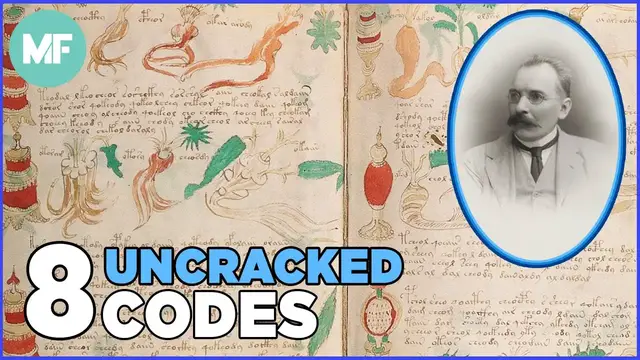
you'd expect a certain degree of intrigue to accompany it. The so-called Voynich Manuscript
3:41
named for a Polish antiquarian who purchased it in 1912, doesn't disappoint. It may well
3:46
be the most famous item on this list, but I will never get tired of discussing it—until someone
3:50
deciphers the roughly 35,000 words in its text, at least. After Wilfrid Voynich acquired the
3:55
manuscript in the early 20th century, he claimed he'd been sworn to secrecy regarding its origins
4:00
It likely has a connection to the Holy Roman Emperor Rudolf II, who Voynich suggested got
4:04
it from an astrologer in the court of Elizabeth I named John Dee. For what it's worth
4:08
that provenance is now considered questionable. The pages are full of drawings of what look like
4:13
plants and seemingly other scientific or pseudoscientific diagrams, along with, of all things
4:19
a lot of ladies bathing. The text appears to be entirely invented—not just the words
4:24
but the letters themselves. Radiocarbon dating done by a team led by the University of Arizona's
4:28
Greg Hodgkins pegged the pages to the early 15th century, but no one knows who wrote the book or
4:33
why. Some of the world's best codebreakers have been drawn to the Voynich manuscript and been
4:38
left stumped, including William and Elizabeth Friedman, a married couple and two of their
4:43
generation's leading cryptysts. William is the same expert we quoted in reference to the Beale
4:47
ciphers. The Friedman studied the manuscript and deemed it to be a genuine artifact and not a hoax
4:52
By the time of his death, William seems to have concluded that it was less a code, per se, than
4:57
an early attempt to construct an artificial or universal language of the a priori type
5:01
a language whose vocabulary isn't based on any existing languages. In the absence of a clear explanation for the text, outlandish theories have proliferated
5:10
Voynich himself once said, When the time comes, I will prove to the world that the black magic of the Middle Ages consisted
5:16
in discoveries far in advance of 20th century science. The time apparently never came. His
5:22
dramatic declaration might have just been a bit of showmanship. Still, there are countless theories
5:26
as to the real meaning of the book. One popular idea actually says that there is no meaning to it
5:31
at all—that contrary to the Friedman's ysis, the manuscript was created as some
5:35
kind of hoax, perhaps to fleece Emperor Rudolf. If you managed to decode the secret meaning
5:40
of the most mysterious book of all time do me a favor and drop an English translation in the comments below Another undeciphered and potentially undecipherable code comes from Edward Elgar If that name sounds familiar it probably because Elgar wrote Pomp and Circumstance the second most
5:55
iconic graduation song of all time. Shout out to Vitamin C for having the bravery to star in a
6:00
music video featuring wistful hacky sack. The Dorabella cipher gets its name from its original
6:04
recipient, Dora Penny, a friend of Elgar's who is almost 20 years his junior. It consists of a
6:09
a series of what I'm going to call little squiggly things. A number of people have claimed
6:13
to have cracked Elgar's code, but none of them has been widely declared correct. Tim S. Roberts
6:18
from the University of Central Queensland in Australia, felt that he had come up with a
6:22
solution, which read, P.S. Now droop beige weeds set in it. Pure idiocy. One entire bed
6:30
Luigi Cucubana lovingly tuned Lyoto Studio 2. The first half could maybe refer to a gardening
6:35
project, as Robert said. But then you get into Luigi Cucu Bunnid and have to buy that Elgar was
6:41
referencing a certain Italian composer and poking fun at Dora Stutter while discussing gardening
6:46
Other would-be solutions require arbitrary rules or result in complete gibberish. Leaving Elgar's message a secret. In 1987, a man named Chris Cole posted three ciphers onto a
6:57
Usenet newsgroup dedicated to cryptography. According to the Post, Dr. Richard Feynman had
7:02
showed him the ciphers when Carter was a graduate student at Caltech. The first cipher was actually
7:06
solved in just one day by a Usenet user, but the other two remain uncracked today
7:10
You'd think that displaying a code on the grounds of CIA headquarters would lead to a quick solution
7:15
But even though many United States intelligence officers pass by the Cryptos sculpture on their
7:19
way to the cafeteria in Langley, Virginia, one section of code remains unsolved, even though
7:24
the codemaker has provided several clues to cryptologists over the years. Cryptos was created
7:28
artist Jim Sanborn and installed on Langley's grounds in 1990. In subsequent years, three of
7:34
the piece's four sections of code were cracked. The first section, Decoded, revealed a poetic
7:39
sentence written by Sanborn. Between subtle shading and the absence of light lies the nuance
7:44
of occlusion. Sanborn said he included an intentional misspelling of allusion to mix it up
7:49
which is how I'm going to explain any typos on mental flaws from now on. The second section is a rather opaque paragraph that references Langley's coordinates
7:57
and former CIA head William Webster, who ran the agency when the sculpture was first installed
8:01
Section 3 is my personal favorite. It paraphrases Howard Carter's account of discovering King Tut's
8:06
tomb in 1922. Sanborn has said that the first three sections provide a clue to solving the fourth
8:11
and has also decoded a few specific words from its text, including Berlin
8:16
Klock, and Northeast. Side note, a season 2 episode of the Kevin James show King of Queens
8:21
featured a poster of Kryptos as set decoration. If you happen to have a solution to Section 4 of
8:25
of Cryptos and also starred in the Paul Blart movie franchise? Please let us know in the comments
8:30
In 1948, a man was found dead on Somerton Beach in Australia. He was wearing a suit and
8:35
had a half cigarette resting on his collar The more authorities looked into the case the stranger it got We linked to a great piece in Smithsonian Magazine down below that gets into a lot of the story twists and turns but I try to give you a CliffsNotes version Police never
8:48
figured out who the dead man was or even how he died. Some people suspected a rare poison could
8:53
have done him in and then been metabolized by his body without leaving a trace. The deceased's
8:58
unusually well-defined calf muscles and a label on some clothing that said Keene
9:02
might have been clues or just red herrings. No Keene was ever identified as a match for the man
9:06
and theories that he was a professional dancer or wore high heels remain unsubstantiated
9:11
Months into the investigation, an expert named John Cleland discovered a slip of paper in a
9:15
small pocket in the dead man's pants. The paper had the Persian phrase, or it is ended, printed on it, the final words in many translations of the Rubaiyat of Omar Khayyam
9:25
It took months for someone to come forward with a version of the book that matched the scrap
9:29
and that just created more questions. On the rear cover of the book, which has a provenance
9:34
shrouded in its own layers of fog. Authorities found a phone number and a faint string of
9:38
characters. The phone number led to a woman, who admitted to giving a man named Alfred Boxall a
9:43
copy of the Rubiat. But it turned out Boxall was still alive and still had his copy of the book
9:48
Police went back to that mystery string of characters and placed it under ultraviolet light
9:52
revealing more letters that appear to form some kind of cipher. If it is a code
9:56
it's never been cracked. And given how limited the letters are, it may never be
10:00
Weirdly, no one's ever found another copy of the Rubaiyat that matches the edition found on
10:04
the dead man's body. And perhaps even weirder, another man was apparently found dead in Australia
10:09
near a copy of the same poem. There are those who believe the Somerton man died by suicide
10:13
and others who think he was murdered for his involvement in some kind of high-stakes espionage
10:18
While we may never know the truth, in 2021 the man was exhumed for DNA testing. As of the
10:22
recording of this video, the results of those tests haven't been released
10:26
When the body of Ricky McCormick, a possible homicide victim, was discovered in June 1999
10:31
officials found two handwritten notes in his pants pockets, consisting of an indecipherable
10:36
string of letters. McCormick was allegedly functionally illiterate. His mother, Frankie Sparks, said the only thing he could write was his name. He didn't write in no code
10:45
But authorities don't believe the notes are meaningless scribblings. They actually released
10:49
the possible ciphers to the public in 2011, in the hopes that someone might help solve them
10:54
McCormick's girlfriend believed he could have been involved in trafficking marijuana. He also had a number of health problems, perhaps brought about by his smoking habit, allegedly
11:02
begun at the age of 10, and his penchant for drinking upwards of 20 caffeinated beverages
11:06
per day. A natural cause of death can't be ruled out, but McCormick's purported connection to illegal
11:11
activity and the mysterious circumstances surrounding his death have led many to conclude
11:16
that something nefarious happened. Detective Michael Yarbrough summed up the frustrating confusion of the case to St. Louis's
11:21
Riverfront Times. It's kind of like Humpty Dumpty. All the pieces are there, but how do you put them back together
#education